
When constructing a train/test split in SAS, a data scientist sets the random seed before calling PROC SURVEYSELECT. What is the main purpose of setting the seed?
Select an answer to reveal the explanation.
Short Explanation
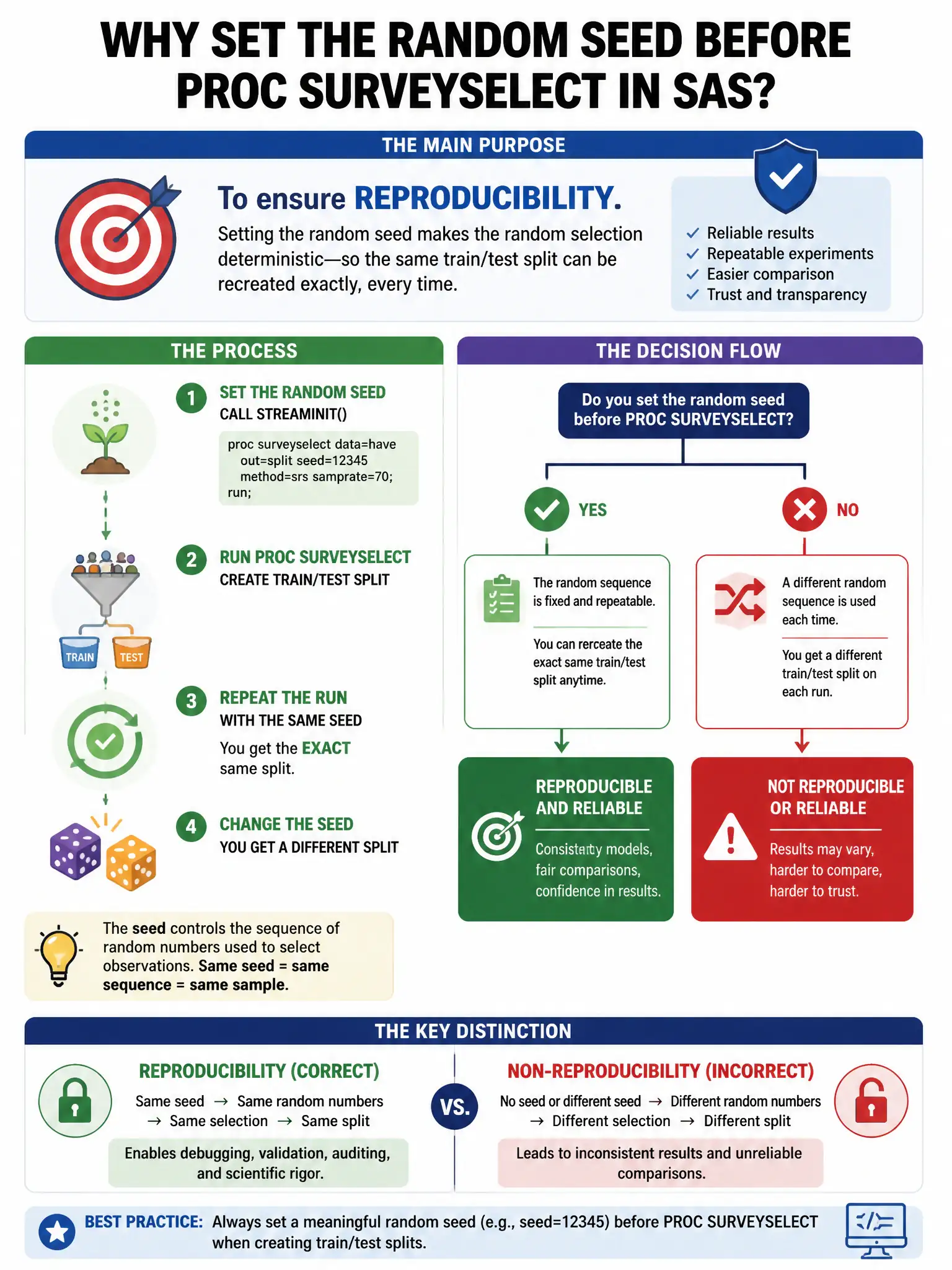
Here's the deal — setting the seed makes the random sampling reproducible across runs because it starts the pseudo-random number generator at the same point every time. You'll get the same train/test split on every run, which is what you need for reliable model evaluation.
Full Explanation
The correct choice is making the random sampling reproducible across runs. A fixed random seed initializes the pseudo-random number generator at the same starting point, producing the same split on every run and enabling reproducibility. Stratifying the split by the target variable is a separate option in PROC SURVEYSELECT, not the purpose of the seed. Increasing the proportion of minority class observations in the training set describes oversampling or class weighting, not seeding. Parallelizing the sampling procedure across CAS workers describes CAS parallelism, which is unrelated to the seed value.