
A data scientist uses PROC DISTANCE with METHOD=EUCLID on a dataset where predictors have very different scales (e.g., age: 18-80, income: 20000-500000). What problem does this create for clustering?
Select an answer to reveal the explanation.
Short Explanation and Infographic
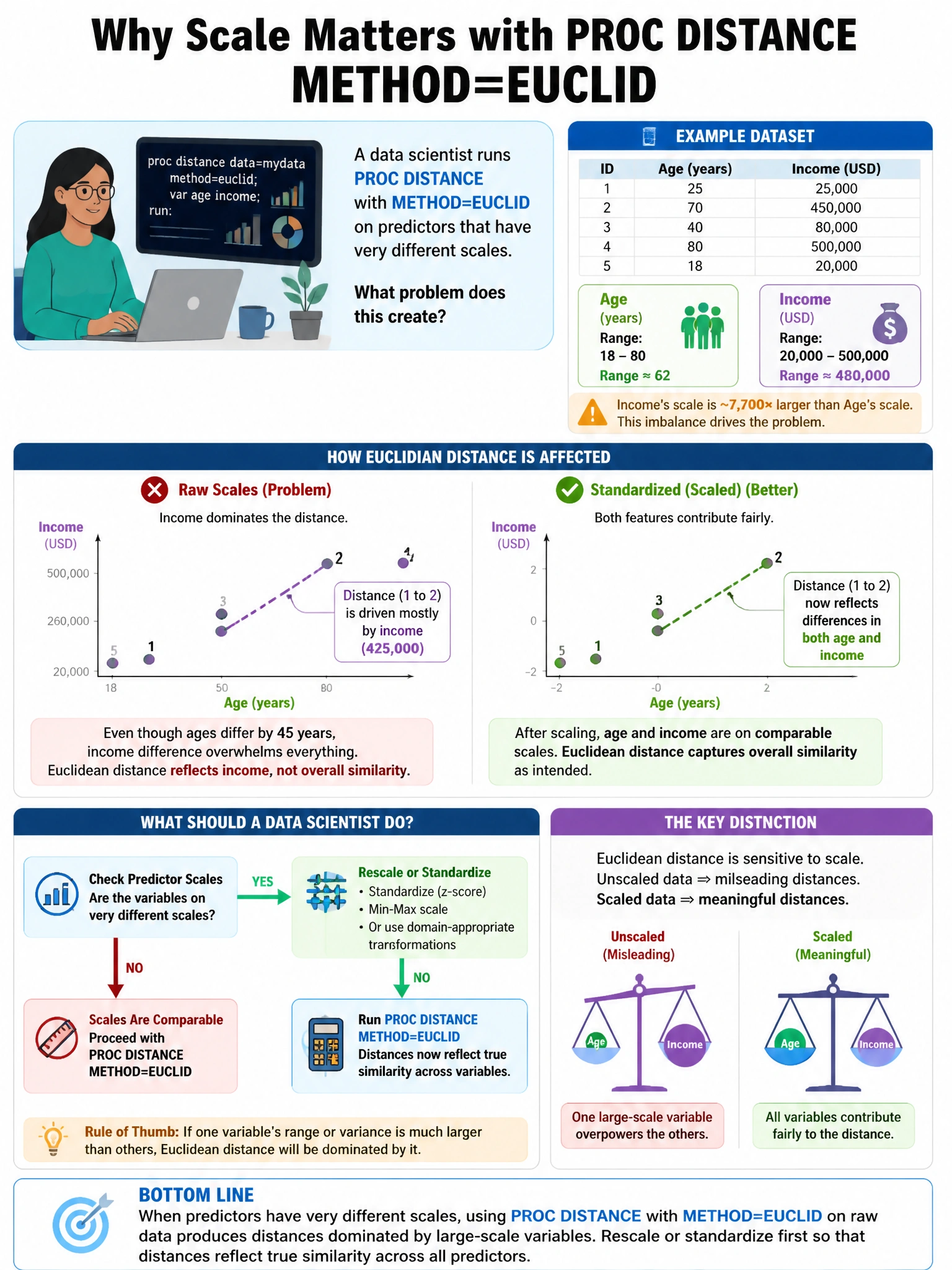
Here's the deal — b is correct because Euclidean distance treats each unit equally: a 1-unit difference in income ($1) is the same as a 1-unit difference in age (1 year) numerically. Since income has a range ~25x larger than age, income dominates the distance calculation, effectively ignoring age's contribution to cluster structure.
Full explanation below image
Full Explanation
B is correct because Euclidean distance treats each unit equally: a 1-unit difference in income ($1) is the same as a 1-unit difference in age (1 year) numerically. Since income has a range ~25x larger than age, income dominates the distance calculation, effectively ignoring age's contribution to cluster structure. The remedy is to standardize variables (PROC STDIZE) or use METHOD=DGOWER before clustering. A is wrong; Euclidean distance does not fail on different units. C is wrong; Euclidean distance handles negative values. D is wrong; Euclidean distance matrices are always symmetric.