
PROC DISTANCE with METHOD=MAHALANOBIS requires an additional option to compute Mahalanobis distance. What does Mahalanobis distance account for that Euclidean distance does not?
Select an answer to reveal the explanation.
Short Explanation and Infographic
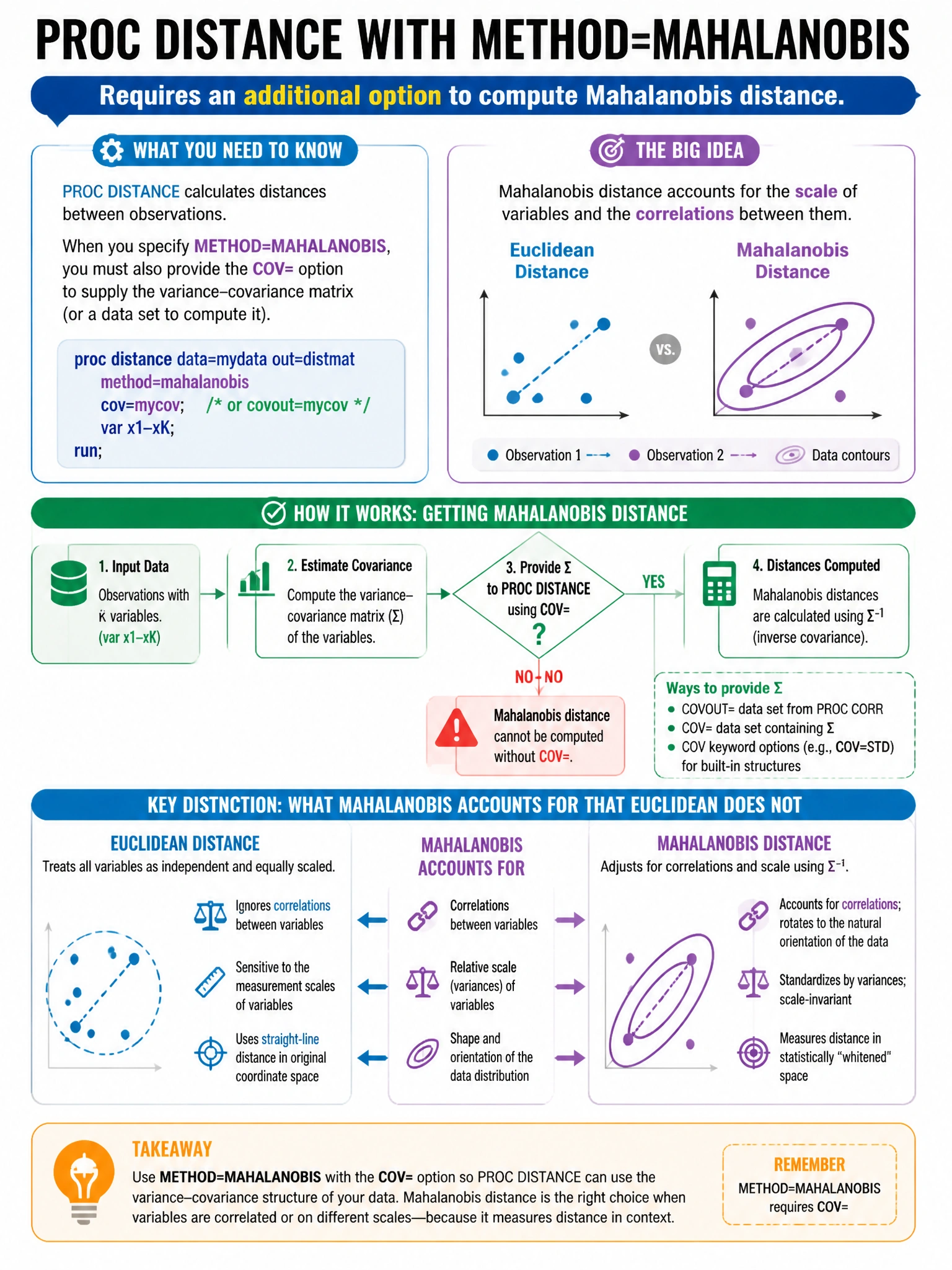
Here's the deal — b is correct because Mahalanobis distance = sqrt((x-mu)^T S^-1 (x-mu)) where S is the covariance matrix. This weights differences by the inverse covariance, accounting for variable correlations (correlated variables don't double-count variation) and making the distance scale-invariant.
Full explanation below image
Full Explanation
B is correct because Mahalanobis distance = sqrt((x-mu)^T S^-1 (x-mu)) where S is the covariance matrix. This weights differences by the inverse covariance, accounting for variable correlations (correlated variables don't double-count variation) and making the distance scale-invariant. For uncorrelated variables with equal variance, Mahalanobis distance reduces to Euclidean distance. A is wrong; Mahalanobis is for continuous variables only. C is wrong; Mahalanobis distance is not bounded. D is wrong; both distance metrics handle negative values.