
How does fuzzy C-means clustering differ from k-means in its representation of cluster membership?
Select an answer to reveal the explanation.
Short Explanation and Infographic
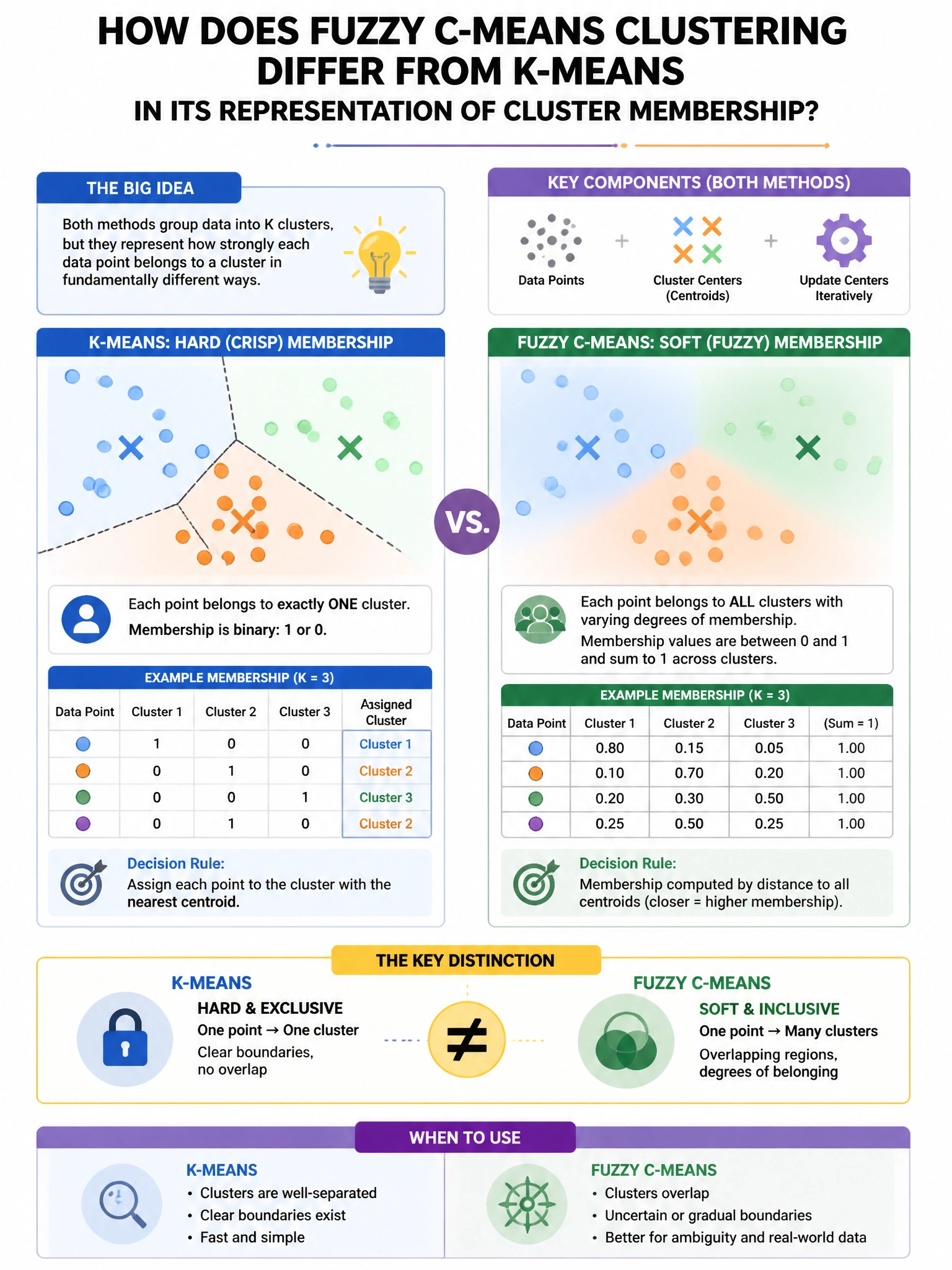
Here's the deal — c is correct because soft (fuzzy) clustering produces a membership matrix where each observation has a degree of membership to each cluster ranging from 0 to 1, with all degrees summing to 1. A boundary observation might have 0.6 membership in one cluster and 0.4 in another.
Full explanation below image
Full Explanation
C is correct because soft (fuzzy) clustering produces a membership matrix where each observation has a degree of membership to each cluster ranging from 0 to 1, with all degrees summing to 1. A boundary observation might have 0.6 membership in one cluster and 0.4 in another. A is wrong; EM with hard assignments is still a type of hard clustering. B is wrong; fuzzy C-means is centroid-based like k-means. D is wrong; the number of clusters is still a user parameter.