
In isolation forests for anomaly detection, why are anomalies isolated in fewer random splits than normal points?
Select an answer to reveal the explanation.
Short Explanation and Infographic
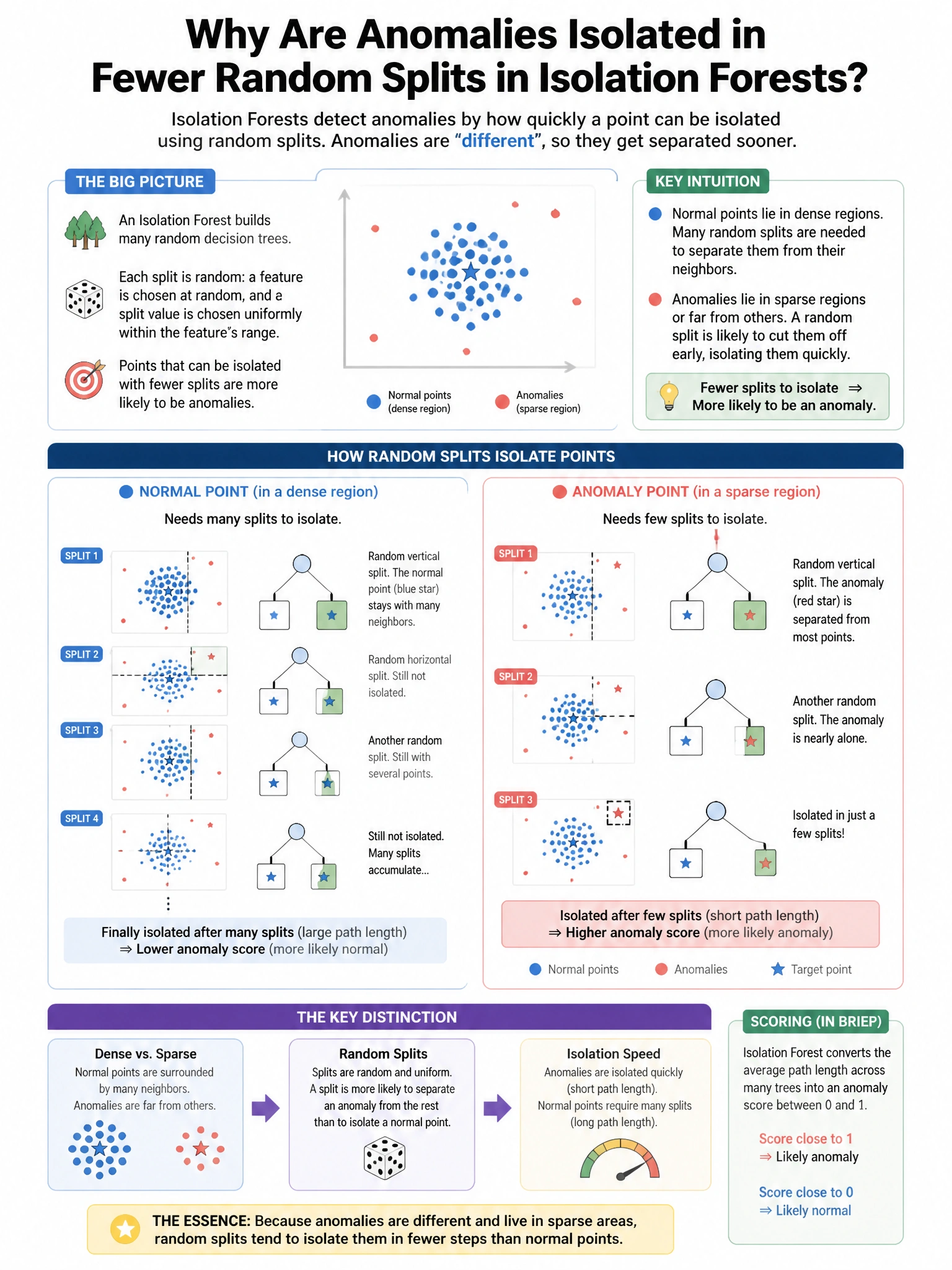
Here's the deal — b is correct because isolation forests exploit the fact that anomalies are rare and lie in sparse feature space regions with few neighbors. In a random partitioning tree, anomalies are isolated in fewer splits while normal points in dense regions require many splits.
Full explanation below image
Full Explanation
B is correct because isolation forests exploit the fact that anomalies are rare and lie in sparse feature space regions with few neighbors. In a random partitioning tree, anomalies are isolated in fewer splits while normal points in dense regions require many splits. A is wrong; anomalies are sparse, not dense. C is wrong; residuals from regression are not the mechanism. D is wrong; missing values are not defining characteristics.