
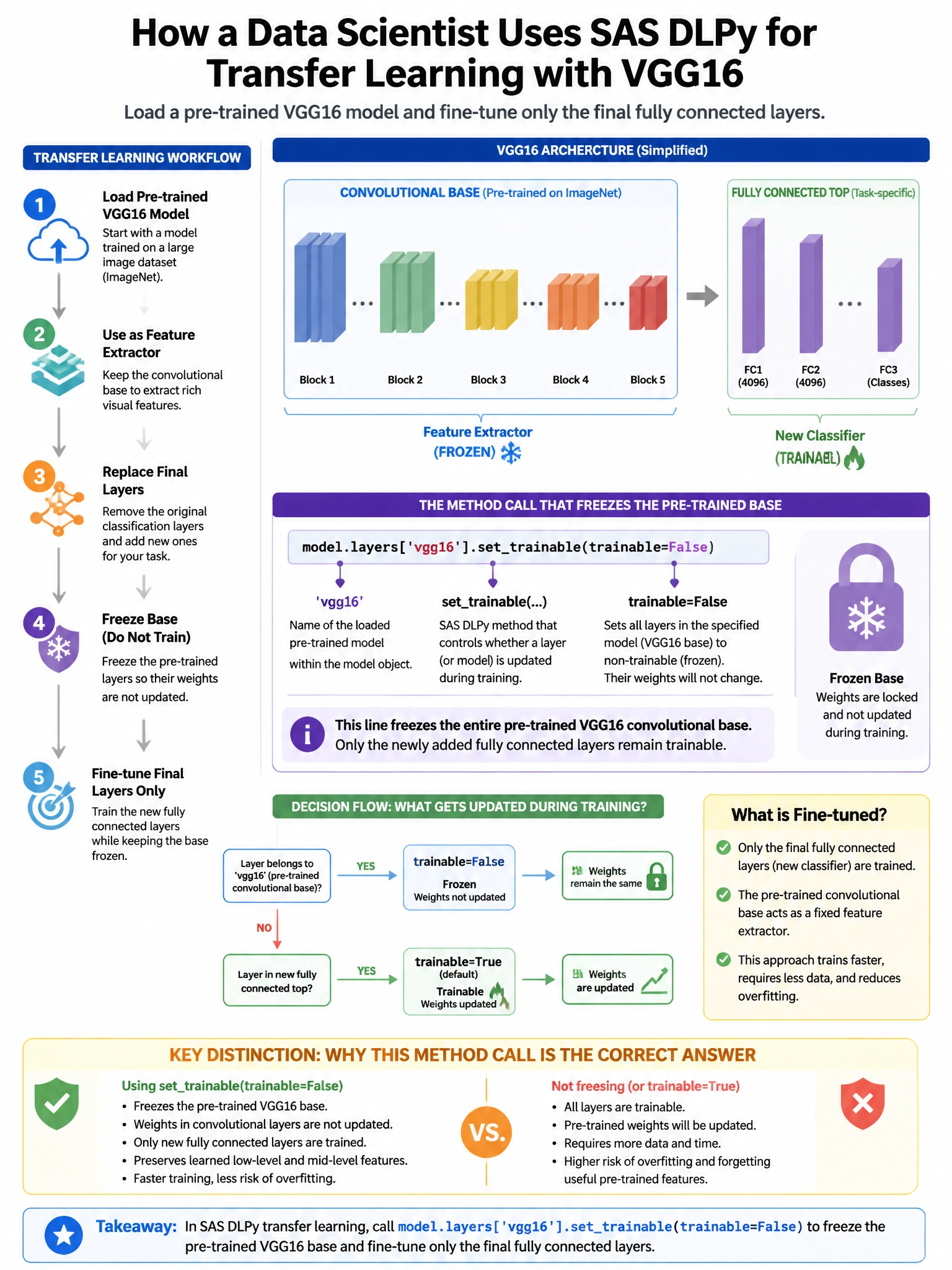
A data scientist uses SAS DLPy to apply transfer learning by loading a pre-trained VGG16 model and fine-tuning only the final fully connected layers. Which method call freezes the convolutional base layers during fine-tuning?
Select an answer to reveal the explanation.
Short Explanation and Infographic
Here's the deal — c is correct because in SAS DLPy, layer-level trainability is controlled by setting the trainable attribute of individual layer objects to False before training. When convolutional layers are set to non-trainable, their weights are frozen during backpropagation and only the specified (unfrozen) layers (e.g., fully connected layers) are updated.
Full explanation below image
Full Explanation
C is correct because in SAS DLPy, layer-level trainability is controlled by setting the trainable attribute of individual layer objects to False before training. When convolutional layers are set to non-trainable, their weights are frozen during backpropagation and only the specified (unfrozen) layers (e.g., fully connected layers) are updated. A uses a method name that does not exist in standard SAS DLPy. B uses incorrect syntax. D is wrong because DLPy does support selective layer training via the trainable property.