
A SAS NLP pipeline applies PROC TEXTMINE to e-commerce product reviews to predict star ratings (1-5). After text parsing and SVD, the data scientist wants to train a gradient boosting classifier on the SVD features. What is the correct workflow?
Select an answer to reveal the explanation.
Short Explanation and Infographic
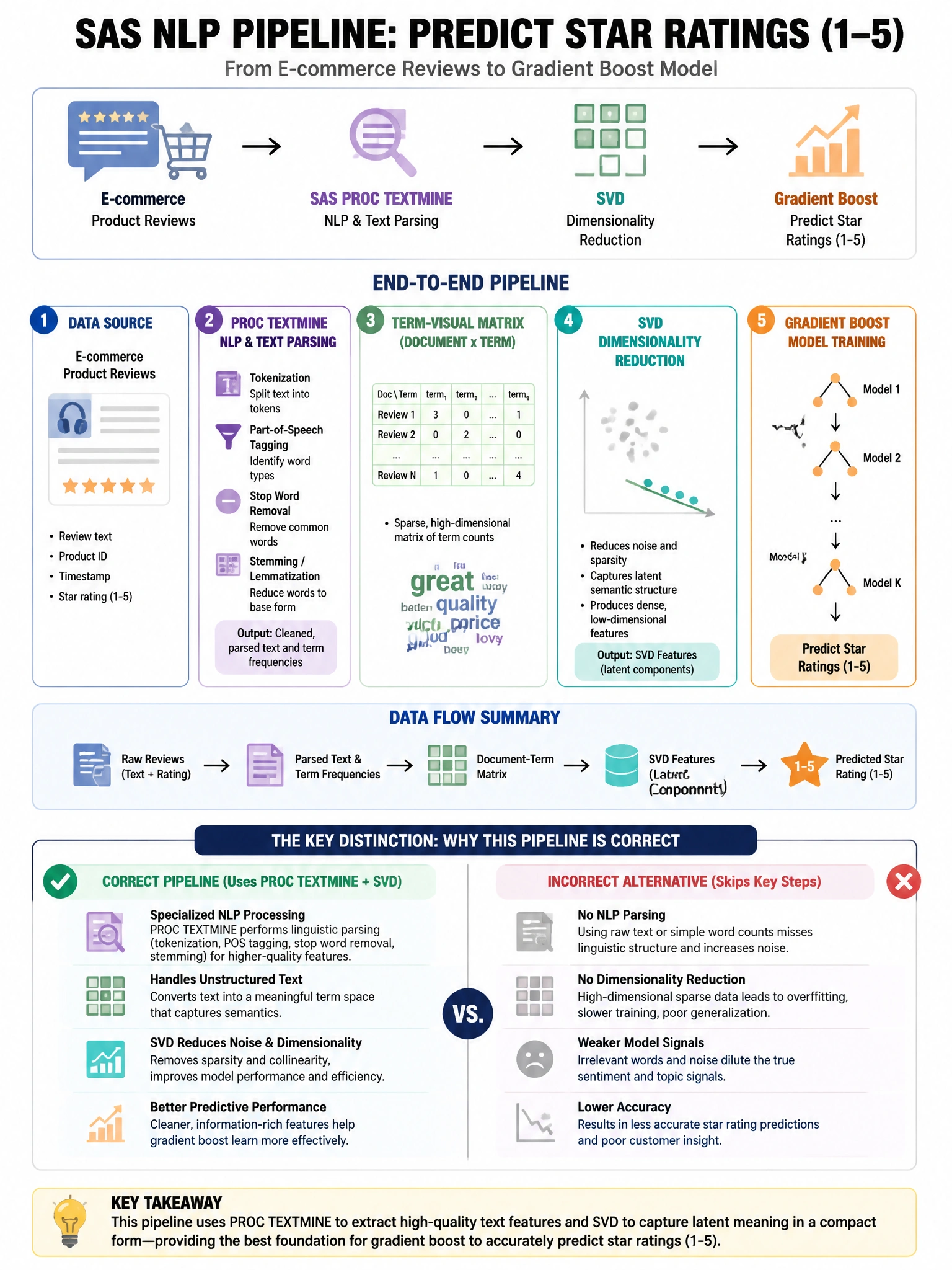
Here's the deal — b is correct because the standard SAS NLP-to-ML pipeline is: (1) PROC TEXTMINE produces SVD dimensions as numeric features per document, (2) these are joined with the target variable (star ratings), and (3) a standard ML procedure like PROC HPFOREST, gbtreetrain CAS action, or PROC HPLOGISTIC is trained on the numeric SVD features. A is wrong because PROC HPFOREST has no TEXT= option.
Full explanation below image
Full Explanation
B is correct because the standard SAS NLP-to-ML pipeline is: (1) PROC TEXTMINE produces SVD dimensions as numeric features per document, (2) these are joined with the target variable (star ratings), and (3) a standard ML procedure like PROC HPFOREST, gbtreetrain CAS action, or PROC HPLOGISTIC is trained on the numeric SVD features. A is wrong because PROC HPFOREST has no TEXT= option. C is wrong because PROC HPNEURAL does not have a raw text input layer. D is a valid alternative but not the SAS-native workflow described.