
A model trained on a small dataset achieves 99% training accuracy but only 62% test accuracy. Which remediation strategy would most directly address the bias-variance tradeoff issue present?
Select an answer to reveal the explanation.
Short Explanation and Infographic
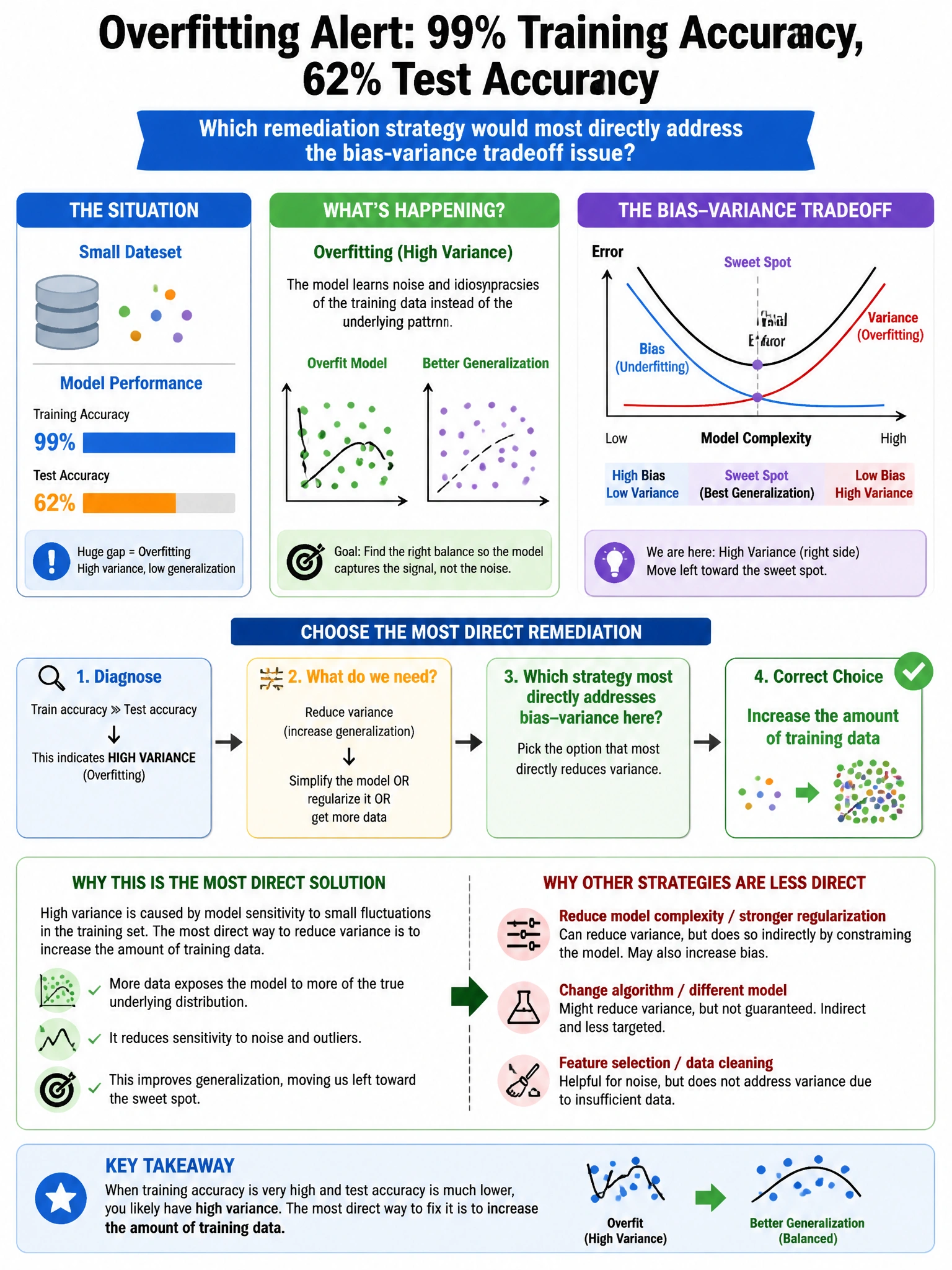
Here's the deal — b is correct because the large gap between training and test accuracy indicates high variance (overfitting). Collecting more training data reduces variance by exposing the model to more patterns, and regularization penalizes complex solutions directly.
Full explanation below image
Full Explanation
B is correct because the large gap between training and test accuracy indicates high variance (overfitting). Collecting more training data reduces variance by exposing the model to more patterns, and regularization penalizes complex solutions directly. A is wrong because a higher learning rate does not address model complexity. C is wrong because switching to a simpler model addresses the symptom but is less targeted than regularization. D is wrong because removing all features would destroy predictive power.