
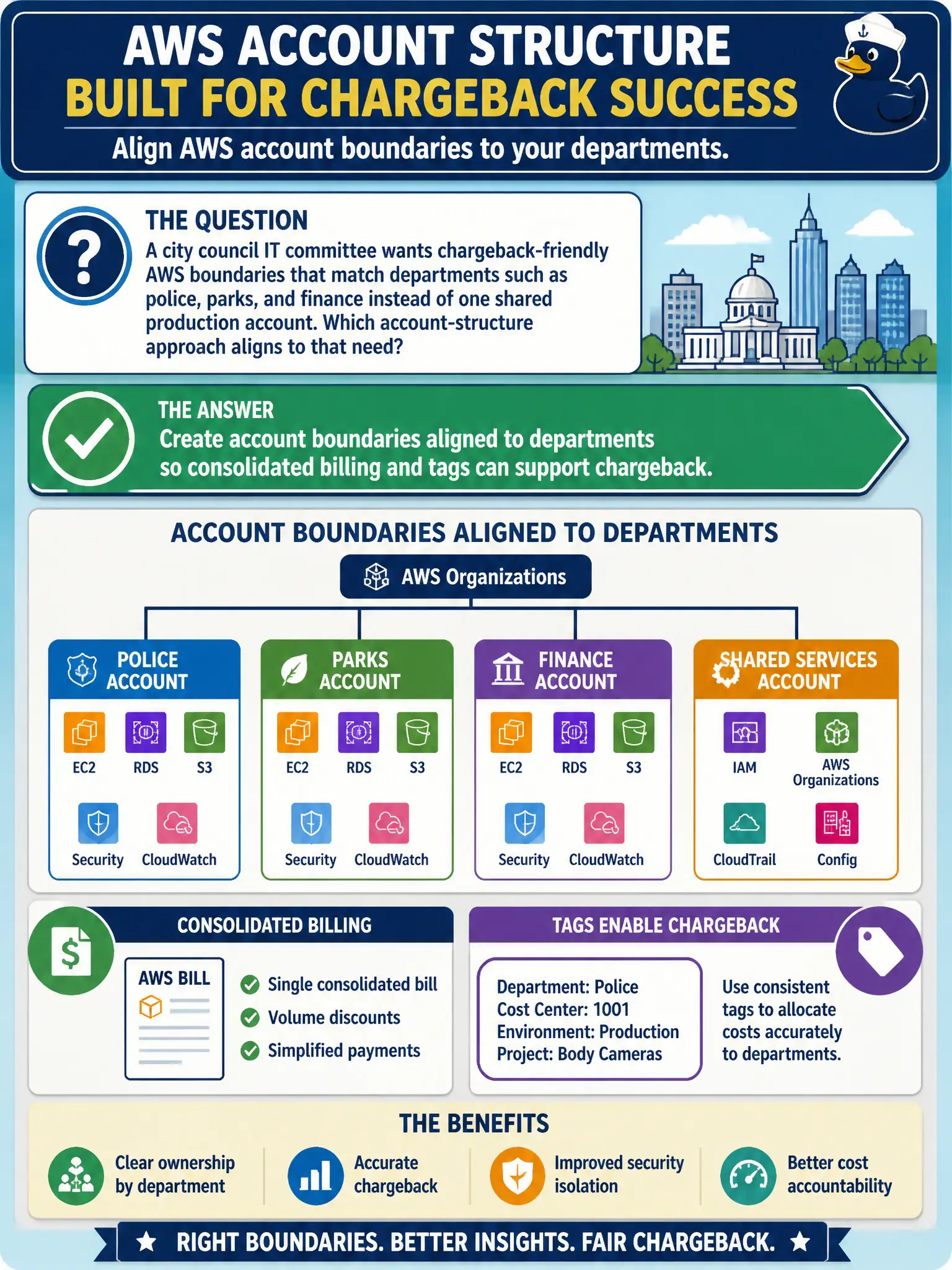
A city council IT committee wants chargeback-friendly AWS boundaries that match departments such as police, parks, and finance instead of one shared production account. Which account-structure approach aligns to that need?
Select an answer to reveal the explanation.
Short Explanation
If parks and police share one cash register drawer, the council will never know who spent what. Give departments account boundaries that match the org chart so chargeback has a clean line of sight.
Full Explanation
Chargeback-friendly AWS boundaries for police, parks, and finance should use account boundaries aligned to departments so consolidated billing and cost-allocation tags can attribute spend cleanly. Separate accounts provide hard isolation and natural cost dimensions in the payer invoice; tags then refine fund codes and projects inside those accounts. Informal naming conventions on a single shared production account cannot meet a city council IT committee’s expectation of departmental chargeback clarity.
Keeping one shared production account and relying on informal EC2 Name tags alone fails durable attribution when tags drift or resources lack tags entirely. Merging all departments into a single OU with no account separation reduces both cost clarity and blast-radius isolation. Disabling consolidated billing so each team invents its own payment method monthly abandons organizational finance control and creates procurement chaos.
Exam caveat: accounts are the strongest chargeback boundary; tags complement accounts—they do not fully replace them when departments need isolation and showback. Operational check: create or map department accounts, activate cost-allocation tags, build Cost Explorer reports by account and tag, and validate a sample invoice showback with parks and police finance liaisons.