
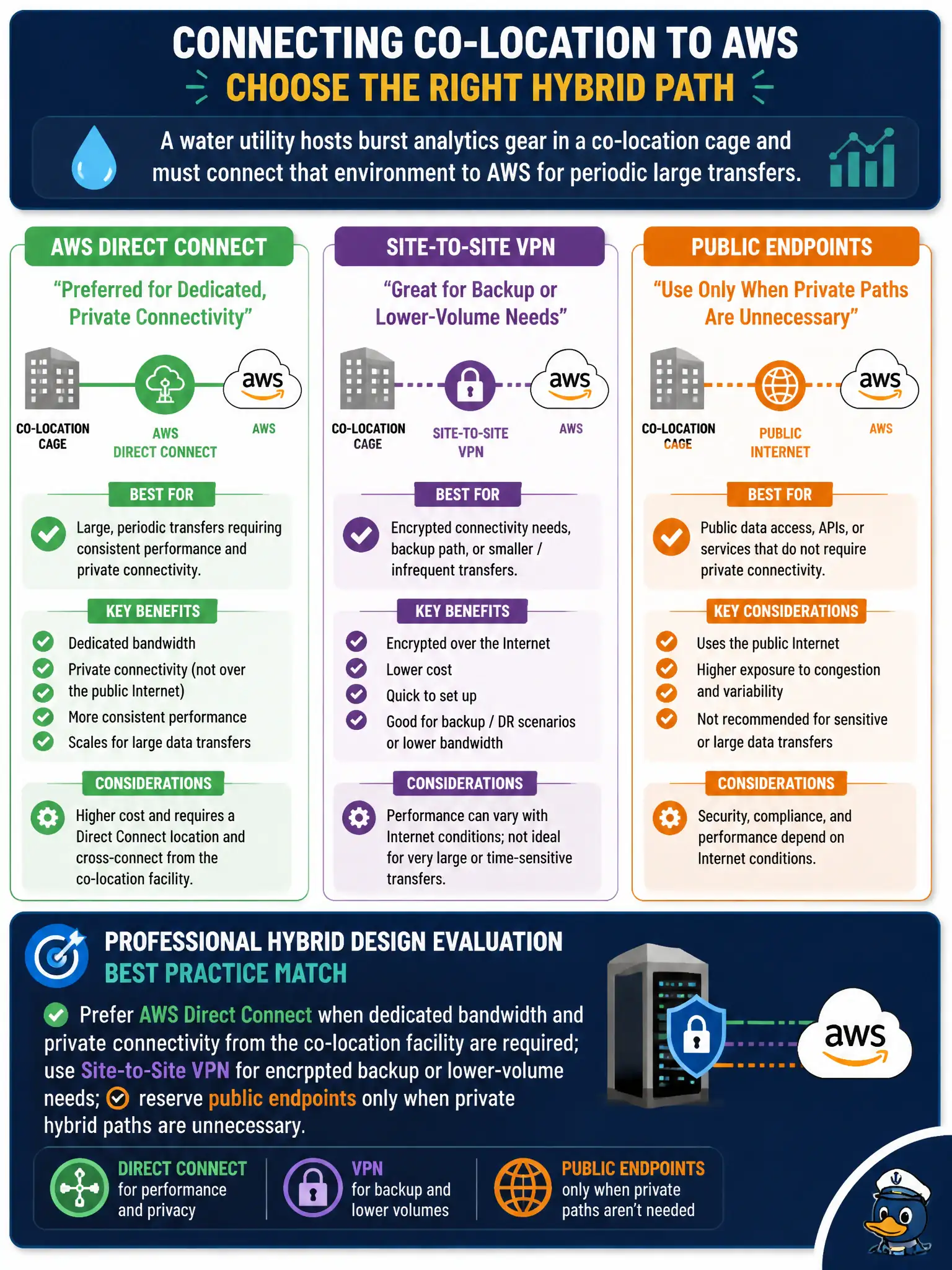
A water utility hosts burst analytics gear in a co-location cage and must connect that environment to AWS for periodic large transfers. Architects must choose among Direct Connect, Site-to-Site VPN, and public endpoints. Which evaluation best matches professional hybrid design?
Select an answer to reveal the explanation.
Short Explanation
Co-lo to cloud is a menu, not a slogan. If you need a fat private pipe, order Direct Connect; if you need encrypted backup or lighter flows, VPN still shines; public endpoints are the takeout window. Match the link to the burst analytics appetite.
Full Explanation
Choosing hybrid connectivity from a water-utility co-location cage into AWS is a requirements-driven menu: prefer AWS Direct Connect when the facility can deliver dedicated bandwidth and private connectivity for periodic large transfers; use Site-to-Site VPN when encrypted backup paths or lower-volume needs dominate; reserve public endpoints for cases where private hybrid paths are unnecessary. That evaluation matches professional hybrid design instead of slogan-driven single answers. Co-location providers commonly host Direct Connect on-ramps, so DX is often available exactly where burst analytics gear already lives.
Always using public internet endpoints because “Direct Connect cannot terminate near co-location” is factually weak and ignores the dedicated-bandwidth requirement. Requiring Site-to-Site VPN exclusively even when the facility already offers adequate Direct Connect forgoes the private capacity the large-transfer use case wants. Forbidding any hybrid link and shipping physical disks weekly may work for offline archives but fails SLAs for periodic large electronic transfers the architects were asked to enable.
Exam caveat: SAP-C02 answers usually select Direct Connect for dedicated/private/consistent throughput, VPN for encrypted/flexible/backup, and public endpoints only when private connectivity is not required—match the stem’s adjectives. Operational check: confirm DX or VPN availability at the co-lo, size the virtual interface or tunnels for peak transfer windows, route analytics prefixes privately, and keep a documented fallback (VPN or alternate DX) if the primary path saturates or fails.