
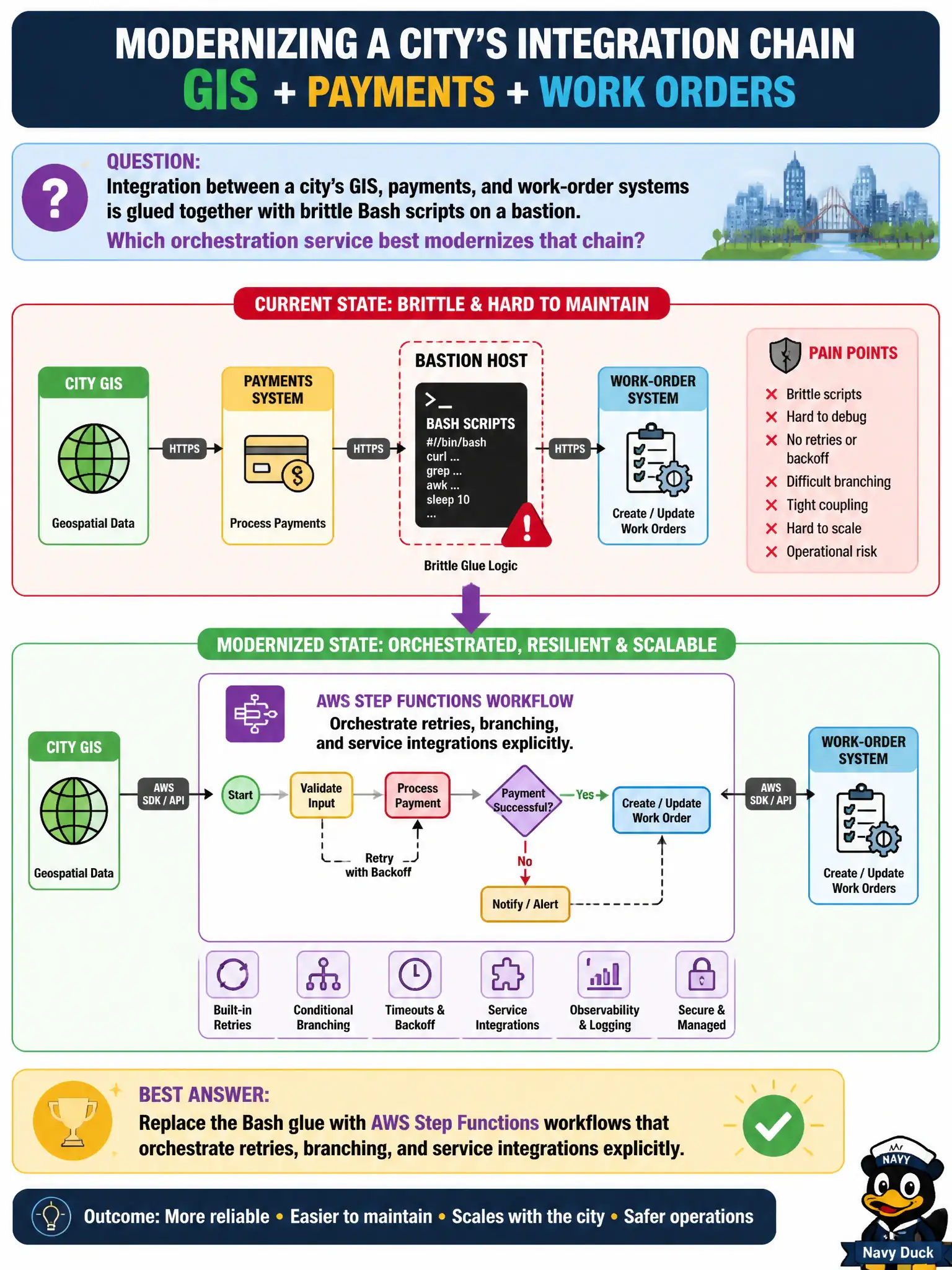
A brittle Bash script on a shared operations host copies extracts between the permitting system, finance, and GIS, with no retries, timeouts, or visible state when a step fails overnight. Which orchestration modernization should architects select?
Select an answer to reveal the explanation.
Short Explanation
Overnight Bash glue is a treasure map nobody can read at 3 a.m. Step Functions turns the handoffs into a flowchart with retries and a status you can actually see. A longer script is still a script.
Full Explanation
A brittle Bash script on a shared operations host that copies extracts between permitting, finance, and GIS—with no retries, timeouts, or visible state when a step fails overnight—should be replaced with AWS Step Functions so municipal system-to-system steps have retries, timeouts, and visible state. Orchestration modernization makes overnight failures diagnosable before morning counters open. Lengthening the Bash script and running it more frequently from the same host fails reliability engineering. Embedding all three systems' logic inside a single Lambda that times out at 15 minutes fails duration and separation of concerns for multi-system flows. Requiring operators to copy files with USB drives when the script fails fails automation and custody. Exam caveat: Step Functions is the retry/timeout/state machine answer for brittle glue scripts. Operational check: model each hop as a state, configure retries and catchers, emit logs to CloudWatch, page on failed executions, and decommission the Bash host after parallel runs succeed. Document the decision in the municipal architecture decision record and re-verify controls after the first production wave so auditors see continuous improvement, not one-time tribal knowledge.