
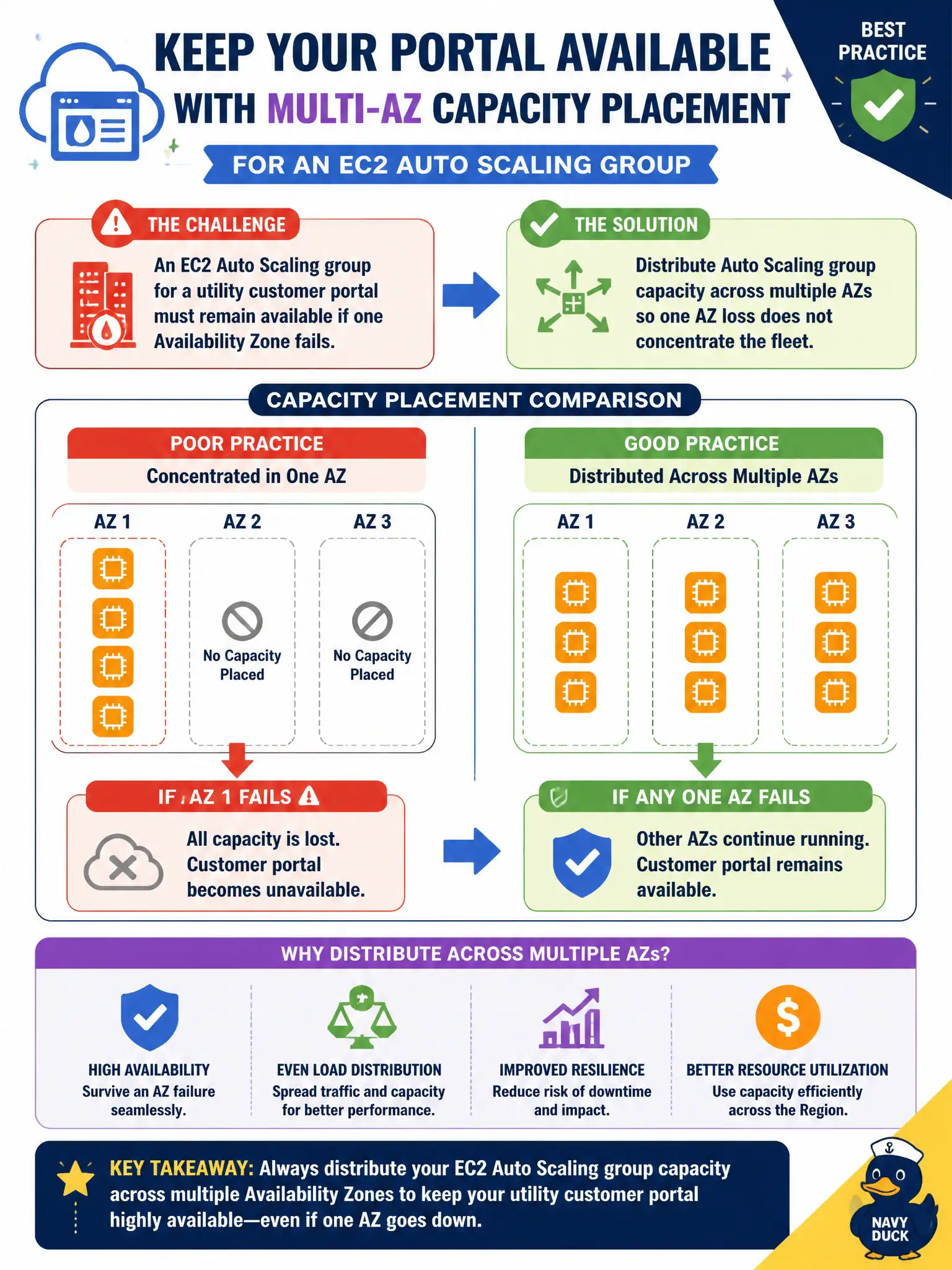
An EC2 Auto Scaling group for a utility customer portal must remain available if one Availability Zone fails. What capacity placement practice should architects apply?
Select an answer to reveal the explanation.
Short Explanation
Don’t park the whole portal fleet in one AZ driveway. Spread Auto Scaling capacity across AZs so one dark zone doesn’t take every instance with it.
Full Explanation
An EC2 Auto Scaling group for a utility customer portal must survive loss of one Availability Zone by not concentrating capacity in that AZ. Distributing ASG capacity across multiple AZs so one AZ loss does not strand the fleet is the required placement practice. Launching all desired capacity into a single preferred AZ for simpler networking fails the AZ-loss objective. Pinning every instance to one host with a restrictive placement group that collapses on AZ failure worsens concentration risk for this HA goal. Disabling Multi-AZ load balancing and registering instances in only one AZ target group removes cross-AZ traffic shifting. Exam caveat: cross-AZ capacity needs correct subnet selection and may incur cross-AZ data transfer—plan desired capacity with AZ failure math (n AZ loss). Operational check: simulate AZ Impairments by terminating or deregistering one AZ's instances, confirm remaining AZs serve the portal, and verify ASG restores capacity across healthy AZs. In municipal cloud governance, record the owners, success metrics, and rollback or restore contacts beside this technical choice so the next incident, budget review, or audit does not rediscover the decision from scratch under time pressure.