
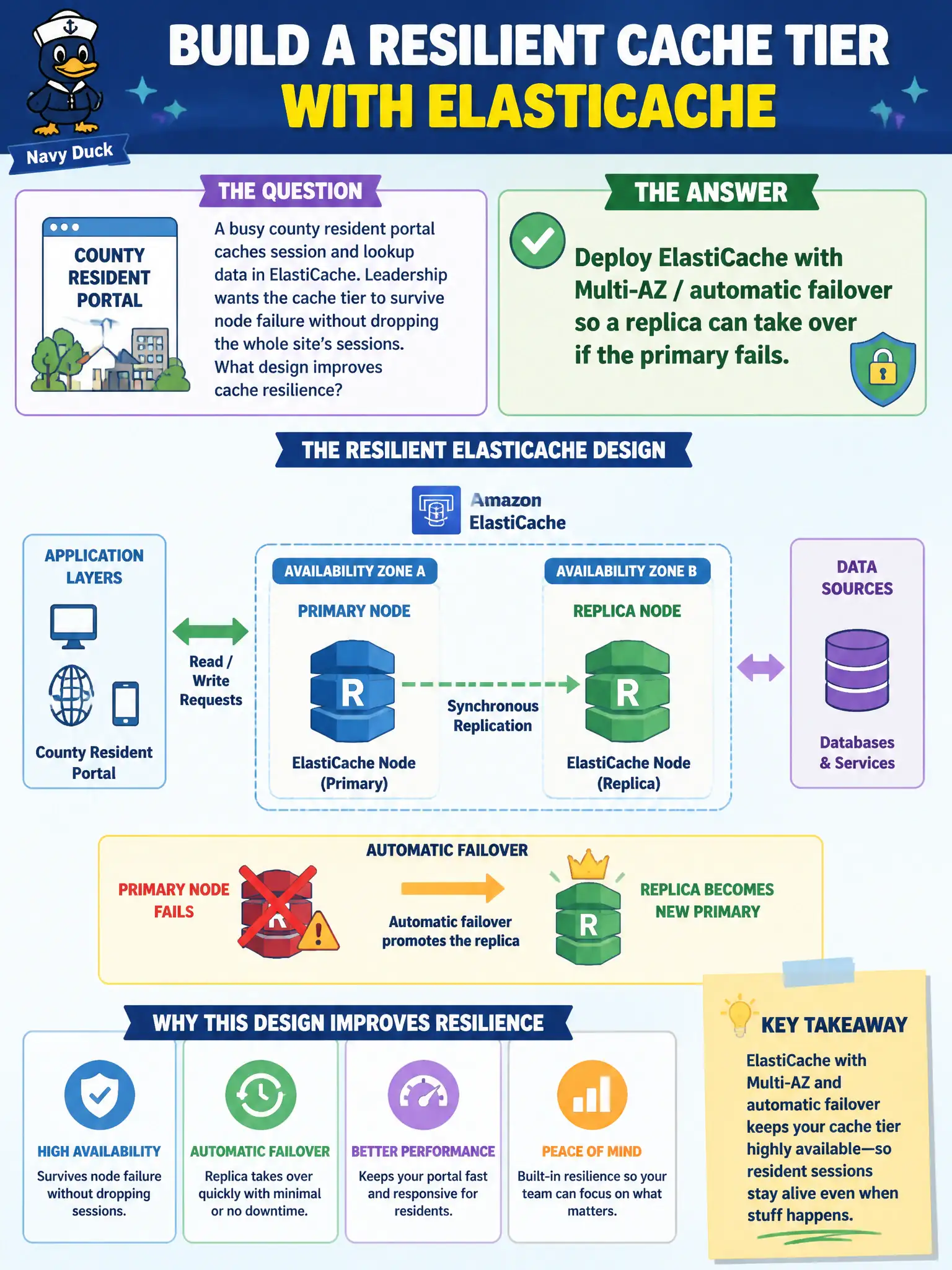
A busy county resident portal caches session and lookup data in ElastiCache. Leadership wants the cache tier to survive node failure without dropping the whole site’s sessions. What design improves cache resilience?
Select an answer to reveal the explanation.
Short Explanation
Sessions hate surprise evictions. Multi-AZ ElastiCache with failover keeps a warm spare ready so one sick node doesn’t boot every resident out of the portal.
Full Explanation
Batch GIS transform jobs that can pause and resume are candidates for cost-down compute such as Spot with checkpointing, while citizen-facing synchronous APIs usually need On-Demand or stable capacity. Mixing those models intentionally—Spot for interruptible GIS batch with checkpoints, stable compute for interactive citizen APIs—optimizes spend without putting interactive SLAs on interruptible capacity. Running both GIS batch and citizen APIs exclusively on Spot without interruption handling risks user-visible outages. Using only the largest On-Demand instances for every nightly transform ignores savings available to checkpointed batch. Disabling Auto Scaling and checkpoints so Spot kills permanently lose progress wastes both time and money. Exam caveat: Spot interruption notices and IAM/network setup for diversified pools are part of the design, not afterthoughts. Operational check: run a GIS batch on Spot with checkpoints, simulate interruption, confirm resume, and keep the citizen API on stable capacity through the same window. In municipal cloud governance, record the owners, success metrics, and rollback or restore contacts beside this technical choice so the next incident, budget review, or audit does not rediscover the decision from scratch under time pressure.