
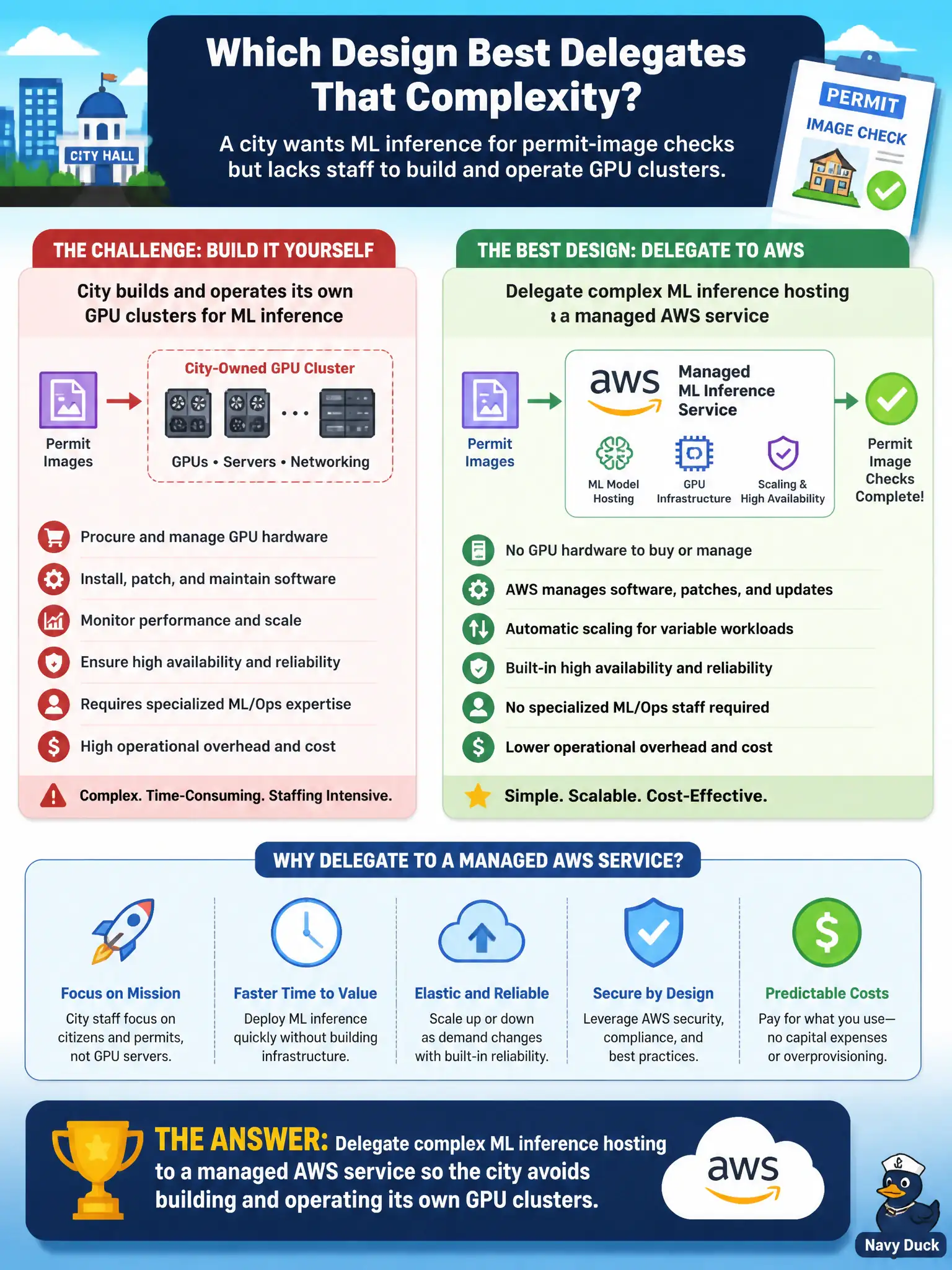
A city wants ML inference for permit-image checks but lacks staff to build and operate GPU clusters. Which design best delegates that complexity?
Select an answer to reveal the explanation.
Short Explanation
GPU clusters are a specialty shop most cities do not need to run. Point the permit checker at a managed AWS inference service and skip the rack, the drivers, and the 2 a.m. GPU tickets.
Full Explanation
Municipal permit-image checks may benefit from ML inference, but most cities lack the staffing to build, patch, and capacity-plan GPU clusters responsibly. Delegating inference hosting to a managed AWS ML or inference service provides the capability through APIs and managed endpoints so the city avoids owning GPU hardware lifecycles, driver stacks, and after-hours cluster incidents. Purchasing and racking dedicated GPU servers in every branch office multiplies capital and operations cost for a workload that is typically bursty and centralized at the permitting authority. Mandating that every planner train models on personal laptops overnight is neither secure nor reproducible and fails service-level expectations for consistent permit decisions. Storing model weights only in email attachments provides no hosting platform, versioning, access control, or controlled inference path. Exam caveat: managed inference still requires data-handling review—permit images may include sensitive property or personal information that must stay in approved regions and encrypted paths. Operational check: call the managed endpoint with a representative permit image set, measure latency and error rates against SLA targets, confirm IAM boundaries for who can invoke the model, and document residual risk of not operating in-house GPUs.