
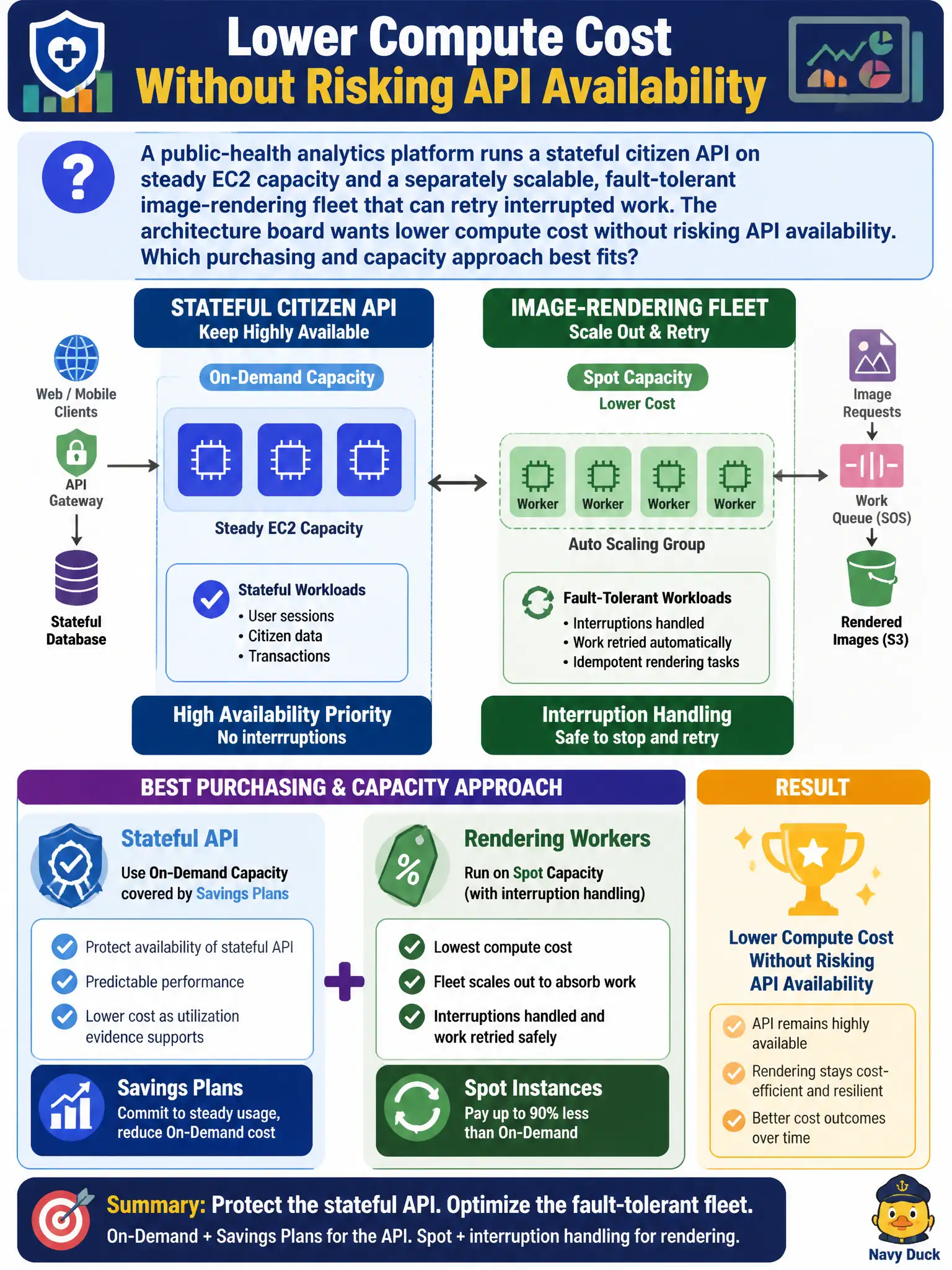
A public-health analytics platform runs a stateful citizen API on steady EC2 capacity and a separately scalable, fault-tolerant image-rendering fleet that can retry interrupted work. The architecture board wants lower compute cost without risking API availability. Which purchasing and capacity approach best fits?
Select an answer to reveal the explanation.
Short Explanation
Spot loves work that can die and come back—rendering fits. The citizen API needs to stay up, so keep it on-demand with Savings Plans once the CPU pattern is steady. Don’t Spot the stateful front door.
Full Explanation
A public-health analytics platform with a stateful citizen API on steady EC2 capacity and a separately scalable, fault-tolerant image-rendering fleet should split purchasing strategy by interruptibility. Run rendering workers on Spot with interruption handling and retries, and keep the stateful API on on-demand capacity covered by Savings Plans as utilization evidence supports. That preserves API availability for residents while cutting cost on work that can restart. Placing the stateful API exclusively on Spot while locking rendering onto five-year Standard Reserved Instances only fails because Spot interruption risk on a stateful citizen API threatens availability, and long-dated RIs for a fault-tolerant fleet overcommit the wrong workload. Converting both fleets to Spot with no on-demand baseline or Savings Plans coverage fails by removing the availability floor the API requires. Purchasing Dedicated Hosts for the rendering fleet because Spot cannot run containerized batch work fails on concept: Spot routinely runs containerized and batch workloads; Dedicated Hosts address license or tenancy needs, not a Spot capability myth. Exam caveat: match commitment and Spot to fault-tolerance characteristics—stateful user-facing tiers keep on-demand/Savings Plans baselines; interruptible workers use Spot. Operational check: measure API steady-state for Savings Plans sizing, implement Spot interruption hooks and queue retries for render jobs, set mixed capacity if needed, and review CloudWatch and Cost Explorer monthly so the health department does not drift back to all on-demand render nodes.