
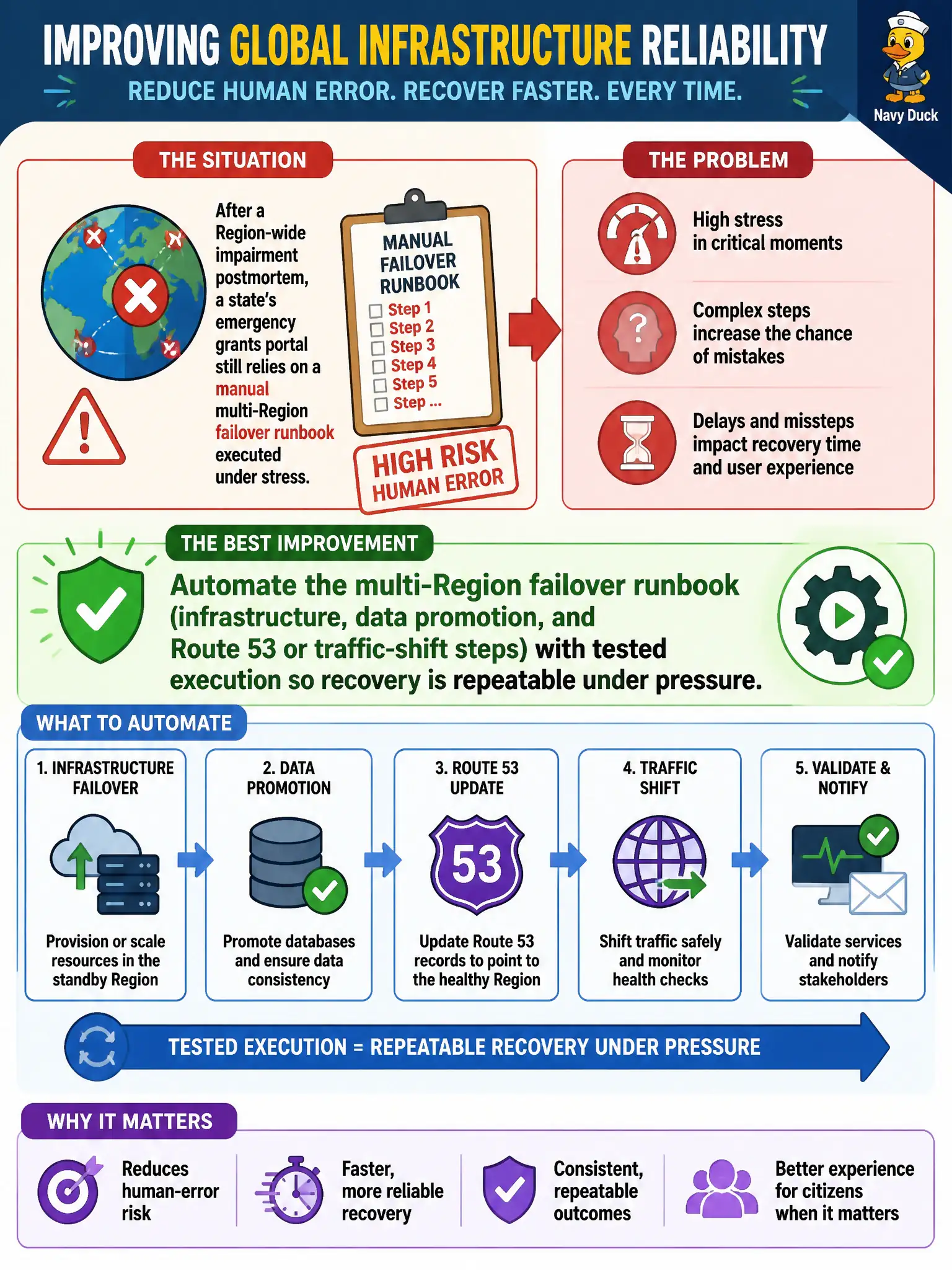
After a Region-wide impairment postmortem, a state’s emergency grants portal still relies on a manual multi-Region failover runbook executed under stress. Which Global Infrastructure reliability improvement best reduces human-error risk?
Select an answer to reveal the explanation.
Short Explanation
Manual failover at 3 a.m. is how typos become outages. Script and test the Region shift—DNS, data, and infra—so the grants portal recovers like a drill, not like improv theater.
Full Explanation
After a Region-wide impairment postmortem, a state’s emergency grants portal that still relies on a manual multi-Region failover runbook executed under stress retains high human-error risk. Automating the multi-Region failover runbook—infrastructure, data promotion, and Route 53 or traffic-shift steps—with tested execution makes recovery repeatable under pressure. That Global Infrastructure reliability improvement works because disaster cognitive load is exactly when manual DNS and promotion mistakes happen. Printing additional paper copies of the same manual steps fails by multiplying documents without reducing execution error. Requiring verbal approval from five directors before any DNS change during an incident fails by adding coordination delay to RTO. Disabling Route 53 health checks to prevent accidental failover fails conceptually by removing automated detection that safe automation depends on. Exam caveat: automation needs guardrails, dry-run modes, and clear abort criteria so a bad health signal cannot flap traffic endlessly. Operational check: encode the failover in Infrastructure-as-Code plus a tested runbook/Automation document, execute a planned Regional failover drill, measure RTO and error rate, and fix any manual leftover steps before storm season.