
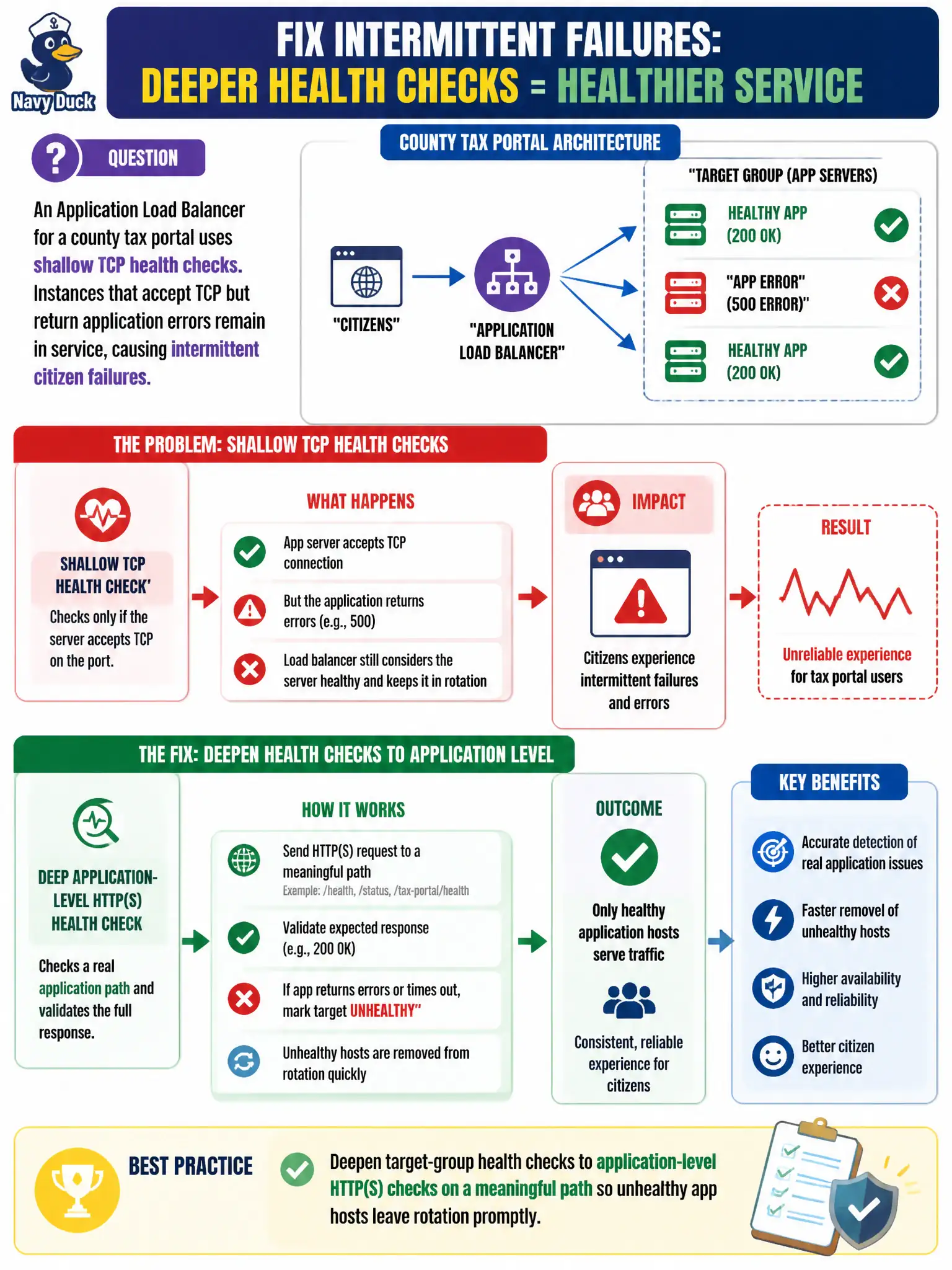
An Application Load Balancer for a county tax portal uses shallow TCP health checks. Instances that accept TCP but return application errors remain in service, causing intermittent citizen failures. Which HA improvement best fixes detection?
Select an answer to reveal the explanation.
Short Explanation
A door that opens is not the same as a clerk who can help. TCP-only checks keep broken app hosts in the tax portal rotation—switch to real HTTP checks on a path that proves the app works.
Full Explanation
An Application Load Balancer for a county tax portal that uses shallow TCP health checks leaves instances accepting TCP but returning application errors in service, causing intermittent citizen failures. Deepening target-group health checks to application-level HTTP(S) checks on a meaningful path removes unhealthy app hosts from rotation promptly. That HA improvement works because TCP open does not equal a healthy tax application—only an app-level probe detects logic and dependency failures. Removing health checks so the ALB never drains targets during incidents fails by keeping broken hosts in the pool forever. Checking only whether the instance’s IAM role can call S3 fails conceptually as unrelated to request-serving health. Health-checking the operators’ laptops instead of the target group fails as nonsensical monitoring of the wrong system. Exam caveat: choose a health path that exercises critical dependencies carefully without expensive side effects; overly heavy checks can overload the app or create false unhealthy flaps. Operational check: point the target group at an authenticated or lightweight /health that verifies app readiness, break a dependency in nonprod, confirm the ALB drains the target within the unhealthy threshold, and monitor flap rates after go-live.