
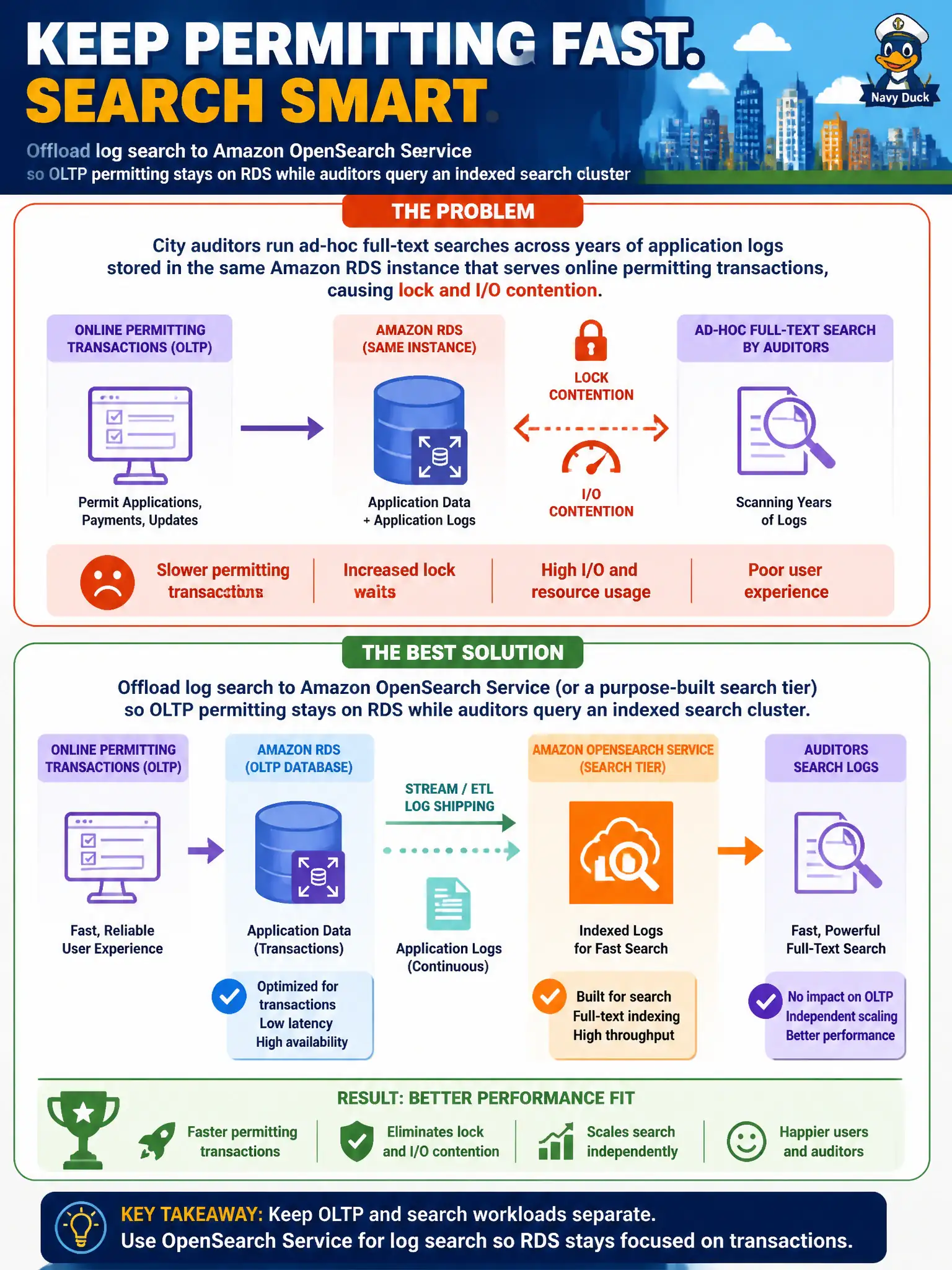
City auditors run ad-hoc full-text searches across years of application logs stored in the same Amazon RDS instance that serves online permitting transactions, causing lock and I/O contention. Which managed-service adoption best improves performance fit?
Select an answer to reveal the explanation.
Short Explanation
Do not ask the cash register to also be the library catalog. Keep permitting OLTP on RDS and give auditors a purpose-built OpenSearch index so those heavy text hunts stop punching the transaction lane.
Full Explanation
City auditors running ad-hoc full-text searches across years of application logs on the same RDS instance that serves online permitting create lock and I/O contention against citizens. Offloading log search to Amazon OpenSearch Service—or a purpose-built search tier—keeps OLTP permitting on RDS while auditors query an indexed search cluster sized for text search. That managed-service adoption improves performance fit because relational OLTP and heavy full-text audit analytics are different access patterns. Increasing RDS storage to Maximum while keeping heavy full-text queries on the primary writer fails by not separating workloads. Storing all logs only in ElastiCache as the durable system of record fails durability and search semantics. Exporting logs nightly to basement tape robots and discontinuing online search fails auditor productivity requirements. Exam caveat: shipping logs to OpenSearch needs retention, PII controls, and index sizing; do not grant auditors write paths into the OLTP database as a shortcut. Operational check: stream application logs to OpenSearch, recreate a representative auditor query, confirm permitting RDS CPU/I/O drop during the same query window, and revoke ad-hoc SELECT rights used for full-text on the primary.