
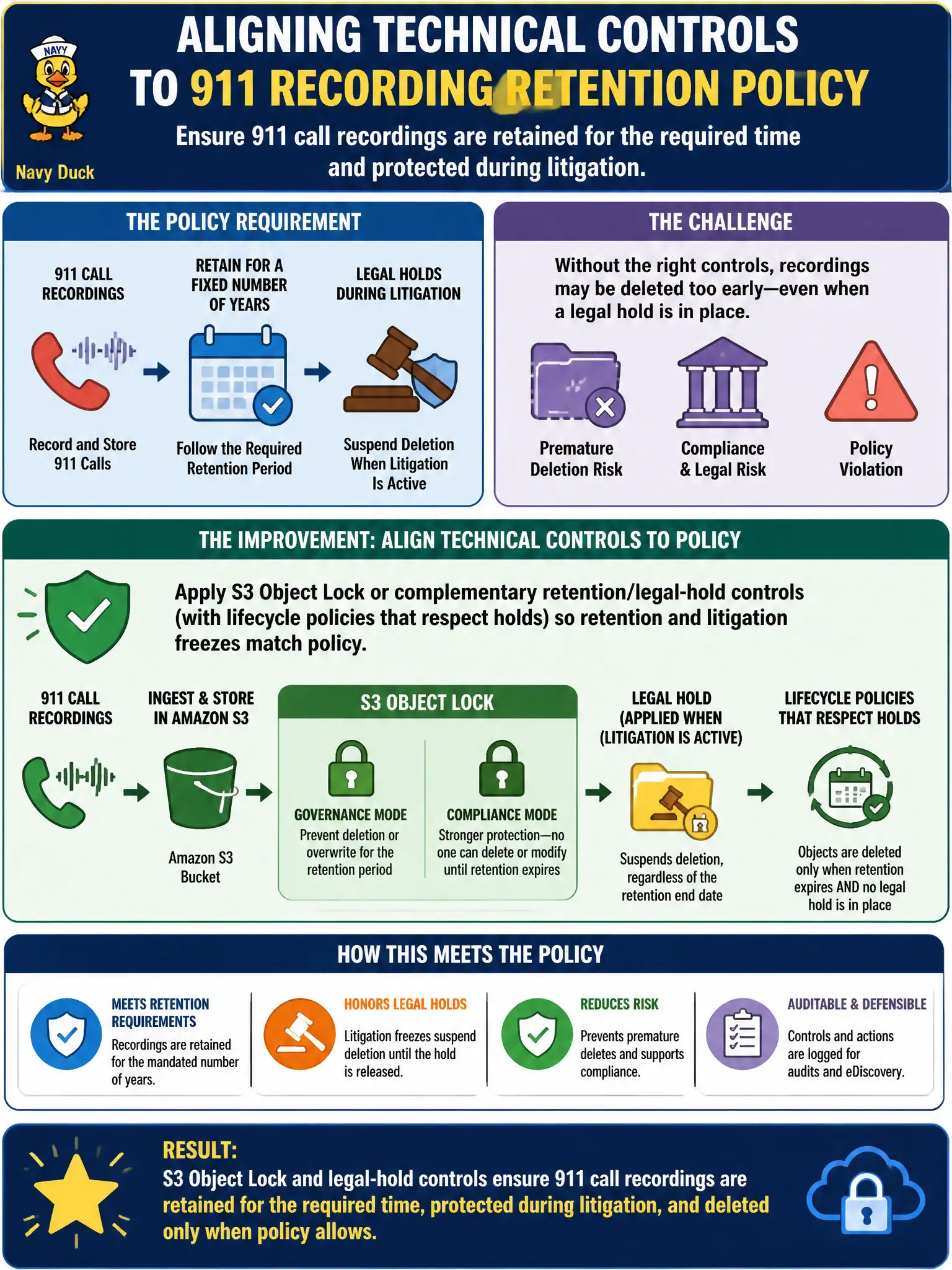
Policy requires 911 call recordings to be retained for a fixed number of years, with legal holds that must suspend deletion when litigation is active. Which improvement aligns technical controls to that requirement?
Select an answer to reveal the explanation.
Short Explanation
Retention policy without a technical lock is a pinky promise to the court. Object Lock or equivalent holds keep lifecycle from eating evidence when lawyers say freeze. Match the bucket behavior to the policy binder, not the other way around.
Full Explanation
Policy that retains 911 call recordings for a fixed number of years and requires legal holds to suspend deletion must be enforced in storage controls, not tribal practice. Applying S3 Object Lock or complementary retention and legal-hold controls—with lifecycle policies that respect holds—aligns technical deletion behavior to records and litigation requirements. That improvement works because WORM-style retention and explicit legal holds prevent accidental or malicious purge while recordings remain under mandate. Setting a one-day S3 lifecycle expiration on all recordings regardless of policy fails compliance and destroys evidence. Storing recordings only on temporary EC2 instance store volumes fails durability and retention for public-safety archives. Allowing any dispatcher to permanently delete recordings from the console without audit when disk is full fails conceptually on authorization, audit, and records integrity. Exam caveat: Object Lock modes and retention periods must match counsel’s schedule; enabling lock without understanding governance can make mistaken retention expensive to reverse. Operational check: classify the 911 recordings bucket, enable Object Lock/retention per policy, test a legal hold that blocks lifecycle delete, attempt a delete as a non-break-glass role (expect denial), and document hold procedures for the records officer.