
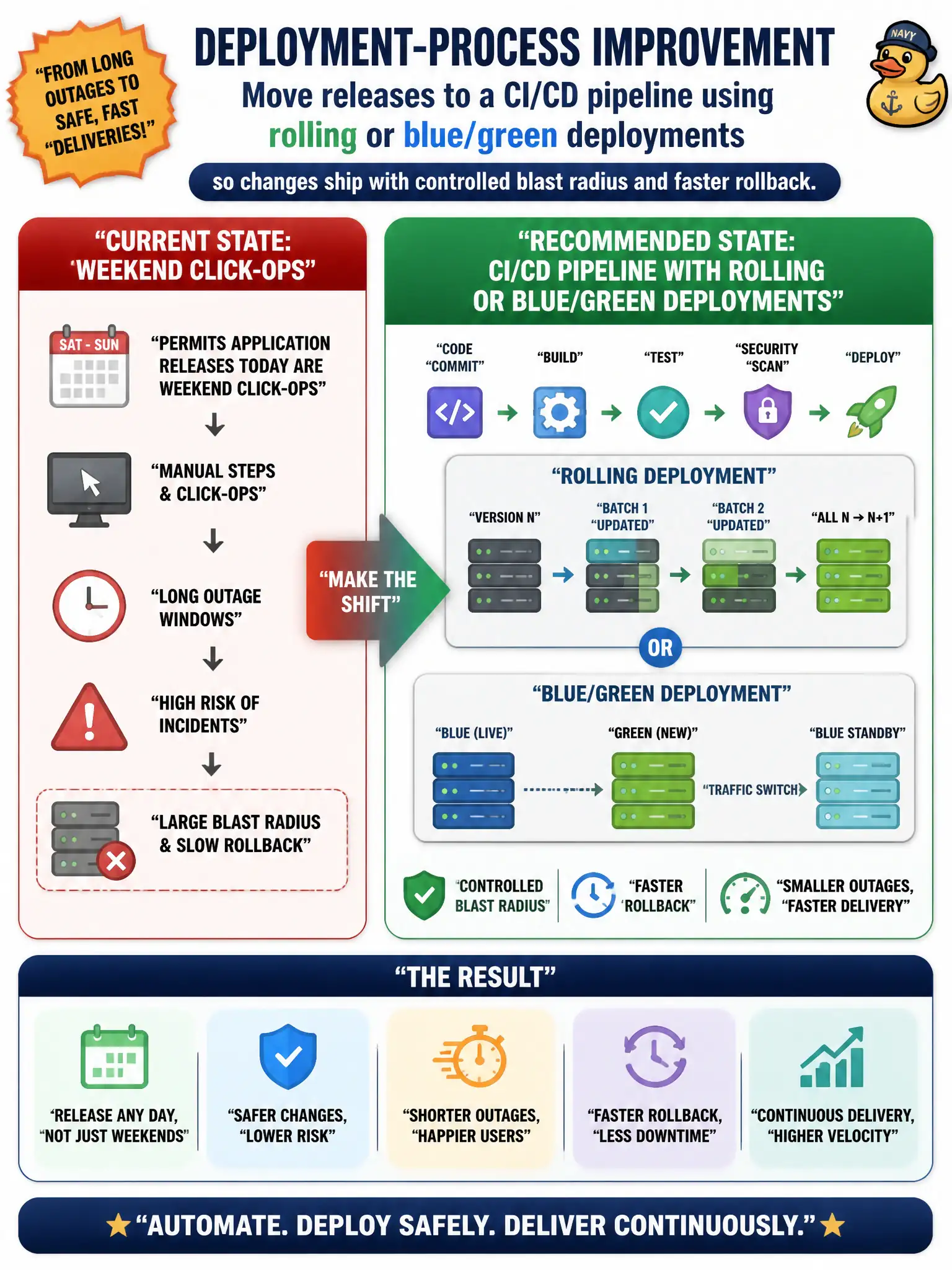
Permits application releases today are weekend click-ops with long outage windows. Which deployment-process improvement should the team adopt?
Select an answer to reveal the explanation.
Short Explanation
Weekend click-ops is a museum exhibit—put permits on a real pipeline with rolling or blue/green so bad builds can bounce back. Hand-editing prod or FTP’ing mystery binaries is how Friday becomes Monday’s outage.
Full Explanation
Weekend click-ops releases for a permits application with long outage windows are an operational excellence debt. Moving to a CI/CD pipeline with rolling or blue/green deployments ships changes with controlled blast radius, automated tests, versioned artifacts, and faster rollback than console folklore. That process works because deployment quality becomes repeatable engineering rather than heroic Friday nights. Continuing exclusive manual console changes on Fridays with no pipeline, artifacts, or automated tests fails by preserving long outages and unreproducible change. Deploying by editing production databases directly as the primary release mechanism fails conceptually—schema and data mutations as “releases” skip validation and complicate rollback. Shipping untested binaries via anonymous FTP to public EC2 instances fails on security and change control for any civic production system. Exam caveat: rolling and blue/green still need health checks, migration compatibility, and traffic-shift gates; a pipeline that auto-promotes broken builds is automation of failure, not excellence. Operational check: stand up a pipeline that builds, tests, and deploys to nonprod with rolling or blue/green, rehearse rollback on a failed health check, then promote the same path to permits production with a shortened change window.