
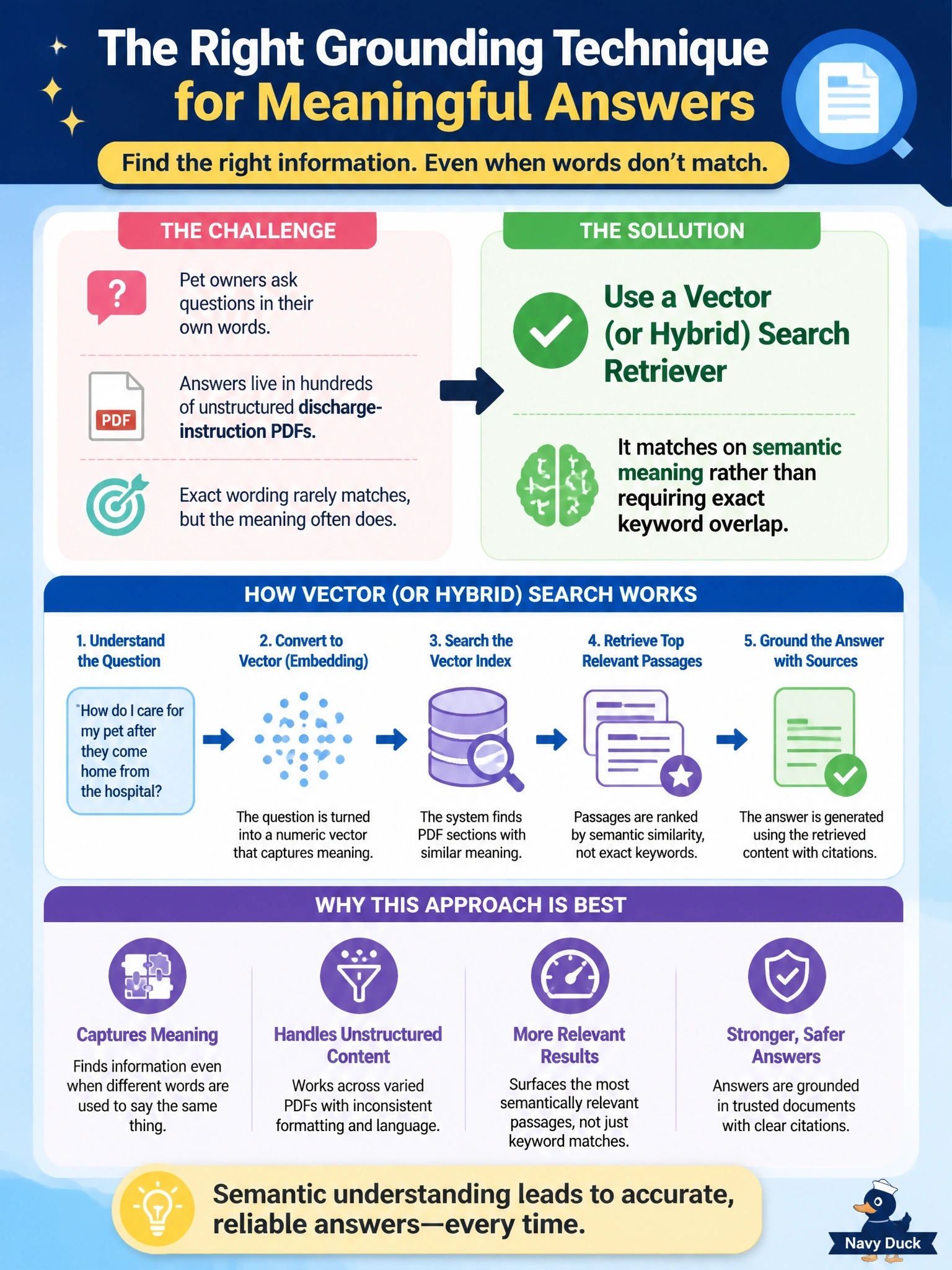
A template must answer pet-owner questions by searching across hundreds of unstructured discharge-instruction PDFs stored in the Data Library, where the exact wording of the question rarely matches the exact wording in the documents, but the underlying meaning often does. Which grounding technique should be selected, and why?
Select an answer to reveal the explanation.
Short Explanation
When the words in the question and the words in the source documents don't match exactly but mean the same thing, you need semantic (vector) search, not literal keyword matching.
Full Explanation
The correct answer is a vector or hybrid search retriever, because the described problem - meaning matches even when exact wording doesn't - is precisely what vector (semantic) search solves, unlike keyword search which depends on literal term overlap; hybrid additionally blends in keyword matching where exact terms do help, giving the best of both. Pure keyword search is the wrong sole choice here because the scenario explicitly says wording rarely matches exactly, which is the exact weakness keyword-only search has; the claim that keyword search is 'always faster' is also not the deciding factor - accuracy for this semantic-mismatch scenario is. A merge field cannot be used to pull semantically relevant content out of a large unstructured document set - merge fields reference known, specific field values, not the results of a search across many documents. An agent-to-agent handoff is a Multi-Agent Interoperability concept for delegating work between agents, not a grounding technique for retrieving content from a document library, so it doesn't address this need at all. The exam-relevant rule: choose vector or hybrid search specifically when meaning-based matching against unstructured content is required, and keyword search when literal term matches are what's needed.