
A prompt engineering lead reviewing a new template notices its instructions say only 'Write something helpful about this pet's visit.' Why is this instruction, on its own, a poor practice regardless of which template type is used?
Select an answer to reveal the explanation.
Short Explanation
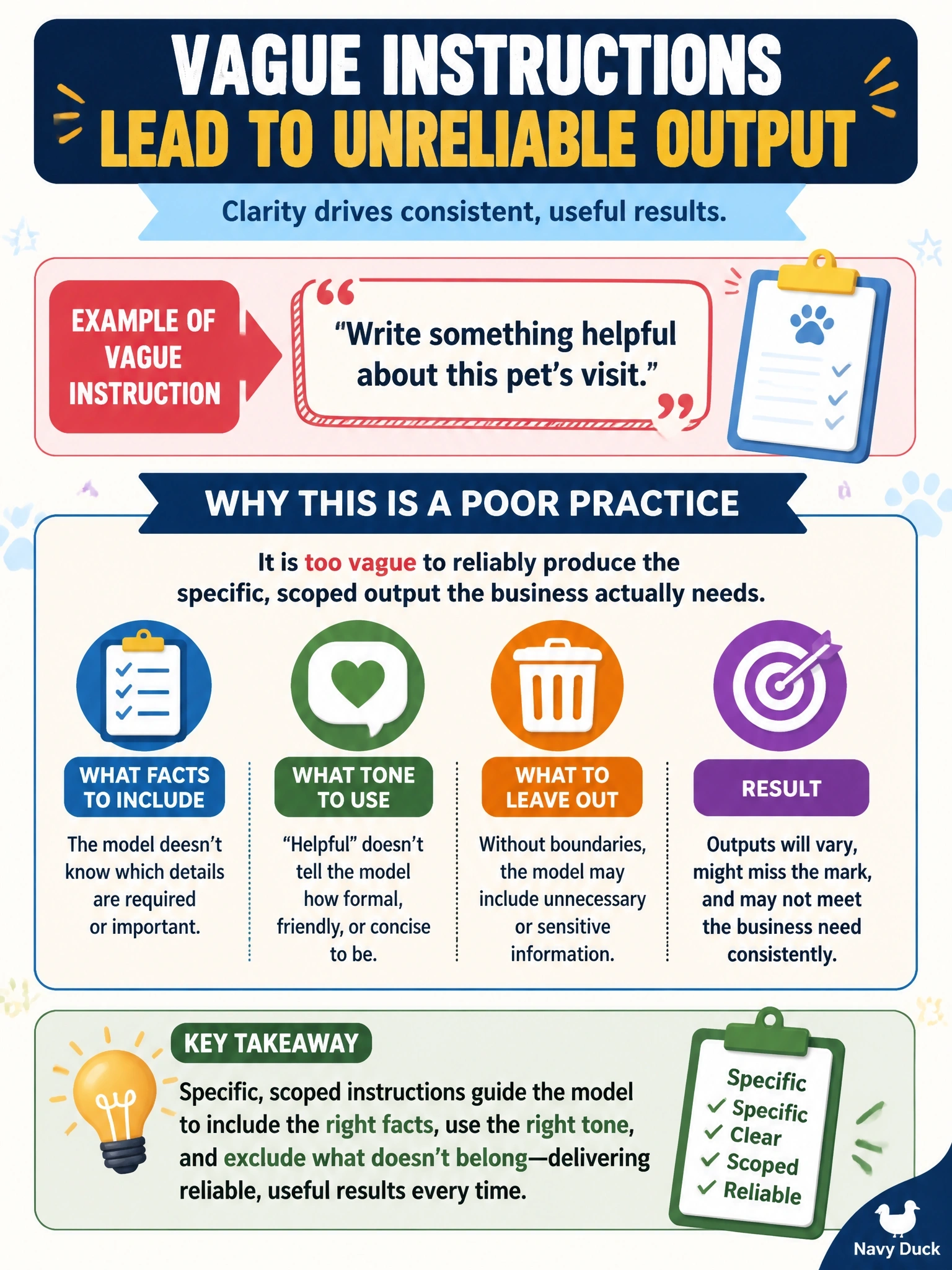
You can’t rely on “something helpful” to produce the specific, scoped output your business needs, because it doesn’t say what facts to include, what tone to use, or what to leave out. Give the model specific guidance so your results are more consistent and useful.
Full Explanation
The instruction is poor practice because “write something helpful” gives the model no concrete direction about the facts to include, the tone to use, or what to leave out. Without that scope, the output may vary unpredictably and may not meet the business’s needs. The claim that instructions are ignored unless written in a formal legal register fails because instructions are natural-language guidance; a legal register is not required. The claim that Prompt Builder rejects instructions longer than one sentence invents a length restriction: there is no such cap, and effective instructions may need enough detail to define the task. The claim that broad wording is strong practice because it lets the model choose useful details and adapt freely gets the principle backwards: unnecessary openness can make outputs inconsistent, while guidance on scope, tone, and exclusions helps produce a business-appropriate result. For the exam, distinguish useful flexibility from vagueness: the prompt should guide the result without relying on a formal register or a one-sentence limit. As a practical check, ask whether the instruction tells the model what facts to include, what tone to use, and what to leave out.