
A referral coordinator needs a tool that can both read data from a Case record and take the deterministic action of updating the Case status field once a referral hospital confirms receipt. Which combination correctly describes how this should be built?
Select an answer to reveal the explanation.
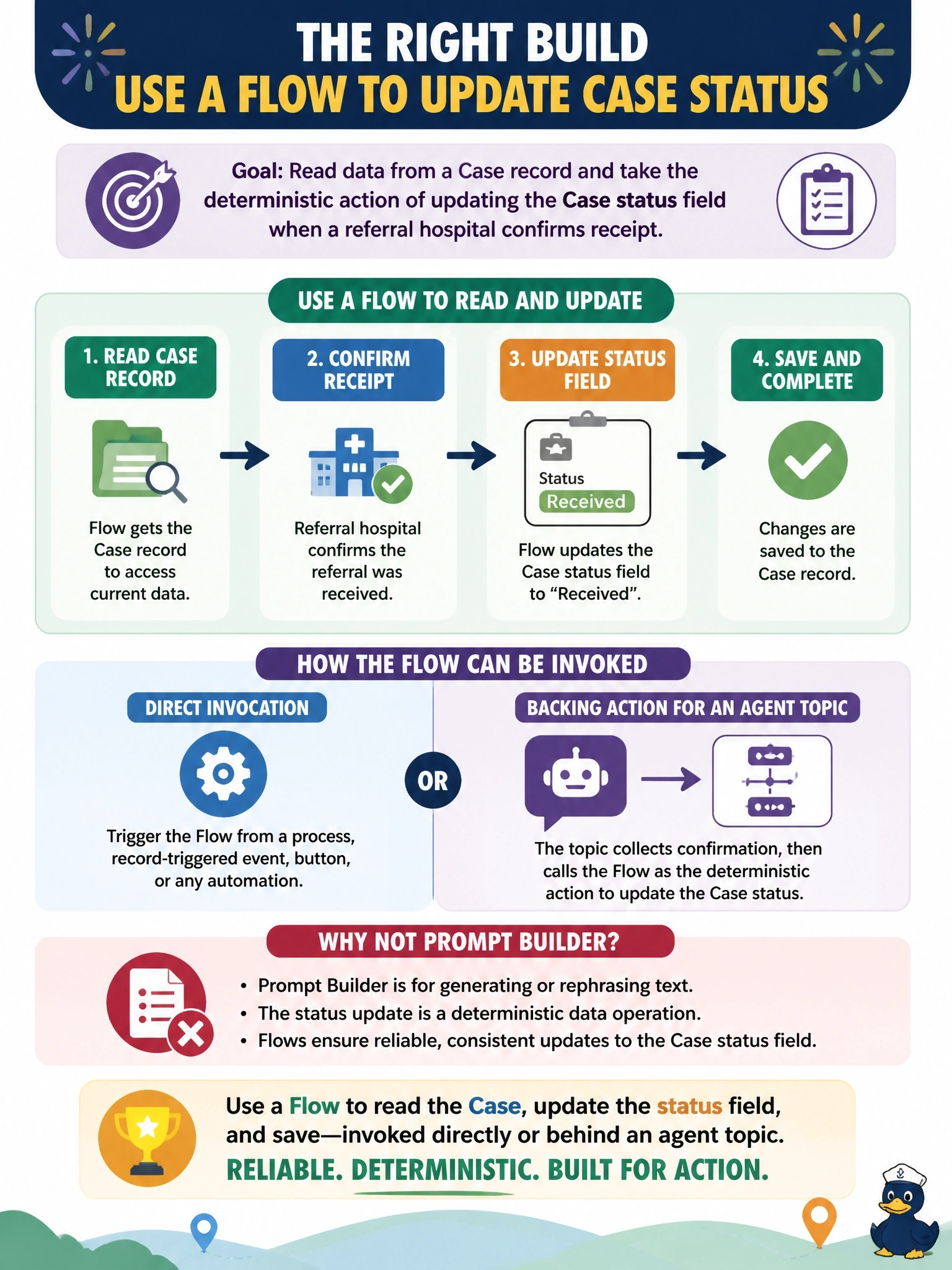
Short Explanation
Prompt Builder can help you generate text grounded in Case data, but it does not make deterministic field updates on its own. Use a Flow for the status change, either directly or as the backing action behind an agent topic.
Full Explanation
The correct approach separates reading and narrating Case data from committing a deterministic change: a Flow updates the status field, either when run directly or as the backing action behind an agent topic. A Prompt Builder template alone can generate text grounded in Case data, but its output does not itself perform record DML; it cannot directly write the determined value to the field. A record-summary prompt template is also for generating narrative text, not for database updates, and it has no write-back permission setting that makes it commit changes. An Einstein Trust Layer masking rule serves a different purpose: masking can hide sensitive values from being sent to or returned by the LLM, but it does not perform a status update. Exam caveat: an agent may invoke an action backed by automation, but that does not make the prompt template itself the update mechanism. For a practical check, confirm that the Flow has the Case record and sets its Status field to the required value when the receipt confirmation occurs. Remember the distinction: prompt templates and generative grounding produce language; Flows and actions built on them produce deterministic record changes.