
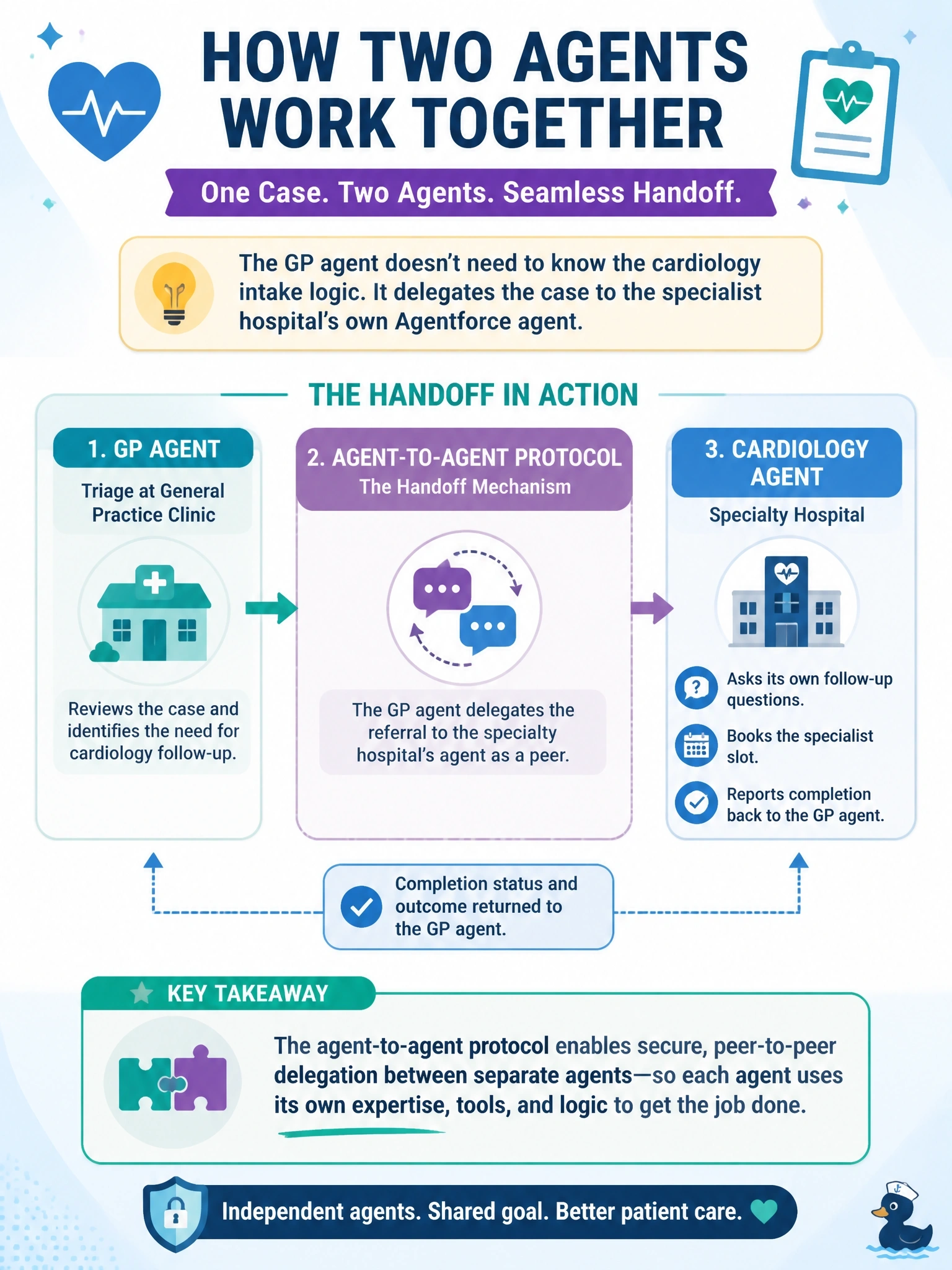
A general-practice clinic's Service agent triages a case that needs cardiology follow-up. Rather than teaching the GP agent all of the specialty hospital's cardiology intake logic, Meridian wants the GP agent to route the case to the specialty hospital's own Agentforce agent, which asks its own follow-up questions, books the specialist slot, and reports completion back. Which mechanism enables this hand-off between the two separate Agentforce agents?
Select an answer to reveal the explanation.
Short Explanation
This is one vet calling a specialist colleague instead of trying to learn cardiology overnight: the GP agent hands the case to another agent that already knows its own domain, and gets a report back. That peer-to-peer hand-off is exactly what the agent-to-agent protocol is for.
Full Explanation
The agent-to-agent protocol exists for exactly this pattern: one Agentforce agent delegating a task to a second, independently-reasoning Agentforce agent that owns its own topics, actions, and domain expertise, and receiving a result back once that agent completes its part. The GP agent does not need to understand cardiology intake logic; it only needs to hand off the referral and consume the outcome.
MCP is the closest-looking trap because it also describes agents exchanging context, but MCP is specifically for connecting an agent to external models and tools, not to another Agentforce agent acting as a full reasoning peer. The Agent API runs backwards for this scenario: it is how an external application calls into a deployed agent, not how two Salesforce-native agents collaborate with each other. A custom agent action backed by a Flow would force Meridian to duplicate and hand-maintain the specialty hospital's cardiology triage logic inside the GP agent's own Flow, defeating the point of reusing the specialty agent's own reasoning.
Exception to note: A2A is for collaboration between agents that each reason independently, which is the durable distinction to remember.