
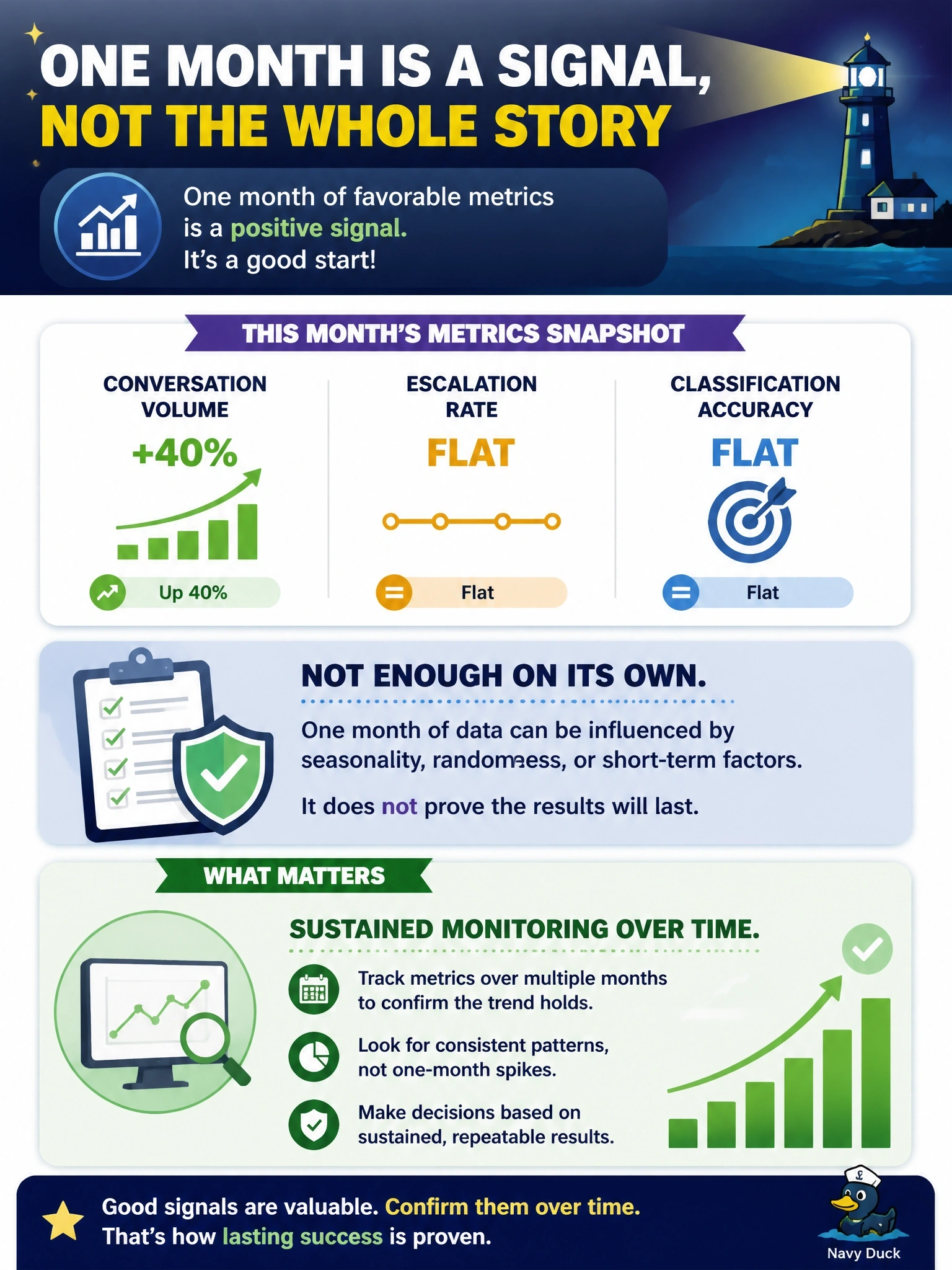
Cormorant Bay Veterinary Group's specialist is reviewing a month of adoption data and finds conversation volume up 40%, escalation rate flat, and classification accuracy flat. Leadership asks whether this month's data alone proves the agent is a success. What is the most defensible answer?
Select an answer to reveal the explanation.
Short Explanation
One good month is a data point, not a verdict. Rising volume with steady escalation and accuracy looks good, but it takes sustained tracking over time to know if that's the real trend or just a good few weeks.
Full Explanation
A single month showing rising volume alongside flat (not rising) escalation and flat classification accuracy is a genuinely positive signal — it means the agent is absorbing more conversations without a corresponding jump in cases it can't handle or a decline in routing correctness. But one month of data cannot confirm the pattern is durable; adoption monitoring exists precisely because production behavior needs to be tracked over time to distinguish a real, sustained trend from a temporary fluctuation that could reverse the following month. Declaring rising volume alone sufficient for success ignores that volume growth without stable resolution quality could just as easily represent a looming problem if escalation or accuracy start slipping later — volume by itself doesn't capture whether the agent is actually serving those conversations well. Insisting escalation must have dropped, not merely stayed flat, sets an arbitrary bar the scenario doesn't require — flat escalation while volume rises 40% is itself a meaningfully good outcome, since the agent absorbed more load without a worse escalation rate. And no single metric among conversation volume, escalation rate, and classification accuracy is 'the' determinant of success in isolation; they are read together, which is exactly why adoption dashboards track all three rather than any one on its own.