
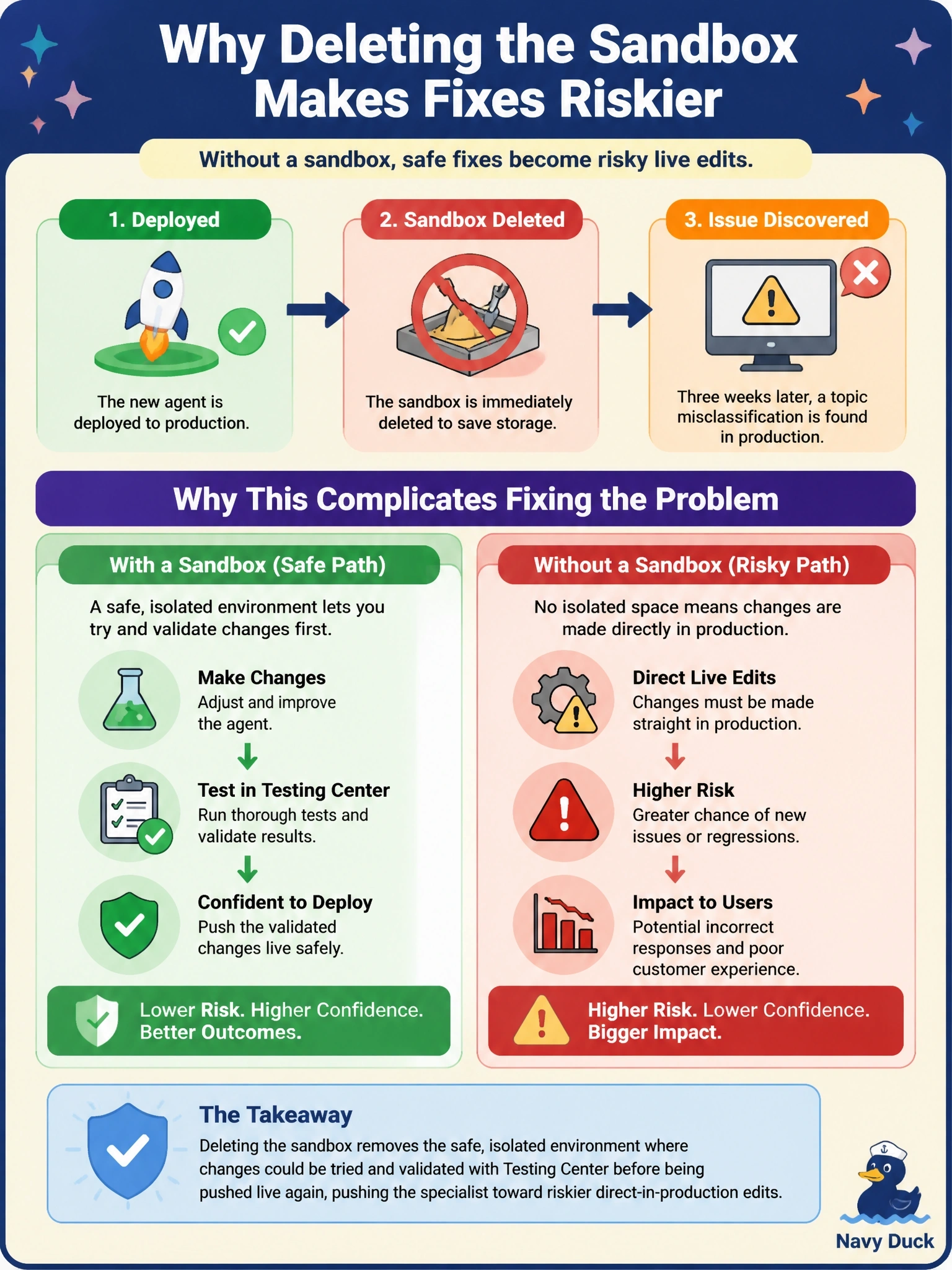
Sunnydale Veterinary Group deploys its new agent to production, then immediately deletes the sandbox where it was built and tested to save storage. Three weeks later a topic misclassification is discovered in production. Why does this decision complicate fixing the problem?
Select an answer to reveal the explanation.
Short Explanation
Deleting the sandbox after go-live is like tearing down the workshop the moment the product ships. The next time something breaks, there's nowhere safe left to tinker before touching the real thing again.
Full Explanation
The sandbox is the safe, isolated place where a fix can be built and validated with Testing Center before it ever reaches production again. Deleting it removes that safety net, so fixing the misclassification now either requires standing up a new sandbox and repopulating enough configuration to test properly, or editing directly in production without a validated staging step — a materially riskier path for a change touching real pet-owner conversations. Claiming fixes can always be made safely directly in production ignores the entire rationale for a sandbox-then-deploy lifecycle that this domain is built around. Testing Center is not production-only; it is commonly run against a sandbox specifically so validation happens before production is touched, which is the whole point of the environment. This is not scoped narrowly to Multi-Agent Interoperability — the value of a sandbox for safe iteration applies to any topic, action, or instruction change, including ordinary classification fixes like this one. The lesson: keeping a working lower environment available is part of sound lifecycle discipline, not an optional convenience.