
Hollowcreek Veterinary Group wants its Testing Center suite to catch cross-topic confusion before deployment, not just per-topic accuracy. Which practice best supports that goal?
Select an answer to reveal the explanation.
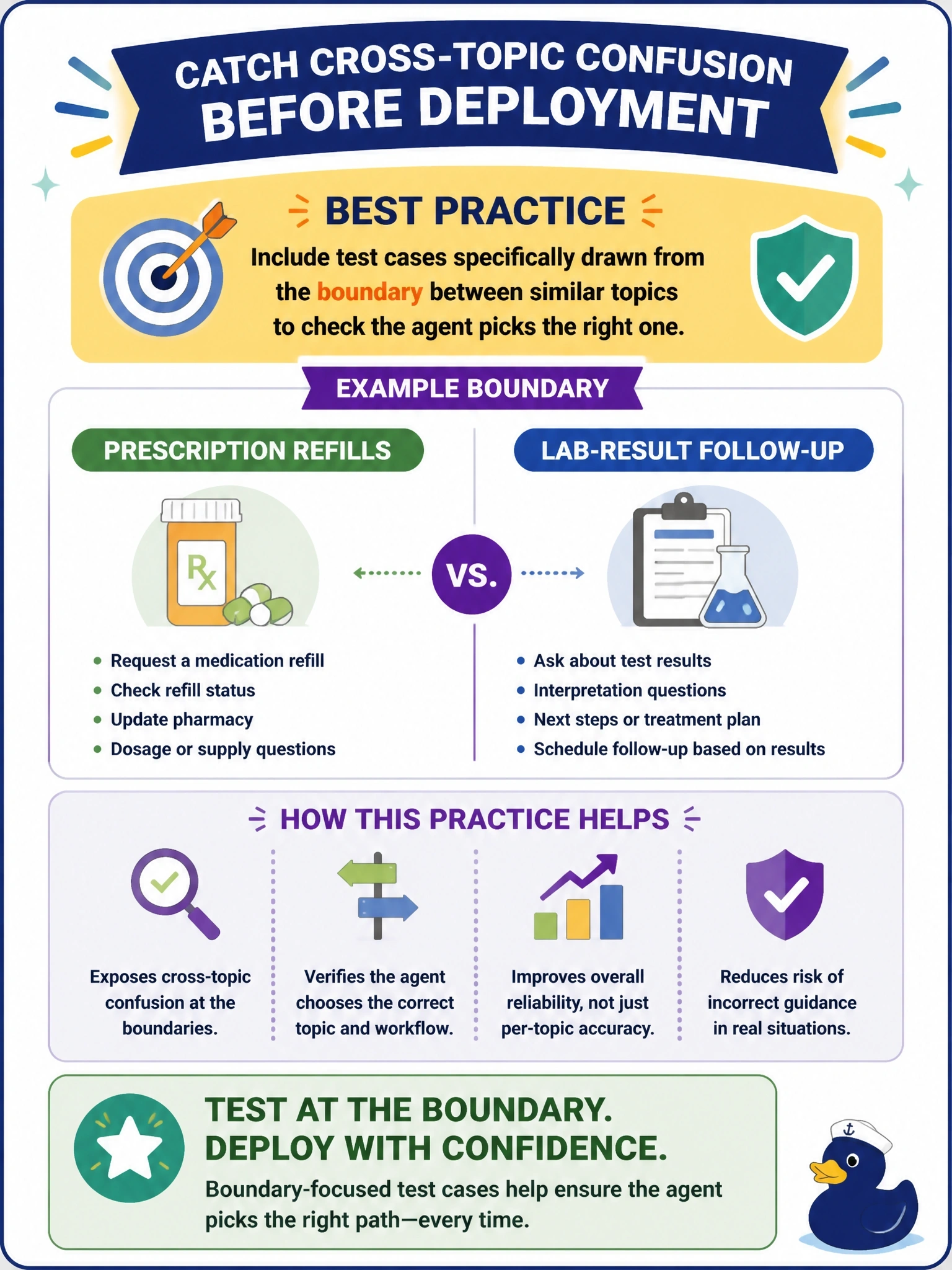
Short Explanation
Confusion always happens at the border, never in the middle of a topic. Deliberately writing test cases that sit right on the line between two similar topics is how you actually catch the agent tripping over that line.
Full Explanation
Cross-topic confusion is best caught by deliberately writing boundary test cases — utterances that plausibly straddle two similar topics, such as refill requests that mention symptoms that could also sound like a lab-result follow-up — and checking that the agent still lands on the correct one. This directly exercises the classification descriptions where confusion is most likely to occur. Writing test cases only within each topic in isolation guarantees you will never actually observe cross-topic confusion, since nothing in the suite ever probes the boundary where it happens. Reducing the number of topics to make confusion 'impossible' sacrifices real functionality the agent needs to serve owners and does not actually test anything; it avoids the problem rather than validating against it. The Einstein Trust Layer's toxicity detection is about harmful or inappropriate content, not about whether the reasoning engine picked the correct topic — it has no mechanism for flagging misrouting. The durable exam takeaway: strong test coverage deliberately targets the seams between similar topics, not just each topic's easy center.