
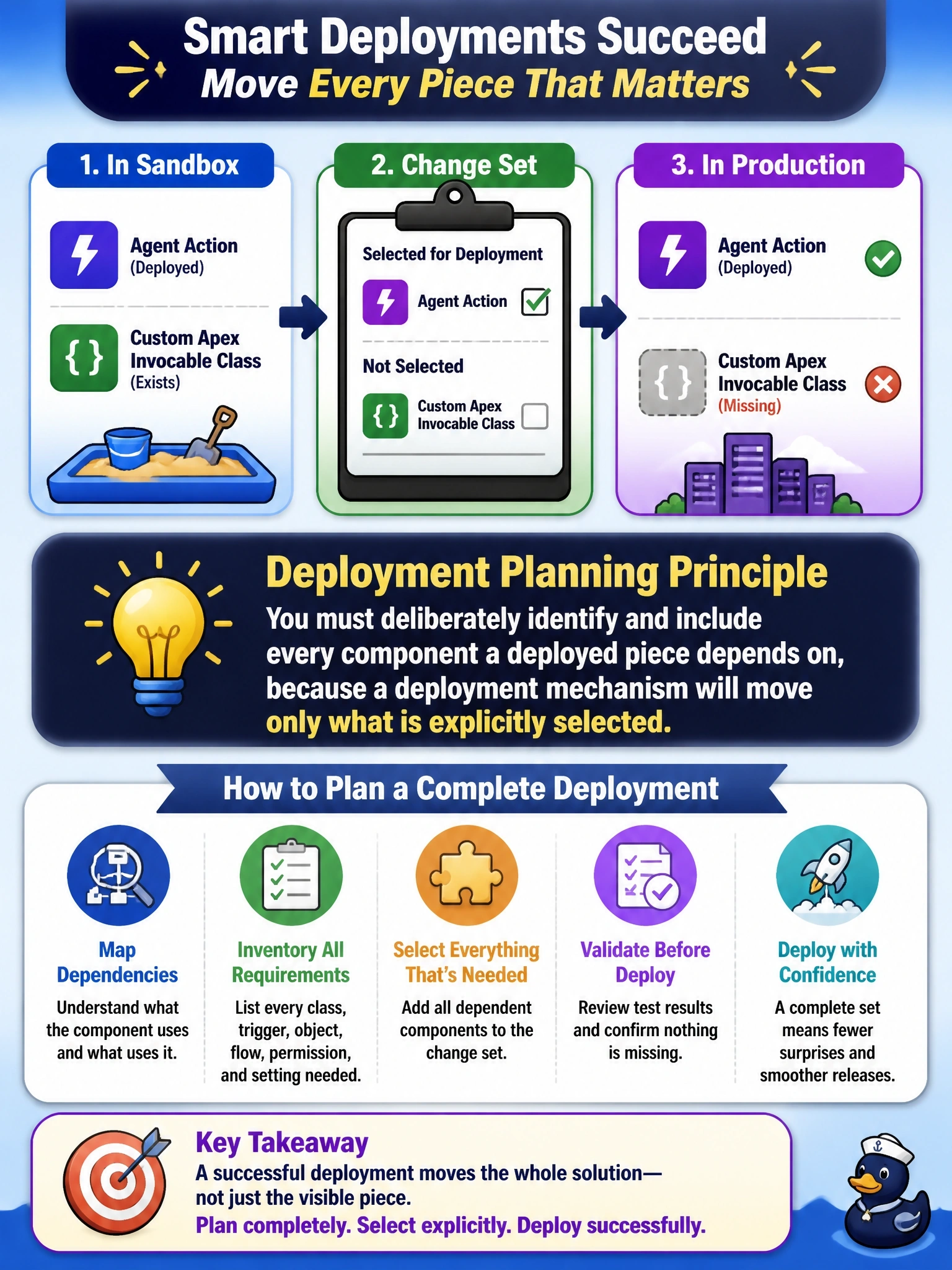
Silverpine Veterinary Group deploys a new agent action from sandbox to production using a change set. After deployment, the specialist finds the action itself deployed but its underlying custom Apex invocable class did not come along, because it was excluded from the change set. What does this best illustrate about deployment planning?
Select an answer to reveal the explanation.
Short Explanation
A change set doesn't read your mind. It moves exactly what you check the box for, so leaving the Apex class unchecked is like packing the suitcase but forgetting the passport, the trip stalls at the border.
Full Explanation
This illustrates a core deployment-planning lesson: deployment mechanisms like change sets move only the components explicitly included, so the specialist is responsible for identifying every dependency a deployed component relies on — here, the Apex invocable class the action calls — and including it, or the action will exist in production but be non-functional. Change sets do not auto-include every dependency; they require the specialist to add each metadata component deliberately, which is exactly why the class was left behind when it was excluded. Apex invocable classes backing an action are not optional; an agent action configured to call one depends on that class existing and being correctly deployed, or invoking the action will fail. There is no rule that actions backed by Apex invocable classes categorically cannot be deployed via change sets — Apex classes are a standard deployable metadata type; the failure here was an incomplete selection, not a platform restriction. The exam expects specialists to treat dependency mapping as a deliberate deployment-planning step, not an assumption.