
Two weeks after Summit Ridge Veterinary Group's Service agent went live for pet-owner appointment questions, the specialist wants to know whether it is actually helping or quietly frustrating owners. What should the specialist look at to answer that?
Select an answer to reveal the explanation.
Short Explanation
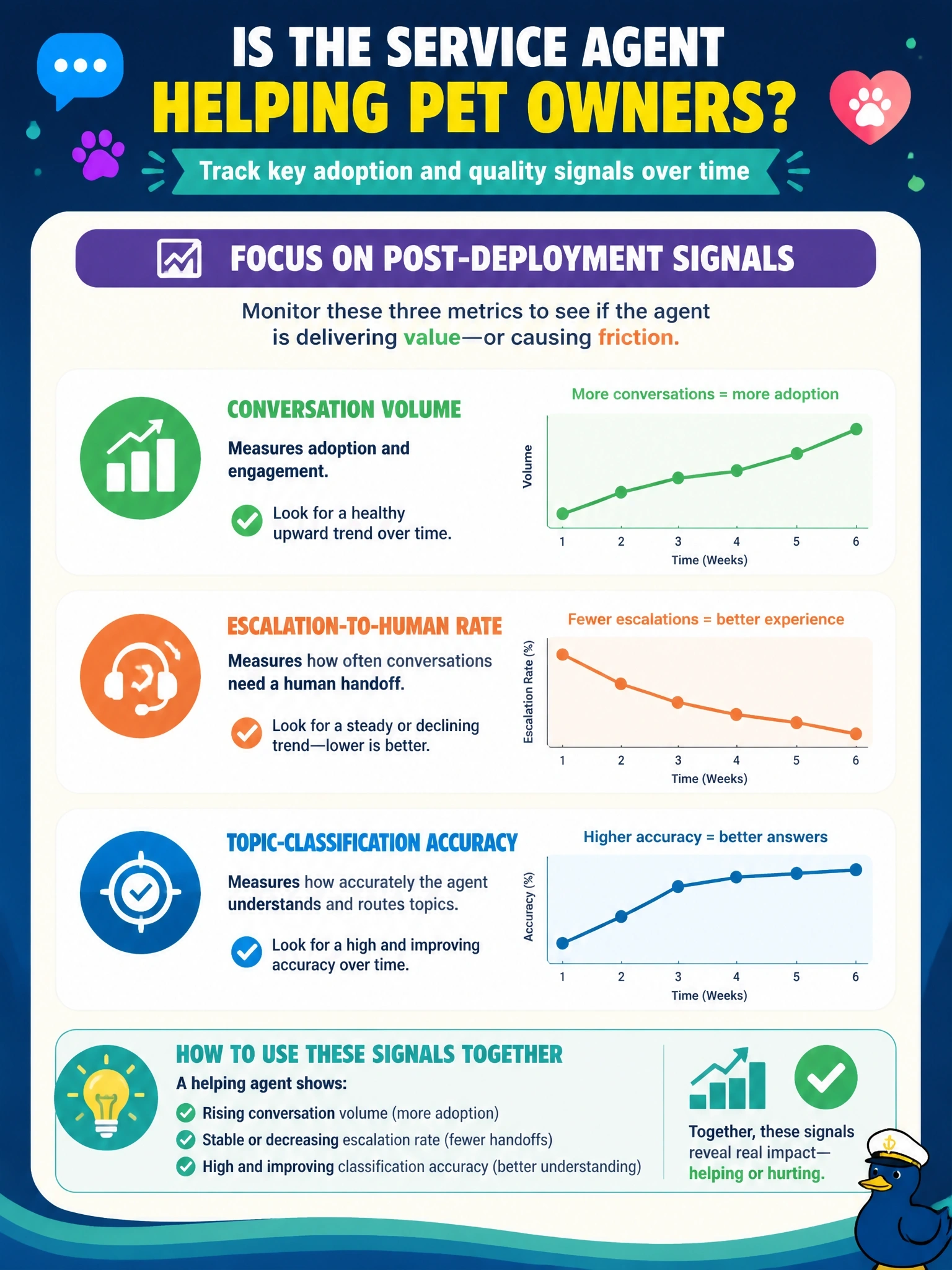
Shipping an agent isn't the finish line, it's the starting gun. Watching how often owners get bounced to a human, and whether the agent is still classifying correctly at scale, tells you if it's actually working in the wild.
Full Explanation
Managing and monitoring adoption after go-live means tracking real usage and quality signals: how much conversation volume the agent is handling, how often it has to escalate to a human agent (a proxy for where it is falling short), and whether topic classification accuracy holds up under real, messier production traffic compared to the controlled Testing Center environment. These are the signals that tell Summit Ridge whether owners are being helped or quietly getting stuck. The number of custom actions configured says nothing about whether owners are succeeding with the agent — more actions can just as easily mean more surface area for confusion. The certification's official passing score is exam-program trivia entirely unrelated to whether a deployed agent is performing well for real users. Counting Apex classes referenced by actions is an implementation detail with no bearing on user-facing adoption or quality, and the exam explicitly keeps Apex authoring/debugging depth out of scope for this credential. The durable takeaway: post-deployment monitoring is about usage and quality signals, not configuration counts.