
Oakhaven Veterinary Group notices its live prescription-refill agent has a rising escalation-to-human rate over the past month, even though its Testing Center pass rate is still 100%. What does this gap most likely indicate?
Select an answer to reveal the explanation.
Short Explanation
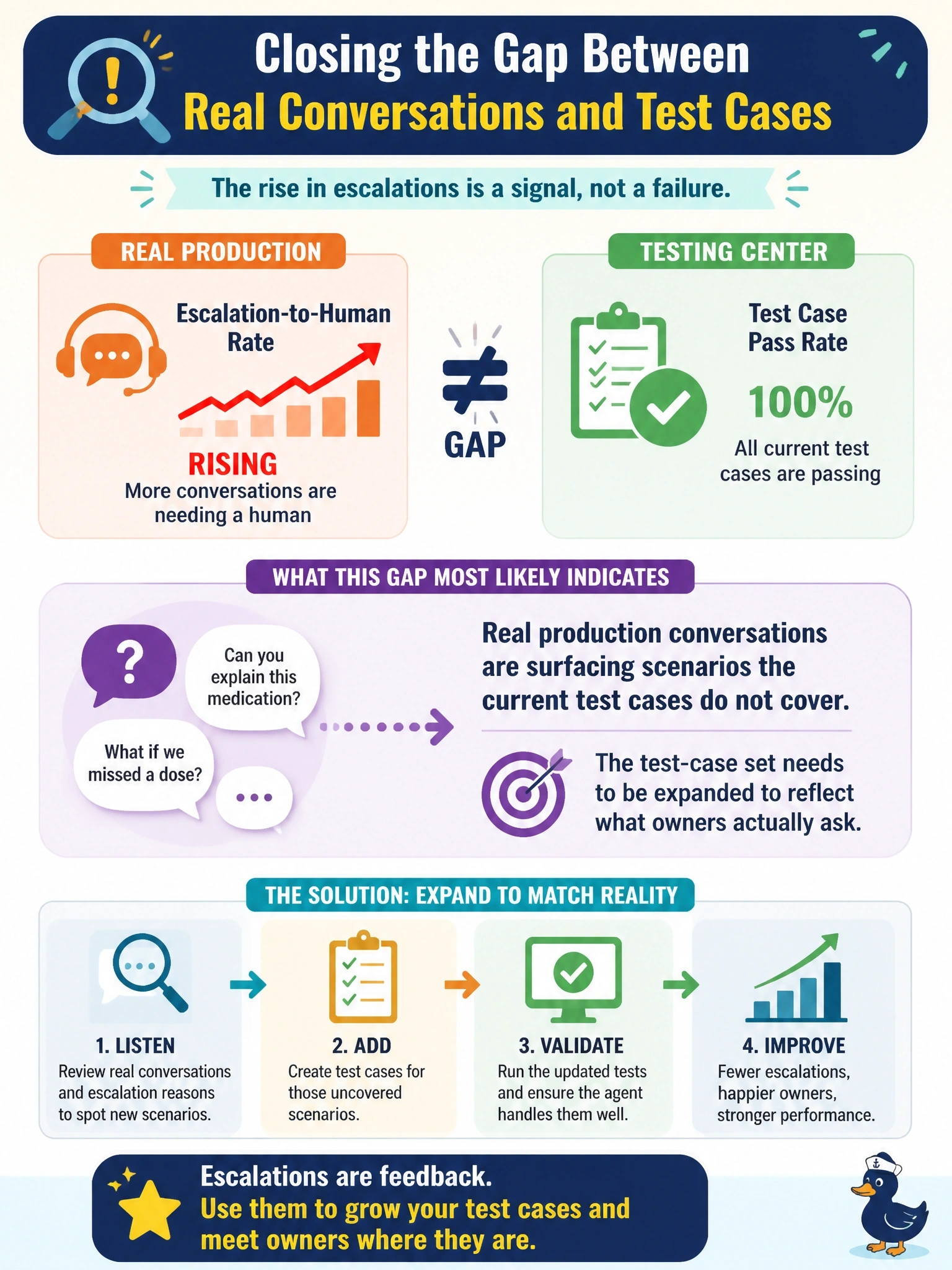
A perfect grade on a practice test that doesn't match the real exam tells you nothing. Rising escalations mean owners are asking things the test cases never imagined, so it's time to go widen the test deck with what's actually happening live.
Full Explanation
A 100% Testing Center pass rate only proves the agent handles the scenarios someone thought to write test cases for. A rising escalation-to-human rate in live production is strong evidence that real owner conversations include phrasing, edge cases, or request types the current test-case set does not cover, so the fix is to mine live escalations for new patterns and expand the test cases to reflect them, then re-test and refine. Testing Center results do not expire on a 30-day timer that needs manual resetting; that is not how the tool works. Escalation to a human is not inherently a bug — it is a designed, often desirable safety valve, especially in a clinical-adjacent context like prescription refills where controlled-substance holds or ambiguous cases should reach a person. Blaming the Einstein Trust Layer specifically is unsupported here; escalation rate is a topic-classification and coverage signal, not evidence of a masking or toxicity-detection misconfiguration. The lifecycle lesson: adoption monitoring feeds back into testing, closing the loop between what was tested and what real owners actually do.