
During deployment of Northgate Veterinary Group's claims-status agent from sandbox to production, the specialist wants to make sure owner-facing data stays protected and the Agent User only sees what it should in the live org. What is the most important check to perform as part of that deployment?
Select an answer to reveal the explanation.
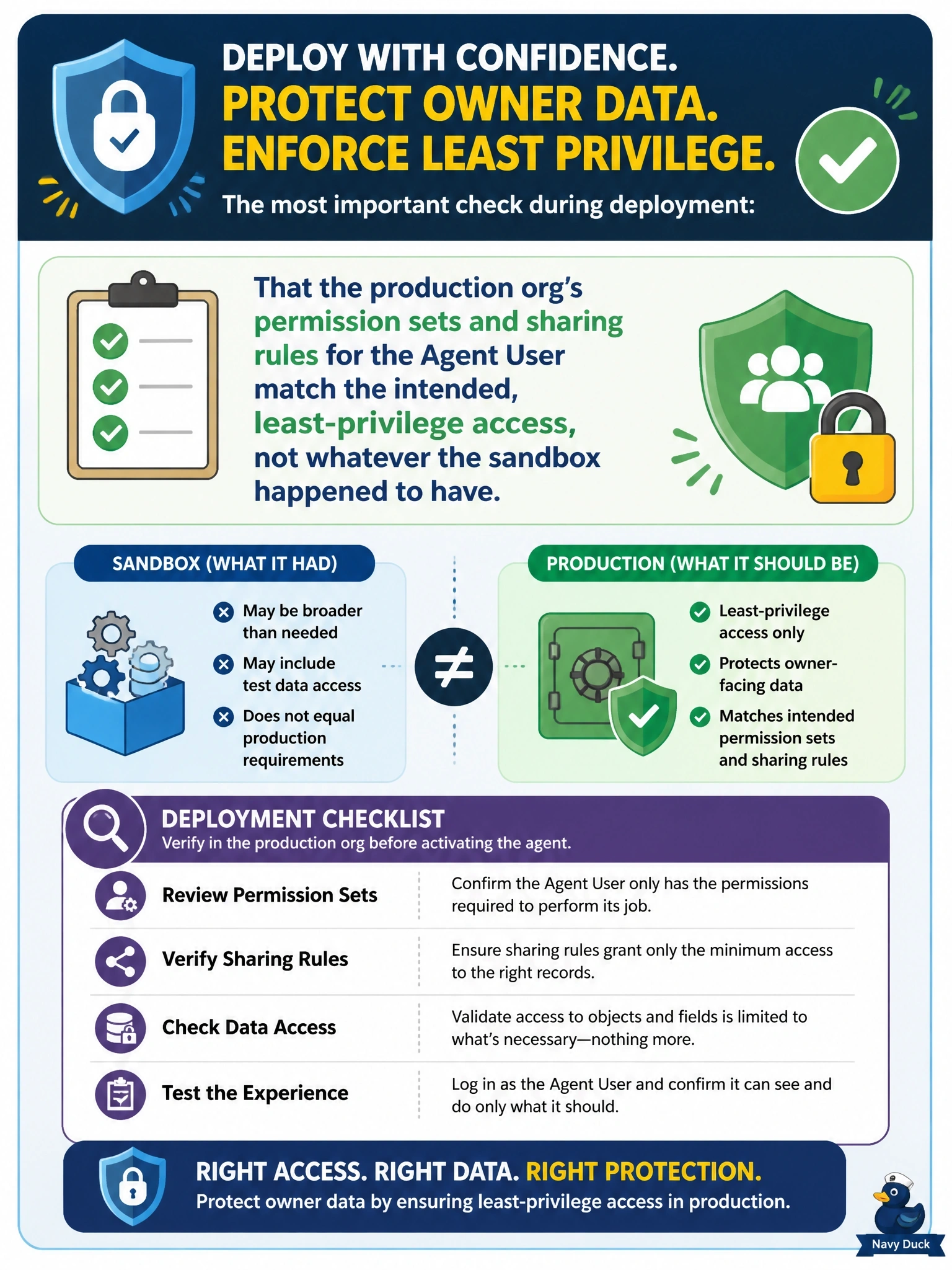
Short Explanation
Sandbox data and access are often looser than production for convenience. Carrying that laxness across the deployment line is how an agent ends up seeing more owner data than it should — so re-verify permissions and sharing on the production side specifically.
Full Explanation
Data integrity and security on deployment hinge on verifying that the Agent User's permission sets and the sharing model in production actually reflect the intended, least-privilege configuration — not simply whatever existed in the sandbox, which is frequently more permissive for testing convenience. Confirming this prevents the agent from being able to see or act on more owner, patient, or claims data than it should once it is handling real production data. Matching human user passwords across orgs is unrelated to agent deployment integrity and is not how Salesforce authentication or deployment works. Matching the agent's display name is a cosmetic detail with no bearing on data protection or correct function. Disabling the Einstein Trust Layer in production would remove masking, toxicity detection, and audit-trail protections precisely where real pet-owner PII is at stake, which is the opposite of a sound deployment practice and directly undermines the goal of protecting owner-facing data. The exam expects specialists to treat permissions and data integrity, not cosmetic parity, as the deployment-time priority.