
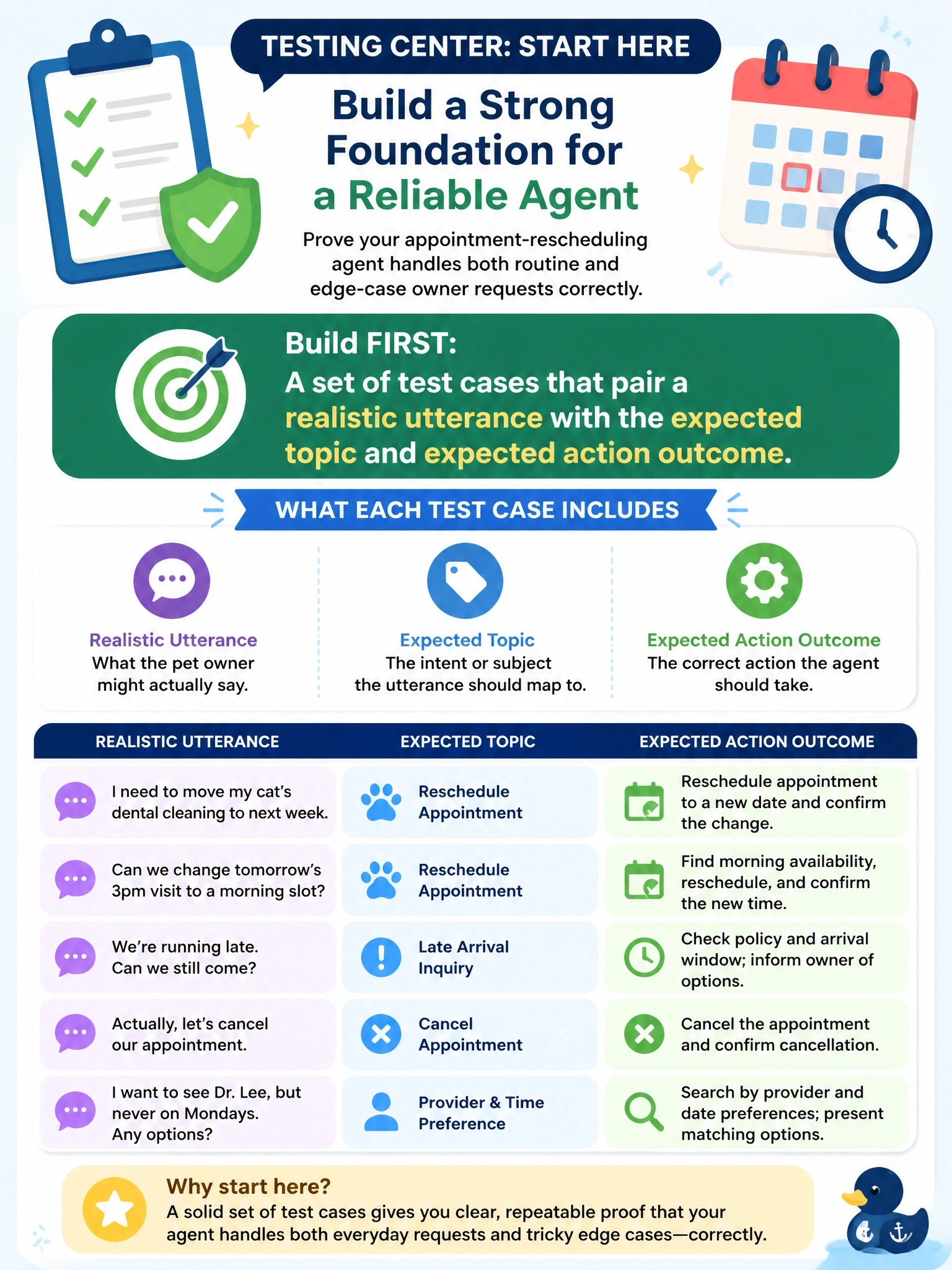
Before Willowbrook Veterinary Group's new appointment-rescheduling agent goes live, the specialist wants structured proof it handles both routine and edge-case owner requests correctly. What should the specialist build first in Testing Center?
Select an answer to reveal the explanation.
Short Explanation
Testing Center works like a syllabus of practice questions before the real exam: you write out the utterance and what the right answer should be, then run it and see who got it wrong. Skipping that and shipping straight to prod is studying by taking the real test cold.
Full Explanation
Testing Center is built around test cases: a realistic pet-owner utterance paired with the expected topic classification and expected action/outcome, so the specialist has a repeatable, structured way to know whether the agent is behaving correctly before real owners rely on it. Building test cases first is the standard, deliberate lifecycle step for validating agent behavior. Building a Flow that reschedules every appointment without agent involvement solves a different problem entirely and skips the point of validating the agent's reasoning and topic selection altogether. Granting the Agent User broad modify-all-data permissions is a security anti-pattern that masks failures rather than catching them, and it is unrelated to how testing actually proves correctness. Pushing straight to production via a change set for live feedback abandons controlled validation in favor of using real pet owners as testers, which risks visible failures, incorrect appointment changes, and a poor experience for the exact population the agent is meant to serve. The disciplined path is always write test cases, run them, review results, iterate, and only then consider deployment readiness.