
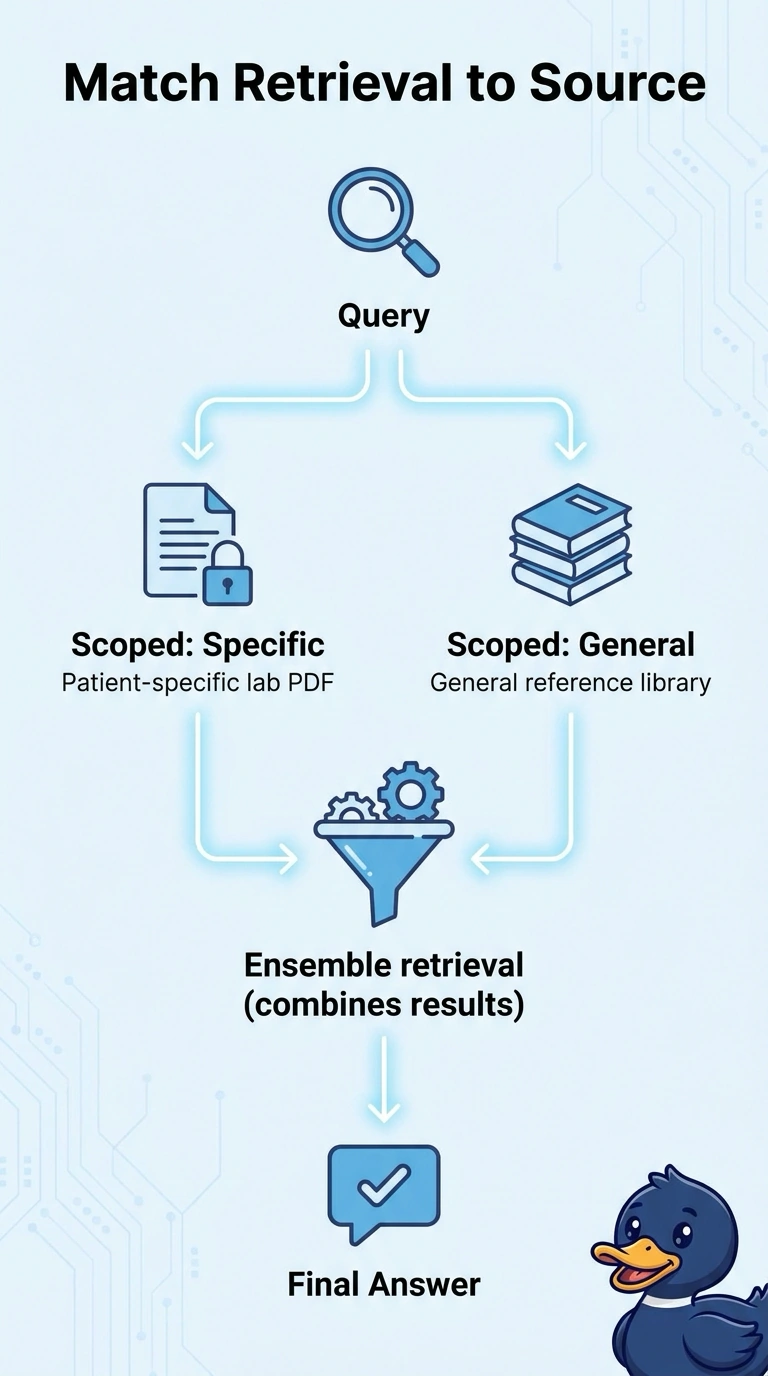
A Ridgeline specialty hospital's agent must accurately answer both 'What were Bella's latest bloodwork values?' (from a specific uploaded lab PDF) and 'What does a slightly elevated ALT typically indicate in the reference guide?' (from a general lab-guidelines library). What combination of Data 360 configuration best supports both questions well?
Select an answer to reveal the explanation.
Short Explanation
Two different questions, two different shelves — scope retrievers to the right sources, pick the search type that fits each query's style, and combine them with an ensemble if one question might need both.
Full Explanation
This capstone scenario needs retrievers scoped appropriately to each relevant source — one reaching the patient-specific lab PDF for Bella's actual values, another reaching the general lab-guidelines library for the reference-level ALT explanation — with search type chosen to fit each query's phrasing (likely keyword or hybrid for the specific values, vector or hybrid for the more conceptual reference question), and these could reasonably be combined into an ensemble retriever if a single agent action needs to draw on both at once. A single keyword-only retriever pointed at everything combined ignores the value of scoping and search-type selection, likely returning a messier, less precise result for a case that clearly benefits from targeted retrieval per source. Dumping the entire reference library into every prompt via a merge field is neither how grounding is meant to work nor efficient — it bypasses chunking, indexing and relevance ranking, and would include enormous amounts of irrelevant text on every single interaction regardless of what was actually asked. Claiming no Data 360 configuration is needed ignores that neither Bella's specific, current lab values nor Ridgeline's exact reference-guide wording exist anywhere in the LLM's general pretrained knowledge — both require grounding to be answered accurately. This question intentionally pulls together source scoping, search-type selection, and ensemble retrieval — the core toolkit for this domain.