
A Ridgeline mobile app surfaces agent answers to pet owners waiting in the exam room, where response speed matters. All else being equal, what is a reasonable consideration when deciding whether to add an ensemble retriever spanning several large sources versus a single, well-scoped retriever?
Select an answer to reveal the explanation.
Short Explanation
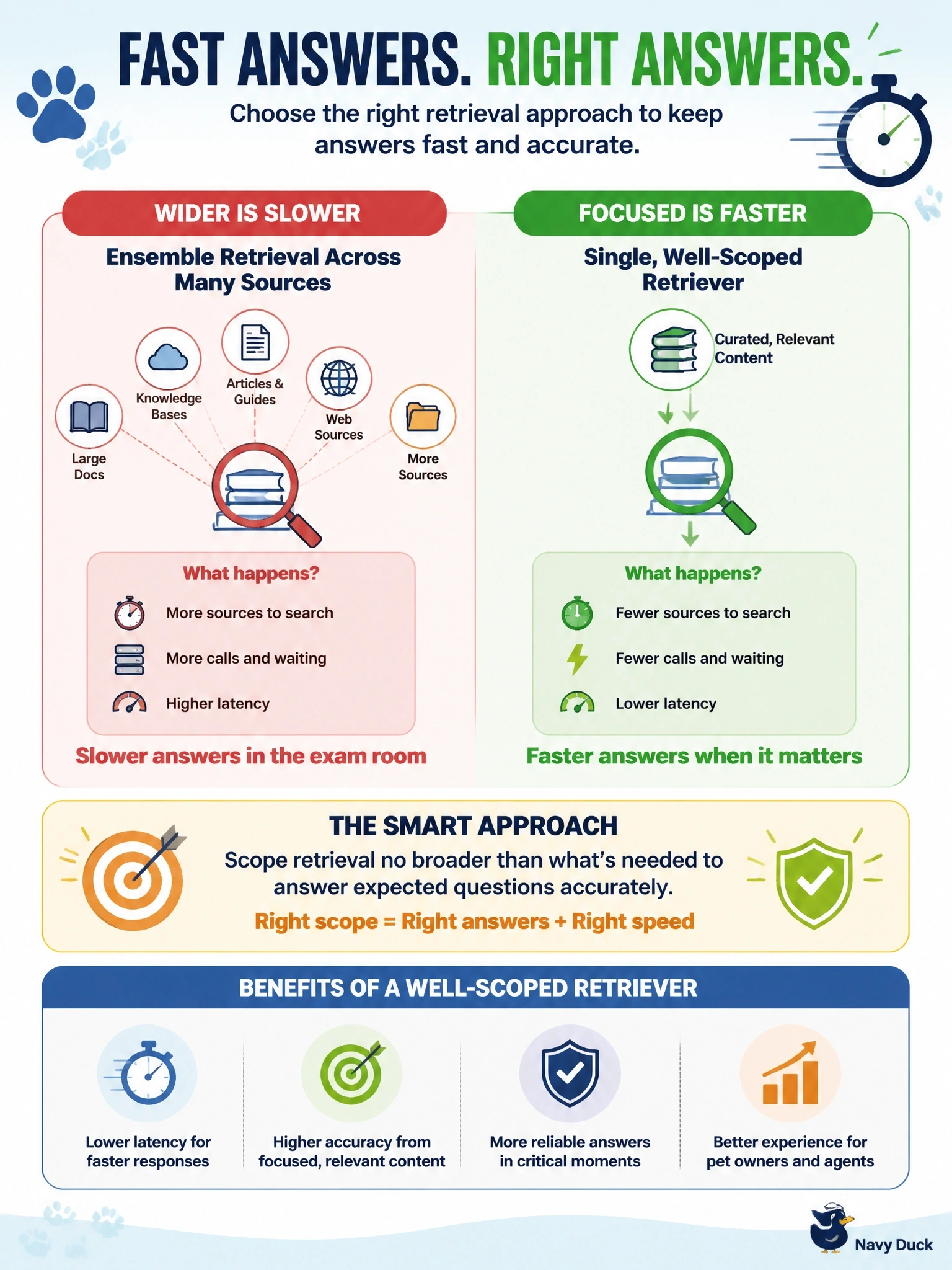
Querying more, larger sources at once is more work than querying one well-chosen source — worth keeping in mind for a use case where the owner is standing in the exam room waiting on an answer.
Full Explanation
Querying more sources generally means more retrieval work happening before a response can be generated, so it's reasonable to expect that an ensemble retriever spanning several large sources could add latency compared to a single, well-scoped retriever — a real consideration for a time-sensitive context like an owner waiting in the exam room. Claiming response speed is entirely unaffected by source count ignores this basic relationship between retrieval scope and processing time. It's also backwards to assert ensemble retrievers are always faster regardless of source count — combining more retrievers to query is additional work, not less, so that claim inverts the likely trade-off. And the number of sources queried is very much related to grounding accuracy — that's the whole reason ensemble retrieval exists, to potentially improve accuracy by covering more relevant content, which is precisely why it's a trade-off worth weighing rather than a free win. For the exam, hold onto this as a case where more retrieval breadth is generally traded for less speed, so scope should match the actual expected use case, not be maximized by default.