
Vets at the group want to ask "what was Bella's last recorded weight" from Slack during rounds, without opening Salesforce. A specialist connects the internal agent to a Slack channel used only by clinical staff. What is an important consideration specific to deploying an agent into Slack?
Select an answer to reveal the explanation.
Short Explanation
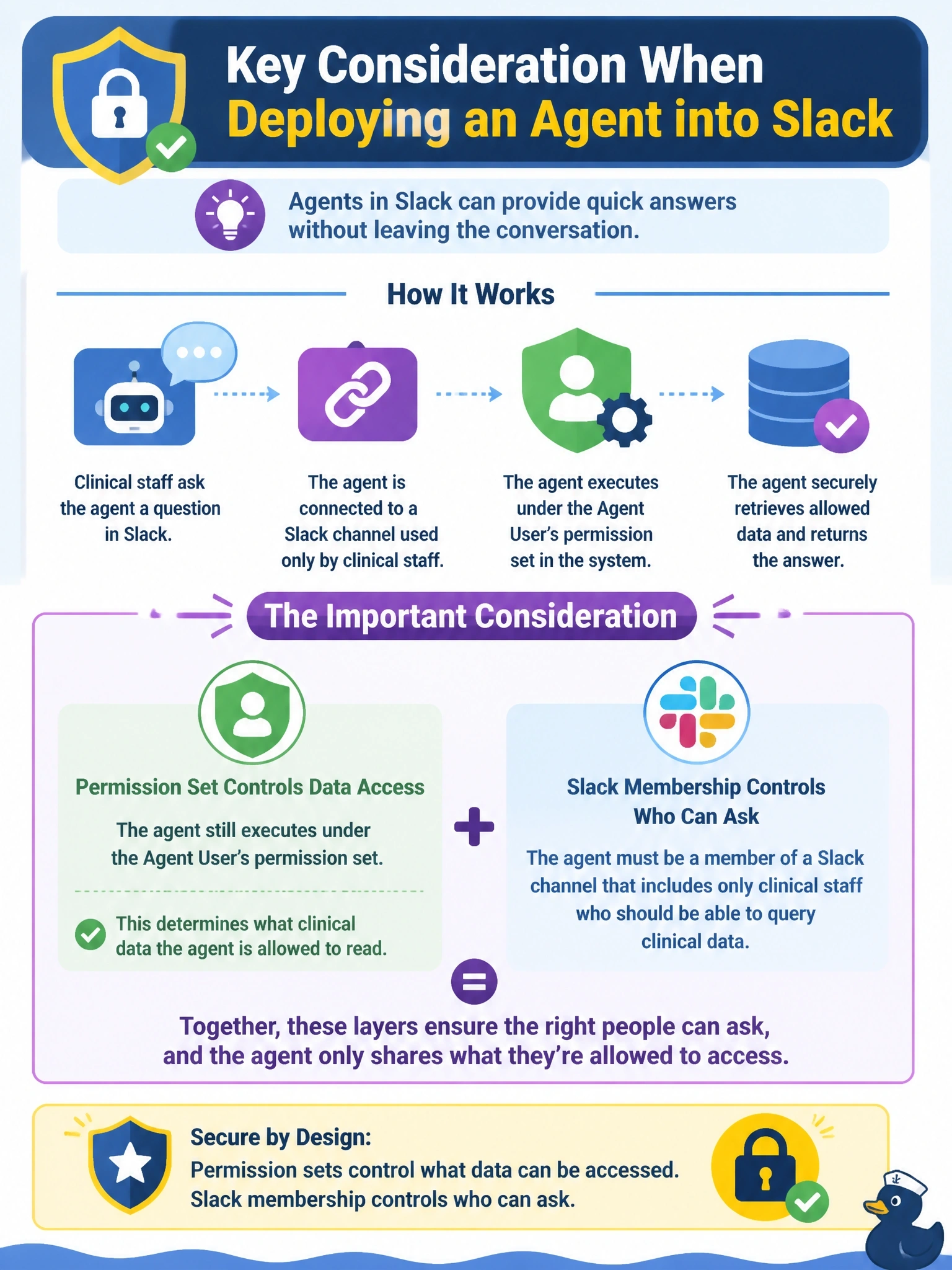
Slack doesn't change who the agent is on the inside. It's still running as the Agent User, so the real control is who you let into that Slack channel in the first place.
Full Explanation
Connecting an agent to Slack is a channel configuration, and the agent still operates under its Agent User's permission set for data access regardless of which channel carried the message, so the specialist's real lever for restricting exposure is limiting Slack channel membership to the clinical staff who should be able to ask these questions, alongside the usual data-layer controls. Claiming Slack removes the need for an Agent User is wrong: every agent action still executes as some user, and Slack authentication governs who can post into the channel, not what the agent's actions are permitted to touch inside Salesforce. Topics and actions built for one channel are largely channel-agnostic configuration; connecting a channel is an additional deployment step, not a rebuild, so claiming total rewrite is required overstates the effort involved. Guardrails are topic-level behavioural constraints that apply to the agent's reasoning regardless of the channel carrying the conversation; nothing about using Slack instead of a web widget suspends them, and believing otherwise would mean channel choice silently disables safety configuration, which is not how the platform works.