
For controlled-substance refill requests, a specialist is deciding between two designs: (A) a topic instruction that says "never approve a refill for a controlled substance without staff review," or (B) a filter that excludes controlled-substance medications from the refill action's eligible record set unless a staff-override flag is set. Which design actually guarantees the restriction holds?
Select an answer to reveal the explanation.
Short Explanation
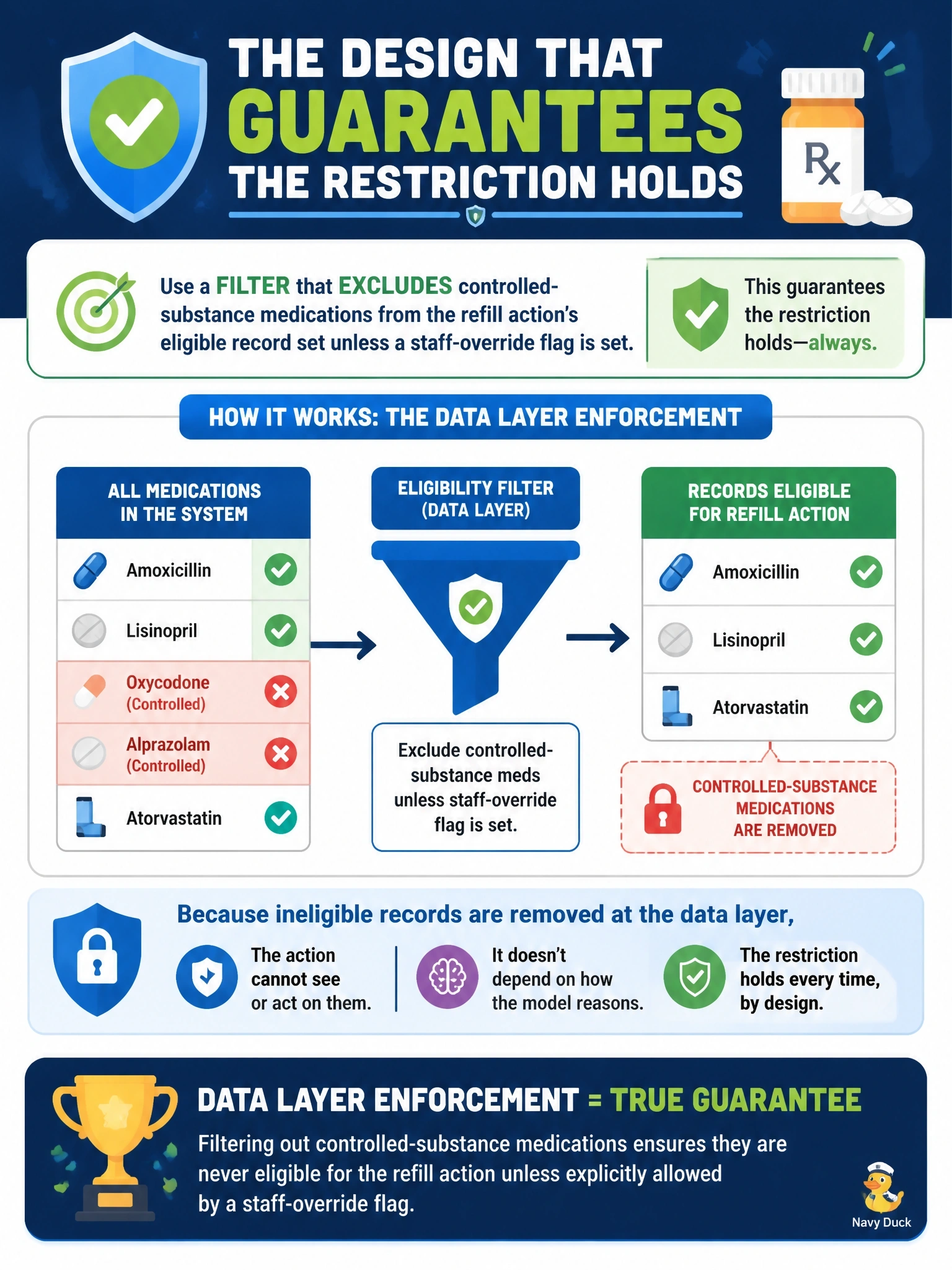
You can think of an instruction as guidance the model tries to follow, while a filter constrains the data the action can reach. For a controlled-substance refill, a data-layer restriction leaves no eligible record for the model to approve without the required staff override.
Full Explanation
A filter that excludes controlled-substance records from the refill action’s eligible set unless a staff-override flag is present enforces the boundary at the data layer: the action cannot access those records for automatic approval, regardless of how the model reasons. A topic instruction to require staff review is genuine guardrail configuration and meaningfully reduces risk, but it is language-layer guidance that the reasoning engine applies probabilistically; ambiguous phrasing or an edge-case request can still lead to the wrong outcome, so it does not guarantee the restriction. Treating the instruction and the filter as equally reliable overlooks that difference. Requiring a custom Apex trigger on the Prescription object overshoots the objective: the expected solution uses declarative tools already available in Agentforce, and custom Apex moves into Platform Developer territory that is out of scope. The exam caveat is that instructions still have value as guidance, but they are not equivalent to an enforced data boundary when a scenario requires a guarantee. As a practical check, verify that controlled-substance records are absent from the action’s eligible set unless the staff-override flag is set; then the action cannot act on them without that exception.