
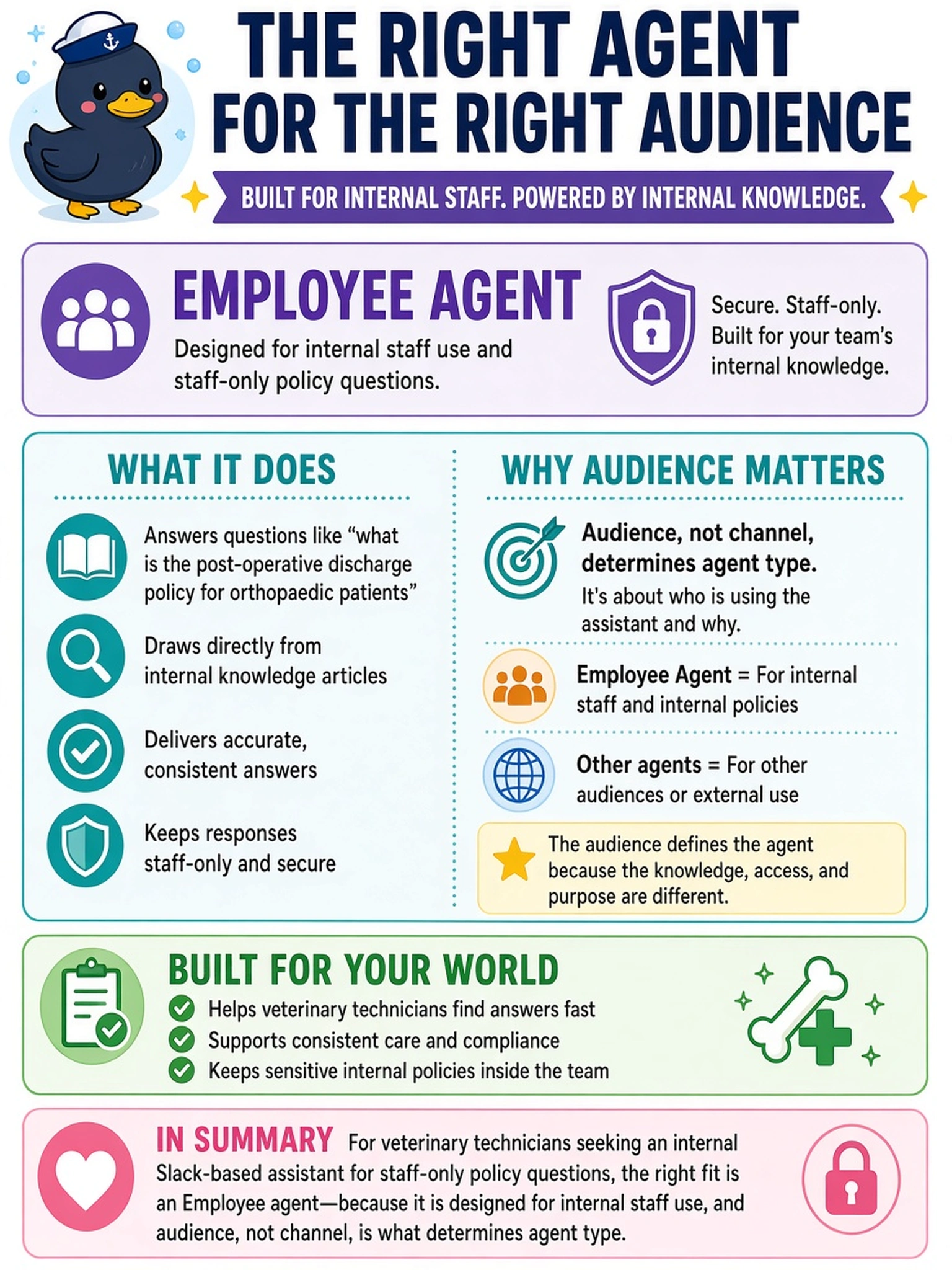
Veterinary technicians want an internal Slack-based assistant that answers "what is the post-operative discharge policy for orthopaedic patients" and similar staff-only policy questions, drawing on internal knowledge articles. Which agent type is the right fit, and why does the audience matter here?
Select an answer to reveal the explanation.
Short Explanation
Slack being the channel tells you nothing about who's on the other end. It's the technician asking about internal policy, not a pet owner, that puts this squarely in Employee agent territory.
Full Explanation
An Employee agent is designed for exactly this situation: internal staff, here veterinary technicians, seeking help with internal knowledge such as clinical or operational policy, delivered through a workplace channel like Slack. The determining factor is audience and intent, staff seeking internal information, not the channel Slack happens to be a valid deployment surface for multiple agent types, which is exactly why it cannot be used to decide the type on its own. Calling this a Service agent because Slack supports customer service undersells what audience means for agent type selection; a Service agent's design centre is external customers, and using it for an internal-only staff tool misapplies the wrong security and interaction model. Framing this as a Sales agent because it saves staff time confuses agent type with a generic productivity benefit; virtually every well-configured agent saves someone time, but that is not what distinguishes Sales agents, whose defining trait is orientation around pipeline and revenue activity, absent here. Saying either type works equally well ignores that agent type shapes default topics, standard actions, and the security model presented to the audience, so picking the wrong type is a real configuration error even if the channel technically connects either way.