
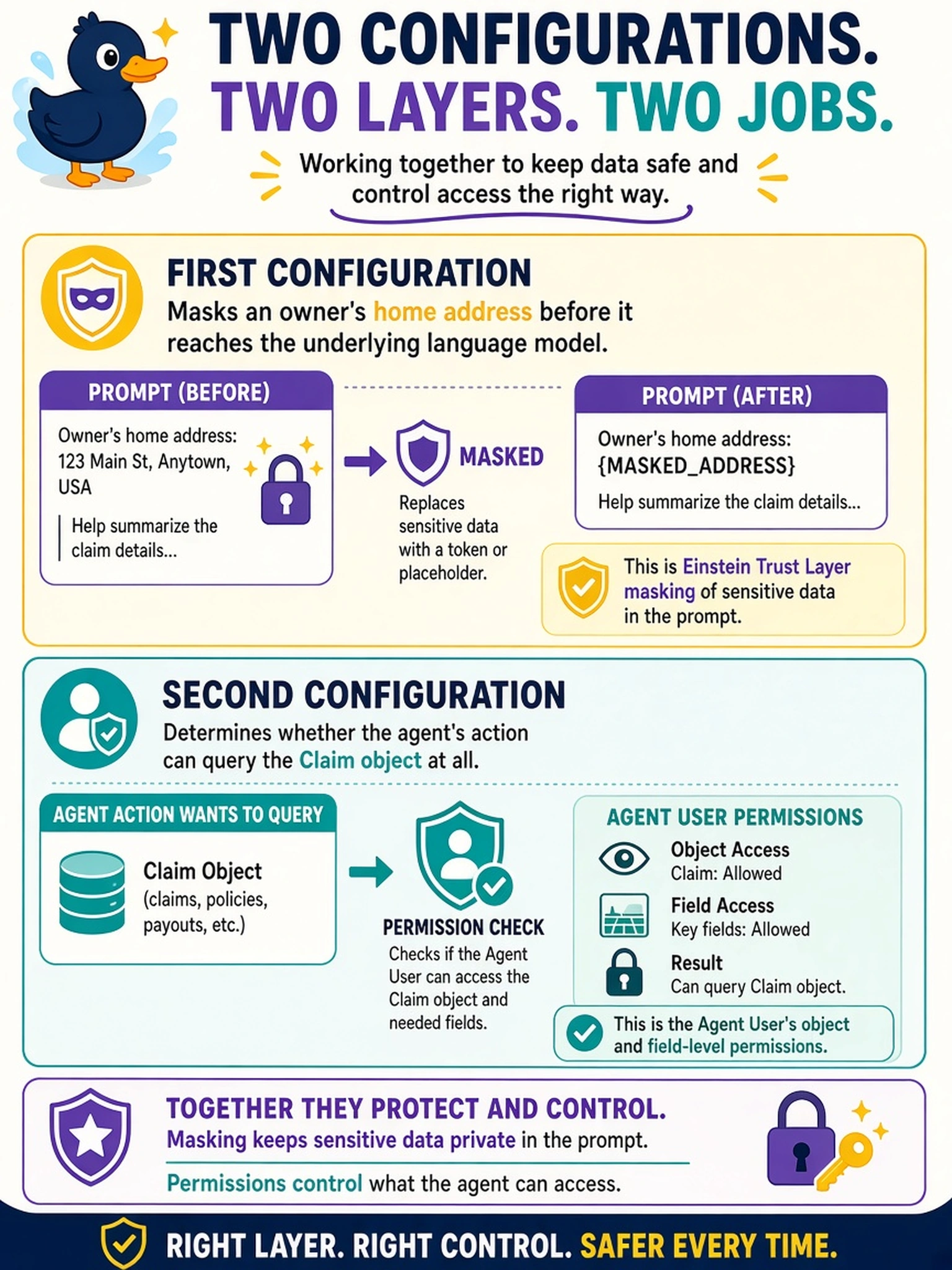
A specialist is reviewing two separate configurations: one masks an owner's home address before it reaches the underlying language model, and another determines whether the agent's action can query the Claim object at all. Which pairing correctly matches each configuration to its layer?
Select an answer to reveal the explanation.
Short Explanation
One of these two decides what the model is even allowed to type into its own reasoning; the other decides what the agent is allowed to look up in the first place. Mixing them up is like confusing the redacted document with the locked filing cabinet it came out of.
Full Explanation
These are two distinct, complementary layers and the exam expects you to keep them separate. The Einstein Trust Layer sits between the agent and the underlying large language model, masking sensitive data like a home address before it is sent to the model and can unmask it again in the trusted response path, alongside toxicity detection and an audit trail; it protects what the model itself is exposed to. The Agent User's object and field-level permissions determine, at the Salesforce data layer, whether an action can query a given object such as Claim at all, entirely independent of what happens afterward with masking. A record the Agent User cannot see never reaches the model in the first place, masked or not, so permissions are the first gate and masking is a second, separate protection applied to data that did pass through. Treating them as the same mechanism, in either direction, is the trap this item is built on: an org can have perfect masking and still leak data through over-broad permissions, and it can have tight permissions but still send unmasked sensitive fields to the model on data it legitimately can see. Knowing which control lives where is what separates a specialist from someone guessing at security theatre.