
An agent action updates a prescription record. What is the recommended way to reduce the risk that the agent performs the update on the wrong prescription?
Select an answer to reveal the explanation.
Short Explanation
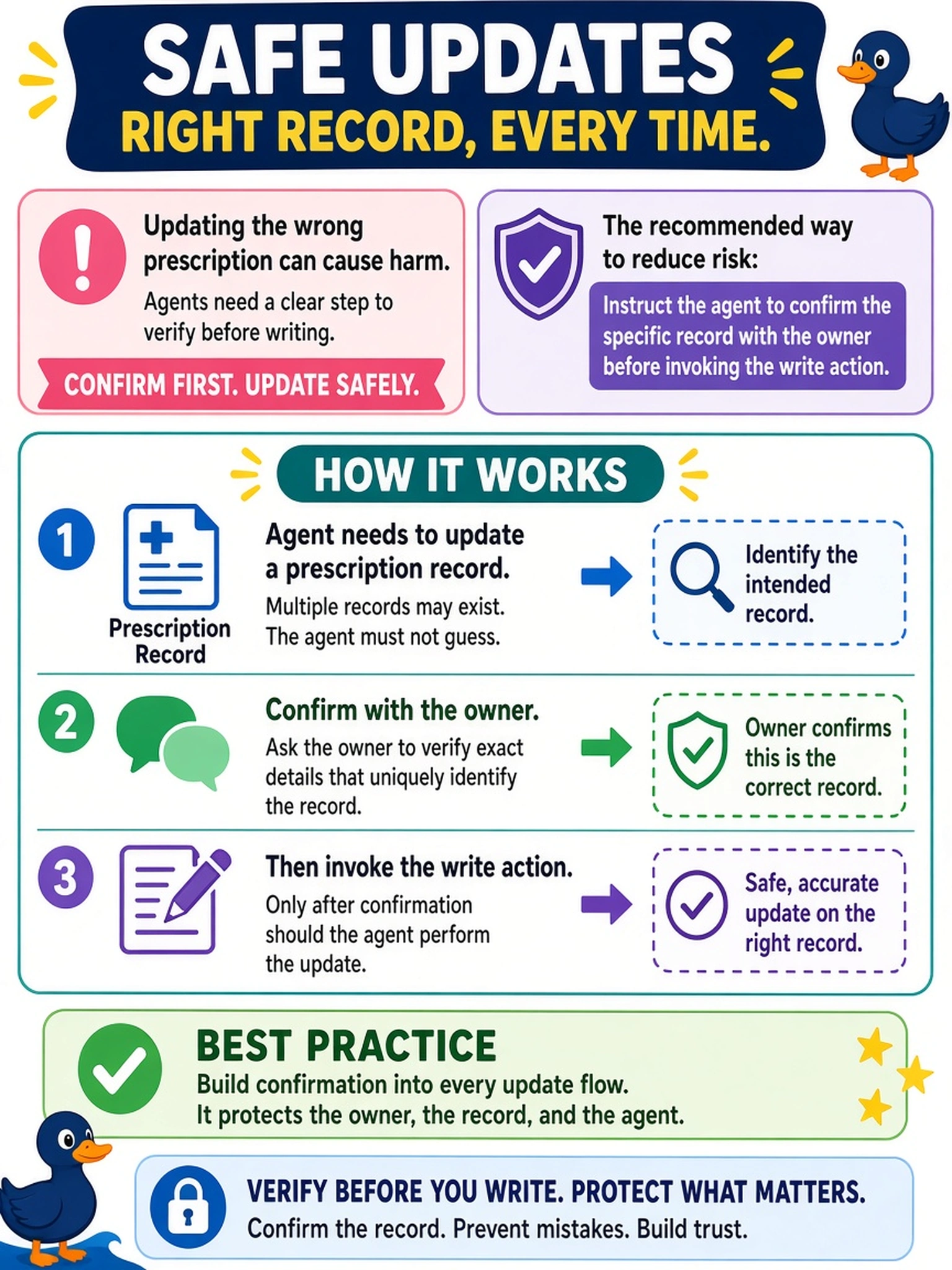
Before you update a prescription, have the agent confirm the specific record with the owner. That confirmation takes a moment and can prevent a costly mistake.
Full Explanation
For an action that changes a prescription, instruct the agent to identify the specific record and get the owner’s agreement before invoking the write action. This makes the owner’s intent explicit, leaves an auditable confirmation in the transcript, and helps catch ambiguity when an owner has several pets or active prescriptions. Making the action asynchronous does not prevent a wrong update: the write still occurs, and the conversation provides no cancellation channel after invocation. Assigning the write action to every topic increases exposure, because the agent could reach it during a claims or booking conversation without the context needed to identify the intended prescription. Removing the record Id input and having the Flow select the most recent prescription may seem deterministic, but it silently guesses for the owner; the newest record may not be the one they mean, especially when a patient has several prescriptions. For the exam, distinguish confirmation before a side effect from making an action cancellable or broadly available. A separate control is least privilege: the Agent User’s permissions limit what can be written at all. As a practical check, review the transcript to verify that the agent named the intended prescription, received the owner’s agreement, and only then invoked the write action.