
Which statement accurately describes standard agent actions in Agentforce?
Select an answer to reveal the explanation.
Short Explanation
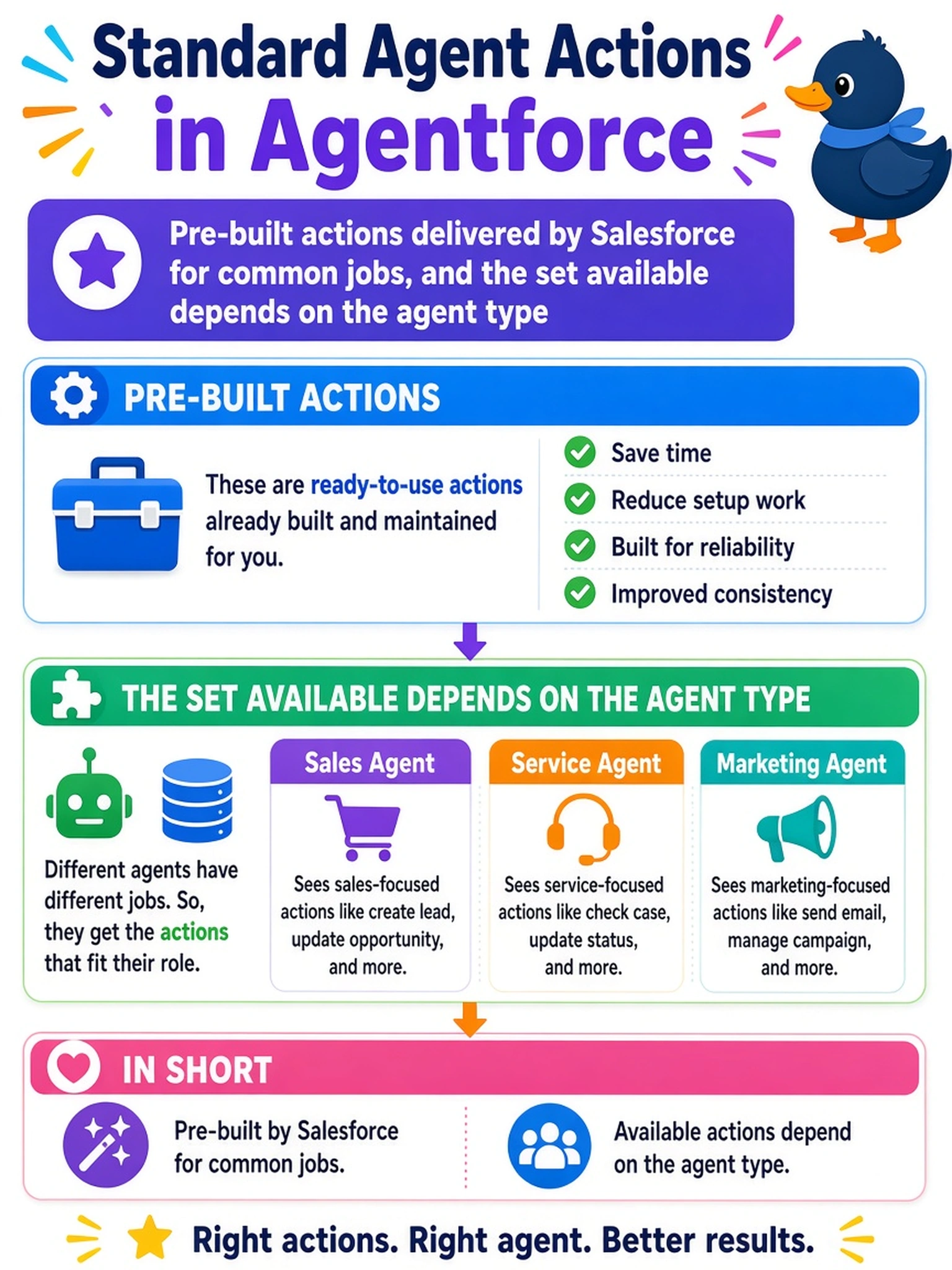
Standard actions are pre-built by Salesforce for you, and which ones you can use depends on the type of agent you are building. A Service agent and a Sales agent do not come with the same toolbox, which can surprise you on exam day.
Full Explanation
Standard agent actions are delivered by Salesforce for frequently needed jobs such as querying records, drafting a reply, summarising a record or escalating to a human. The set available depends on the type of agent you are building: a Service agent, a Sales agent and an Employee agent do different work. Recognising that link is a published objective. The claim that actions are automatically generated from every object confuses standard actions with generic record access; access is governed by permissions, and actions must be explicitly configured where needed. The claim that Salesforce-supplied actions bypass the Agent User’s permissions is a dangerous misconception: everything an agent does executes in the security context of the Agent User, and standard actions are no exception. A standard query action returns only records that user can see, so an agent may report no matching prescriptions even when the patient record exists. The claim that standard actions can only be used in standard topics also reverses the model: you can assign standard actions to custom topics, a common build pattern, such as adding a standard escalation action to a custom controlled-substance topic. Exam caveat: Salesforce supplies the action, but that does not grant it elevated access or make it available for every agent type. Practical check: review the agent type’s available actions and test the action as the Agent User to confirm both availability and record access.