
The group wants the agent to hand a frustrated pet owner to a human representative when the owner explicitly asks for a person. What is the appropriate way to configure this?
Select an answer to reveal the explanation.
Short Explanation
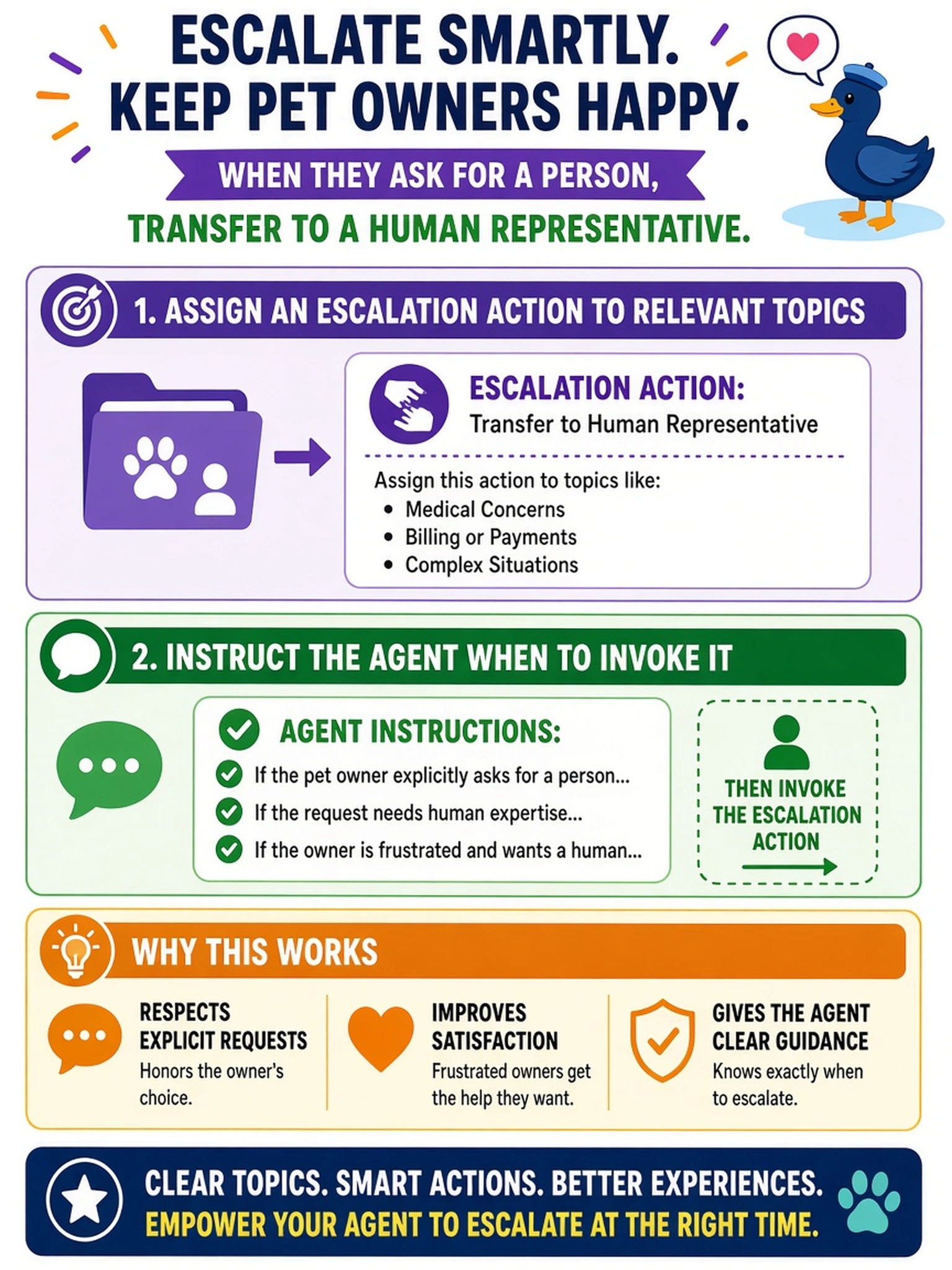
Escalation is an action, not a mood. You wire in a transfer action and you write an instruction that says exactly when to pull that lever, including when the owner just asks for a person.
Full Explanation
Human hand-off in Agentforce is implemented as an action the agent can invoke, typically routing the conversation and its context to a human representative through Omni-Channel, combined with instructions or guardrails that state the conditions under which the agent must invoke it: an explicit request for a person, a clinically urgent symptom, a controlled-substance authorisation, or repeated failure to resolve. Both halves are required, because an unassigned action is never invoked and an instruction with no action to call produces an apology instead of a transfer. Letting the session time out is not a transfer; it abandons the owner and produces no routed work item. The claim of automatic frustration-based transfer is the most attractive distractor because sentiment-driven escalation is a real design goal, but it is behaviour you configure through instructions and actions rather than something the engine performs on its own. Intercepting a keyword at the channel is brittle keyword matching that misses "can I speak to someone" and fires on "is a human going to call me back", and it bypasses the agent's ability to summarise context for the receiving representative. Exam angle: preserving conversation context on hand-off is a key benefit of doing this through an action.