
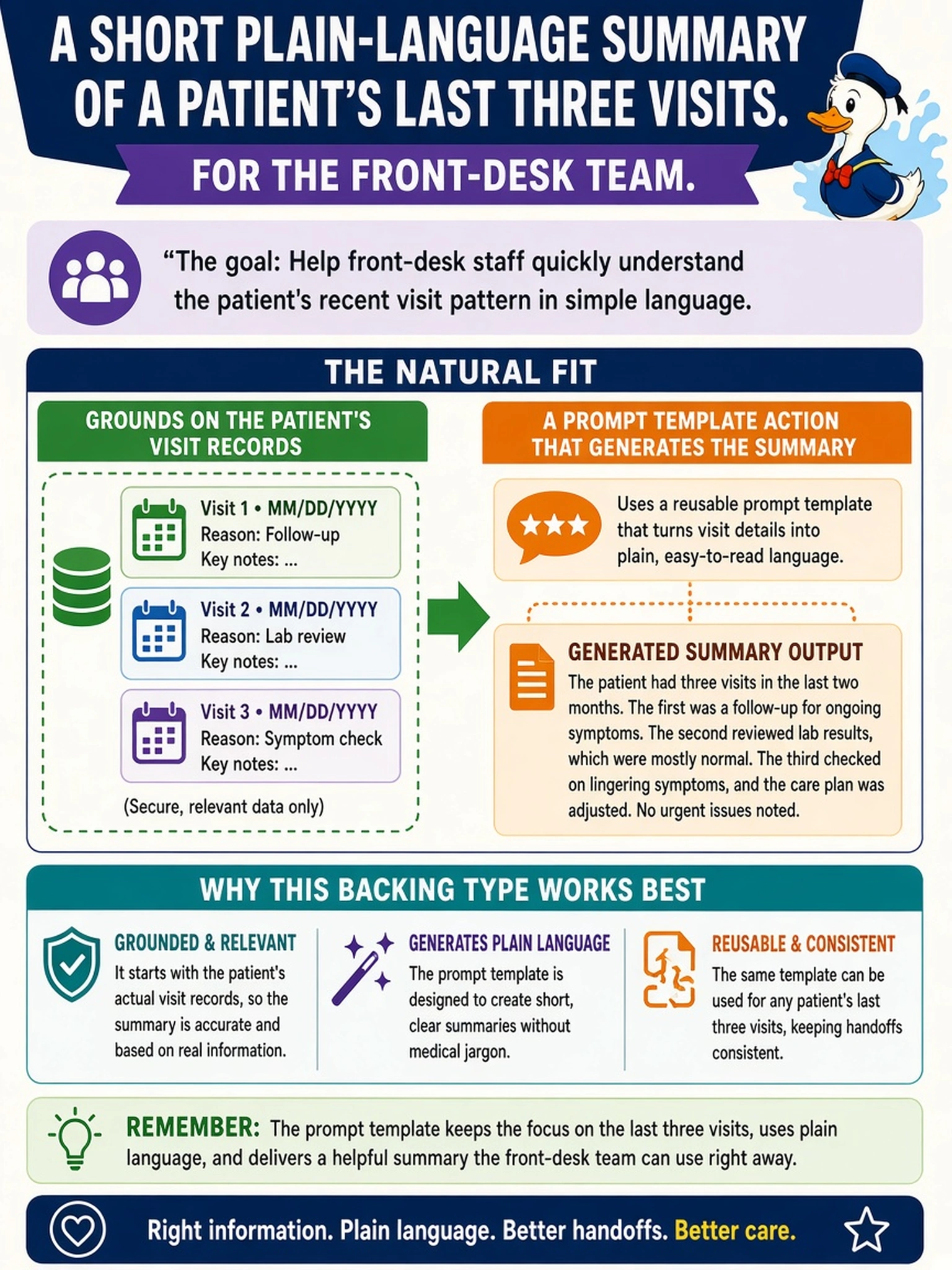
A staff-facing agent should produce a short plain-language summary of a patient's last three visits for the front-desk team. Which action backing type is the natural fit?
Select an answer to reveal the explanation.
Short Explanation
When the deliverable is language, use a prompt template. Flow is great at deciding things; it is terrible at writing something a human wants to read. Summarising three messy visit notes into two friendly sentences is exactly what a prompt template exists to do.
Full Explanation
Prompt template actions exist for the case where the required output is generated natural language grounded in org data. Summarising visit history is a generation task with no single correct string, so a template that grounds on the patient's related records and produces prose is the right backing, and it also keeps the wording under version control in Prompt Builder rather than buried in configuration. The Flow option is the strongest distractor because a Flow really can assemble text, but string concatenation gives you a mechanical field dump rather than a summary, and every change of phrasing becomes a Flow edit. Apex returning structured JSON solves a data-shaping problem rather than a language problem, and handing raw JSON back into the conversation invites the model to do the summarisation anyway without any of the controls a template gives you. A standard record-query action retrieves the rows, which is useful as grounding but is not itself a summary; in practice that action may feed the template, but on its own it leaves the front desk reading raw records. Exam nuance: keep deterministic decisions in Flow and language generation in prompt templates, and it is common for one topic to use both.