
An Agentforce Specialist notices that one topic contains a single instruction of eleven sentences describing everything the agent should do for an insurance claim enquiry. Responses are inconsistent. What is the recommended remedy?
Select an answer to reveal the explanation.
Short Explanation
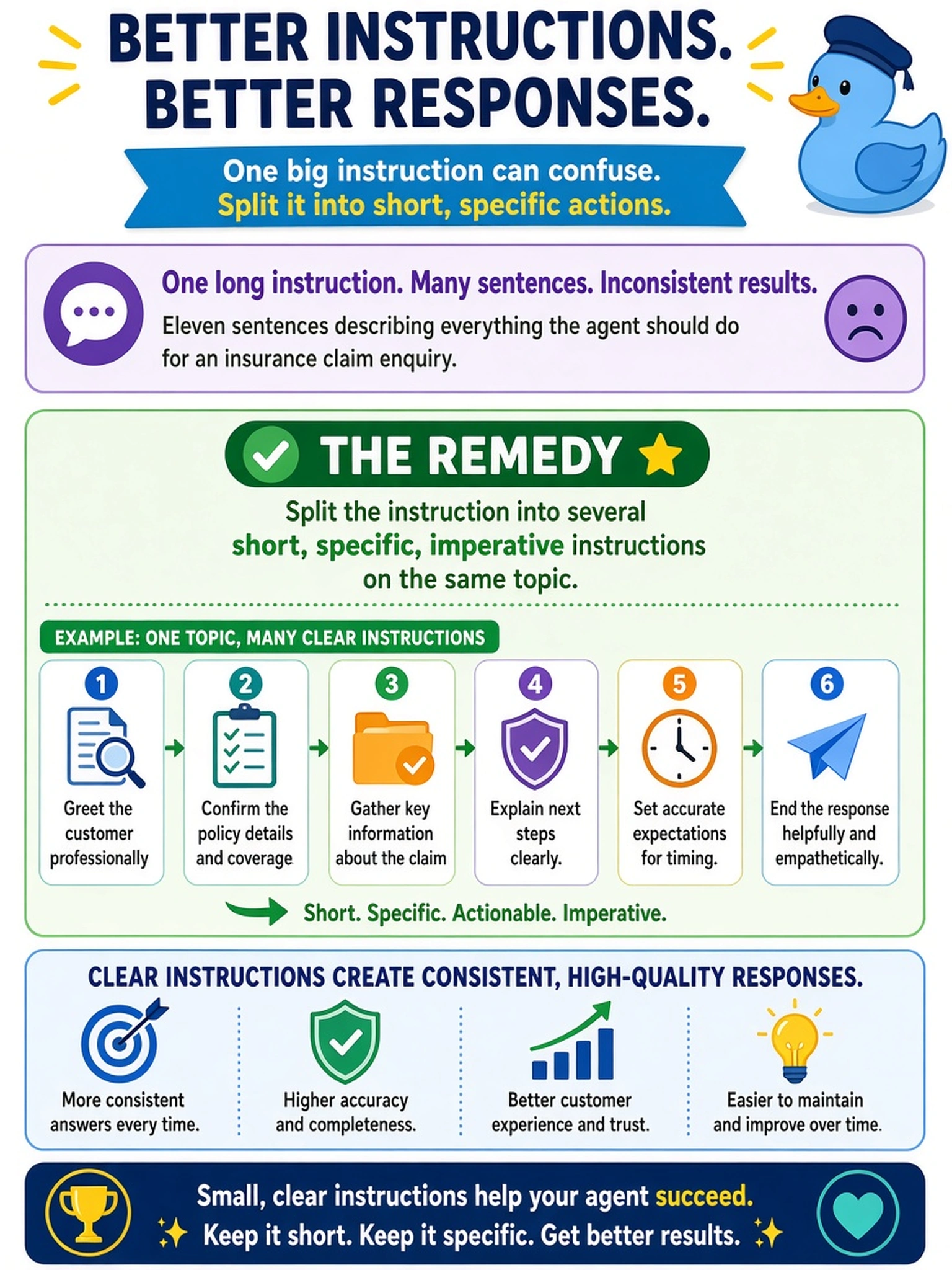
One instruction, one job. A wall of text is a wish list, and the reasoning engine will honour some of it and quietly drop the rest. Break it into short imperative lines and you can also tell which line is failing when a test case goes red.
Full Explanation
Best practice for agent instructions is that each one should be a short, unambiguous, imperative directive covering a single behaviour. Long compound instructions produce inconsistent results because the reasoning engine has to satisfy many implicit requirements at once, and they are almost impossible to debug: when a Testing Center case fails you cannot tell which clause was ignored. Splitting them also lets you order the behaviours and remove one without rewriting the paragraph. Moving the text to the company description is worse, not better: the company description is persona and organisational context applied broadly, so claim-specific procedure there both dilutes the persona and leaks claim behaviour into unrelated topics. Relabelling the paragraph as a guardrail does not help either, and it is the closest-looking trap because guardrails do carry strong constraining force; the problem here is length and ambiguity, not weak framing, and an eleven-sentence guardrail fails for exactly the same reason. Cutting to one sentence and trusting the model discards genuine business requirements, which is how a claims agent starts inventing authorisation rules. Related fact worth knowing: instructions are per topic, so keeping them short is also what keeps topics reusable.