
A pet owner types "my dog is due for his rabies booster, can I get him in this week" into the Companion Care Group service agent. Several topics are configured. What does the reasoning engine evaluate first to decide how to respond?
Select an answer to reveal the explanation.
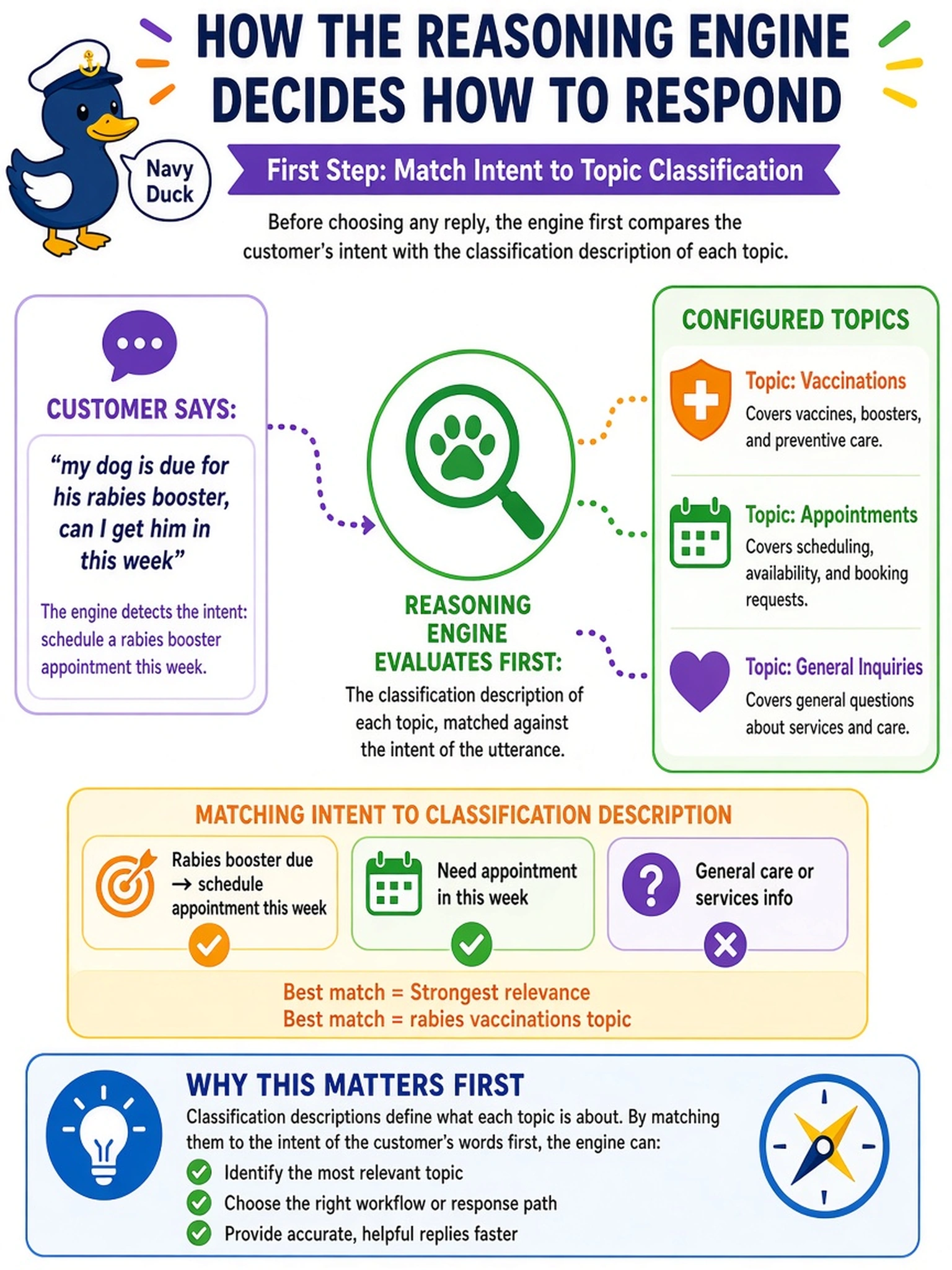
Short Explanation
Think of classification descriptions as the signs over the doors in the clinic lobby. The reasoning engine reads the signs first to pick which room to walk into; only after it is inside does it read the instructions taped to that room's wall. If the sign is vague, the agent walks into the wrong room no matter how good the instructions inside are.
Full Explanation
The reasoning engine performs topic classification before anything else: it compares the user's utterance to the classification description of each topic in scope and selects the single best match. Only then does it load that topic's instructions and the actions assigned to it, and plan a response. That is why a vague or overlapping classification description is the number one cause of misrouted conversations. Reading every topic's instructions first is wrong because instructions are topic-scoped guidance that the engine only consumes after a topic wins classification, and creation order carries no weight at all. Evaluating action input parameters is a later step in the loop: once a topic is selected, the engine decides whether an action is needed and then works out which inputs it must gather. The agent's role and company description are real configuration and they shape tone, persona and general framing, but they do not route an utterance to a topic; they are the closest-looking trap because a booster-vaccination sentence in the company description feels relevant. For the exam, remember the order: classify the topic, apply that topic's instructions, then select and invoke an action.