
A municipal microservices mesh must encrypt service-to-service calls inside the VPC and limit which tiers may talk to each other. Which controls should the architect emphasize?
Select an answer to reveal the explanation.
Short Explanation
Inside the building, you still lock wing doors and use private conversations—not megaphones in the lobby. TLS between services plus tight security groups keep east-west traffic honest. All-open SG rules, public NLBs for everything, or secrets in AMIs are the megaphone approach.
Full Explanation
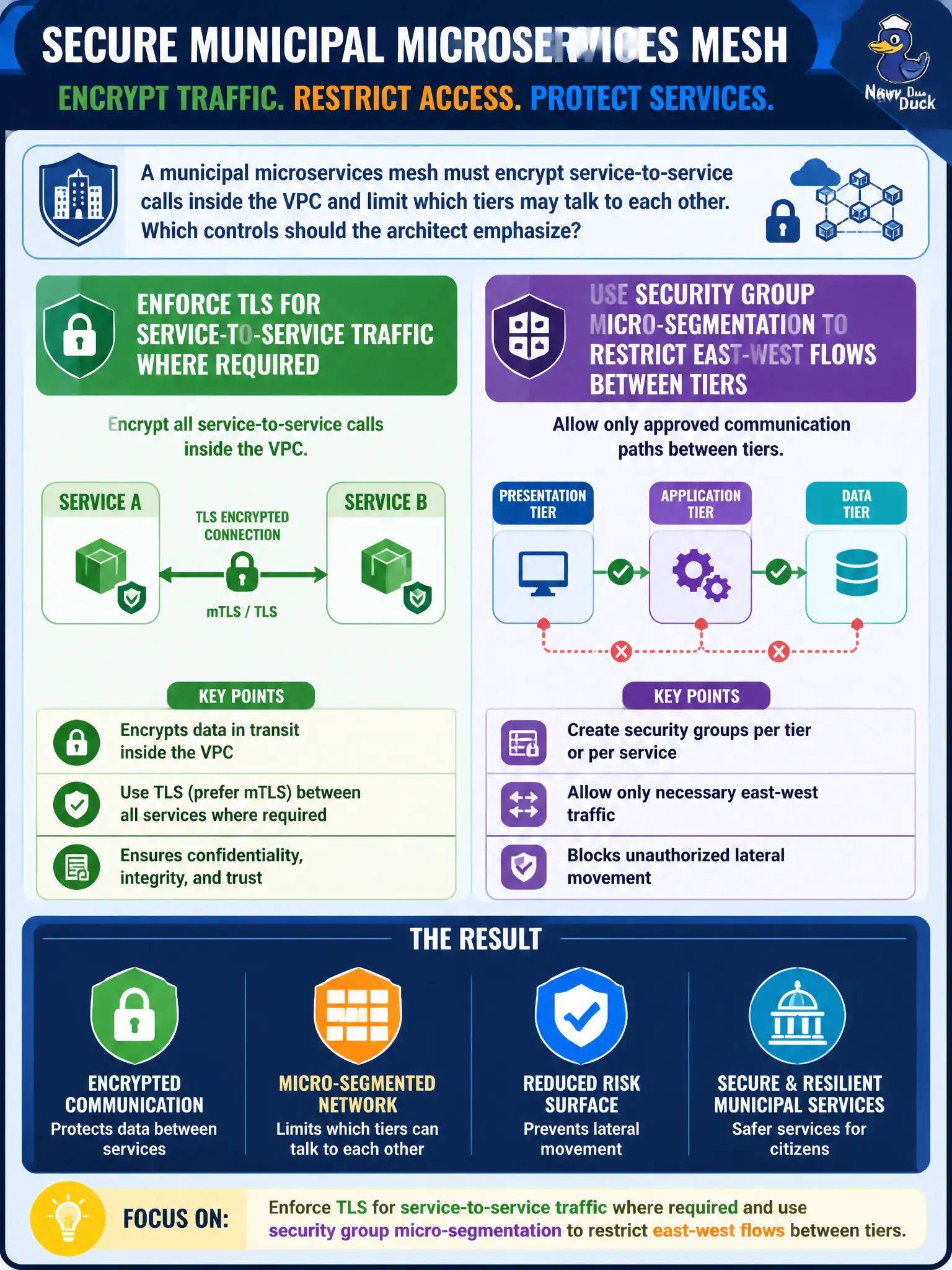
A municipal microservices mesh must encrypt service-to-service calls inside the VPC and limit which tiers may talk to each other by enforcing TLS where required and using security group micro-segmentation to restrict east-west flows between tiers. Encryption protects sensitive payloads even on private networks, while SG rules ensure the web tier cannot speak directly to data stores except through intended service ports—blast-radius control for city platforms.
Allowing all VPC CIDR traffic on all ports between every security group and disabling TLS fails because flat trust and cleartext maximize lateral movement and eavesdropping risk. Exposing every microservice with a public NLB and relying on internet encryption only fails conceptually: public exposure expands the attack surface and does not implement private east-west segmentation. Storing service credentials in plaintext AMI bake scripts without rotation fails because baked secrets proliferate and rarely rotate when instances scale.
Exam caveat: security groups are allow-lists per ENI; they do not replace application identity (mTLS certificates or service mesh auth) when many services share similar network tiers. Operational check: map allowed client SGs to each service port, deny broad VPC CIDR rules, require TLS on internal ALBs/service endpoints for sensitive APIs, and penetration-test that a compromised web task cannot reach the database port directly.