
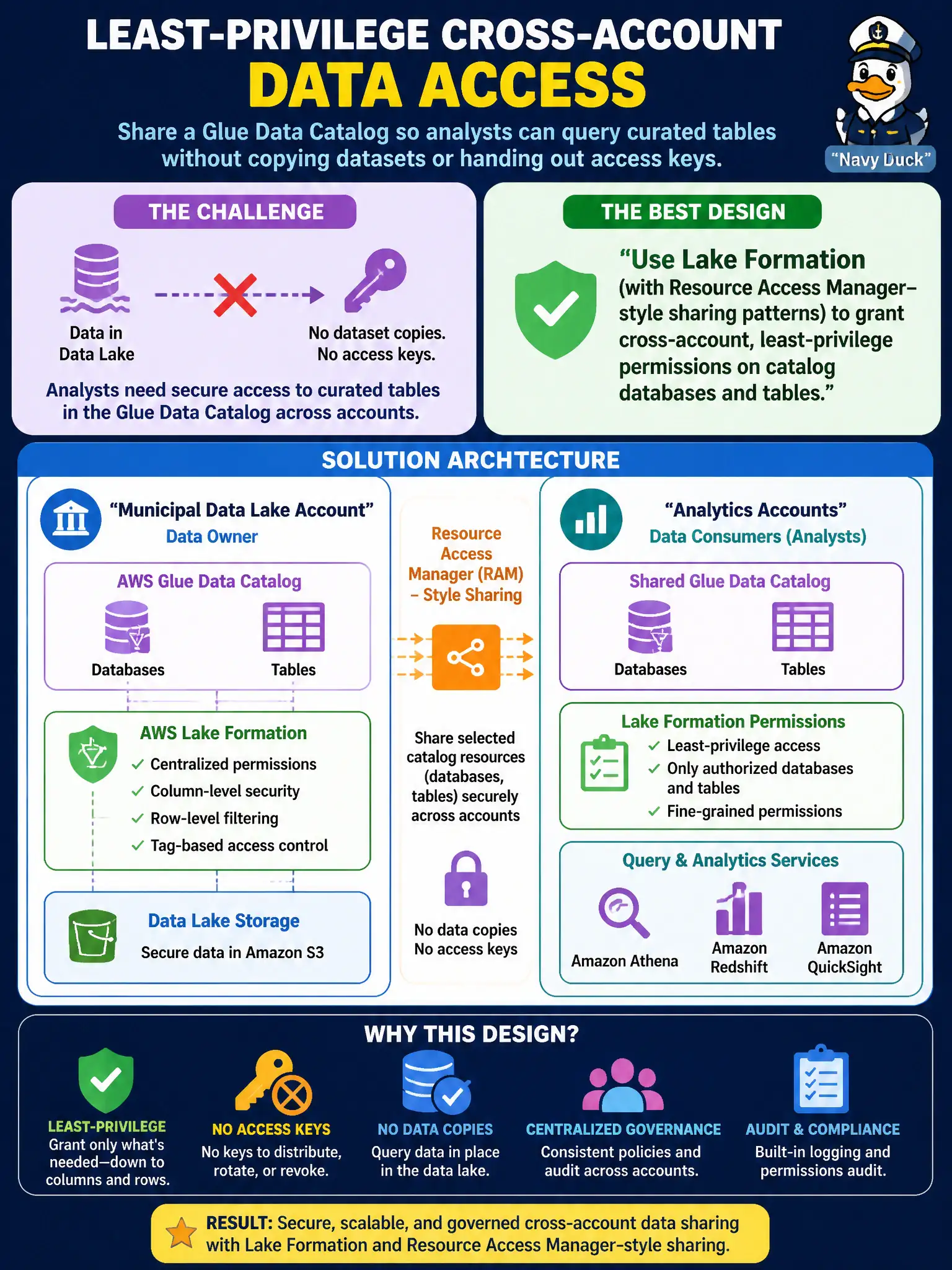
A municipal data lake account must share a Glue Data Catalog with analytics accounts so analysts can query curated tables without copying datasets or handing out access keys. Which design best provides least-privilege cross-account data access?
Select an answer to reveal the explanation.
Short Explanation
Sharing the catalog is like giving library cards for specific shelves, not photocopying the whole library and taping a master key to each copy. Lake Formation (with cross-account share patterns) lets analytics accounts use curated tables under least privilege. Emailing dumps with keys, world-readable buckets, or turning off encryption are shortcuts that blow past governance.
Full Explanation
For a municipal data lake that must share a Glue Data Catalog with analytics accounts, AWS Lake Formation—with cross-account sharing patterns often coordinated through AWS Resource Access Manager—grants least-privilege permissions on databases and tables (and the underlying S3 locations) without copying datasets or handing out access keys. Analysts query curated tables under governed grants, which matches civic open-analytics goals while keeping the lake account as the authoritative store.
Exporting every table to CSV, emailing files, and attaching IAM user keys fails because it duplicates sensitive data outside controlled storage, creates standing credentials, and loses catalog-level governance. Making the data lake S3 buckets world-readable fails conceptually: public readability abandons least privilege and invites anonymous download of municipal datasets regardless of catalog intent. Disabling encryption so analytics accounts can open objects without IAM evaluation fails because encryption is not a substitute for authorization; turning it off weakens confidentiality and still does not produce a governed cross-account query model.
Exam caveat: Lake Formation grants must align with S3 location permissions and encryption key (KMS) policies—catalog permission alone can look correct while GetObject still fails or, worse, a misaligned bucket policy overshares. Operational check: share only required databases/tables to the analytics account, verify analysts cannot list unrelated prefixes, confirm queries succeed via Athena/Redshift Spectrum without local keys, and document the grant owners for annual access review.