
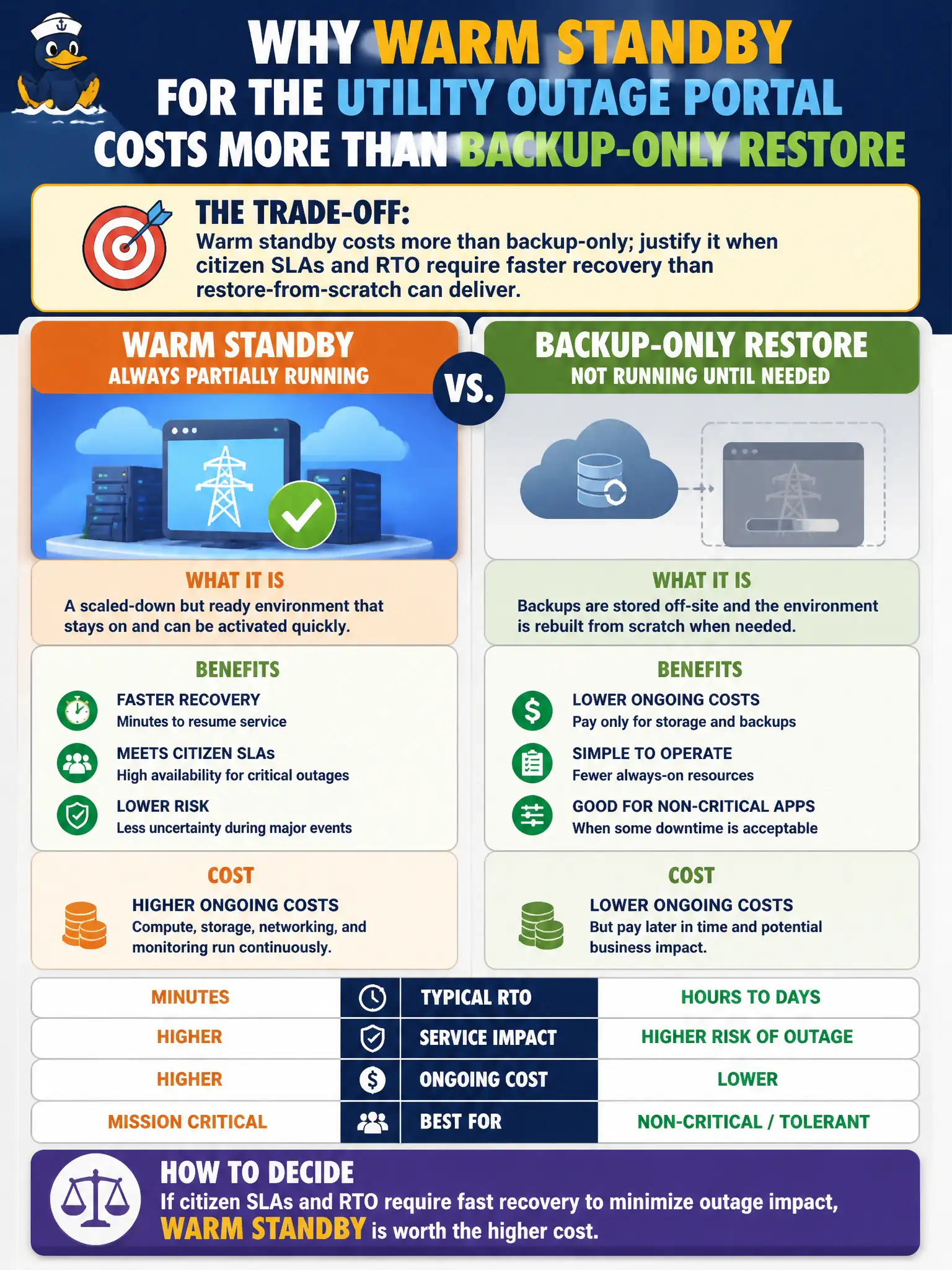
Finance questions why warm standby for the utility outage portal costs more than backup-only restore. How should the architect frame the trade-off?
Select an answer to reveal the explanation.
Short Explanation
Warm standby is the hotel room you keep reserved—pricier than a suitcase in storage, ready when the storm hits. Pay for it when citizen SLAs say restore-from-scratch is too slow. Cheap DR that misses RTO is expensive in headlines.
Full Explanation
Finance often questions why warm standby for a utility outage portal costs more than backup-only restore. The architect should frame the trade-off honestly: warm standby costs more than backup-only, and that cost is justified when citizen SLAs and RTO require faster recovery than restore-from-scratch can deliver. Paying for idle-capable capacity in another Region (or a continuously running smaller standby) buys minutes-to-hours recovery instead of long rebuilds when utilities and outage communications matter most to the public.
Claiming warm standby is always cheaper than backups fails factually and undermines trust with finance. Claiming backup-only always meets hour-level RTO at zero incremental cost fails because cold restore frequently exceeds hour RTO once provisioning, data restore, and validation are included. Asserting DR cost is unrelated to RTO so the lowest bill always wins fails conceptually: RTO is a citizen-impact requirement that drives the minimum viable DR pattern and its cost.
Exam caveat: do not overbuy active-active if warm standby meets the RTO; match spend to measured objectives. Operational check: present a cost-versus-RTO chart for backup-only, pilot light, warm standby, and multi-site, pick the cheapest pattern that still meets the portal’s published RTO/RPO, and rehearse it.