
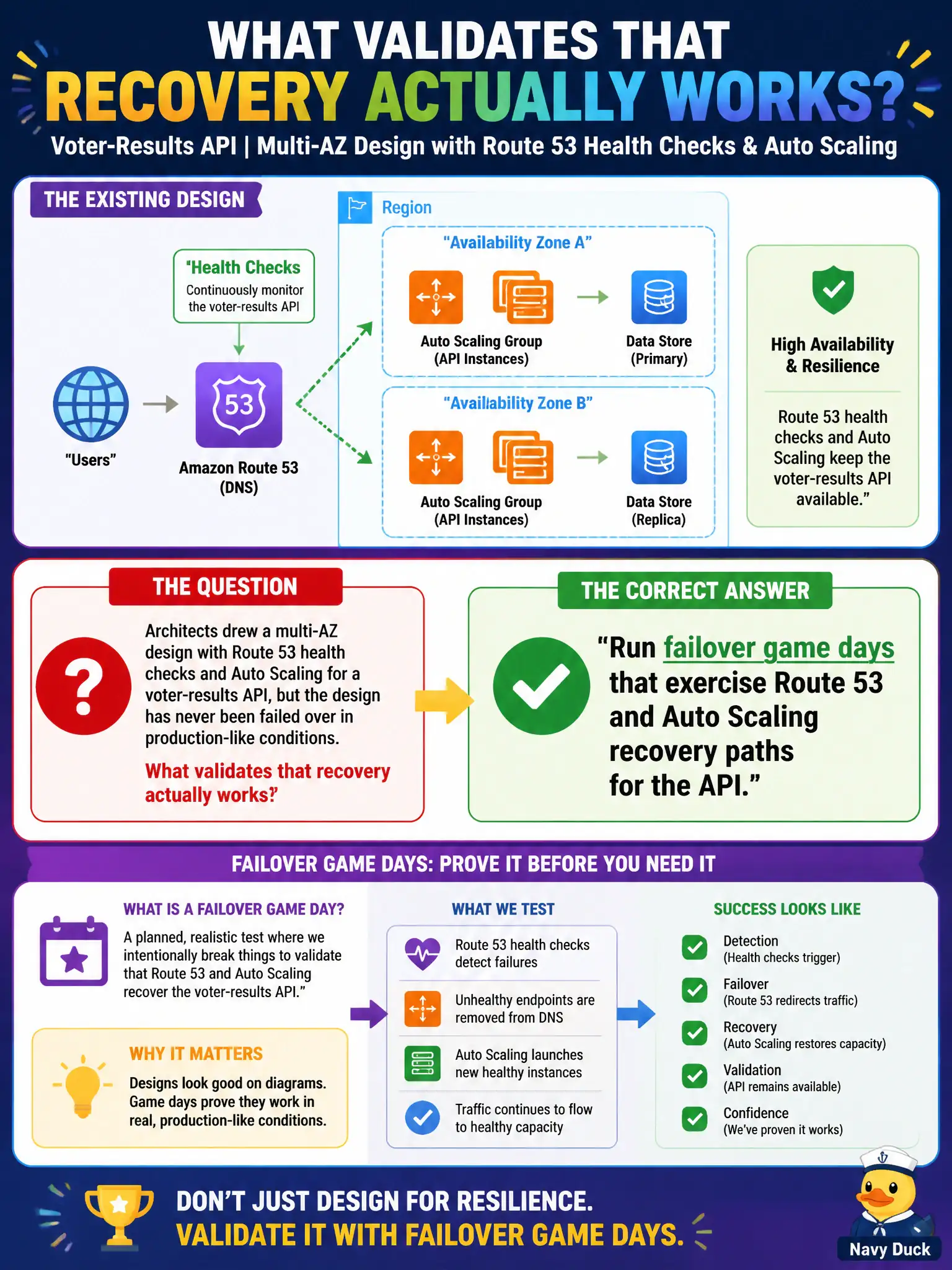
Architects drew a multi-AZ design with Route 53 health checks and Auto Scaling for a voter-results API, but the design has never been failed over in production-like conditions. What validates that recovery actually works?
Select an answer to reveal the explanation.
Short Explanation
Diagrams do not vote—game days do. Pull the AZ or flip the health check and watch Route 53 plus Auto Scaling actually recover the results API. Untested HA is hope with pretty boxes.
Full Explanation
Architects may draw a multi-AZ voter-results API with Route 53 health checks and Auto Scaling, yet an untested design is only a hypothesis. What validates that recovery actually works is running failover game days that exercise Route 53 and Auto Scaling recovery paths under production-like conditions. Game days force DNS failover, target replacement, and dependency behavior into the open so the county learns whether published RTO numbers are real before election-night pressure arrives.
Relying solely on the architecture diagram as proof of RTO compliance fails because diagrams do not fail over. Increasing desired capacity once and never testing removal of an Availability Zone fails because scale-up without AZ loss does not validate multi-AZ recovery. Disabling Route 53 health checks to avoid accidental failovers during quiet periods fails by removing the mechanism that detects unhealthy endpoints and by ensuring failover remains unproven.
Exam caveat: a successful game day in a staging account still needs scheduled production-like drills; configuration drift can invalidate last quarter’s results. Operational check: schedule recurring game days that withdraw an AZ or fail health checks, capture time-to-recover metrics against RTO, fix gaps in runbooks, and record evidence for election-system change boards.