
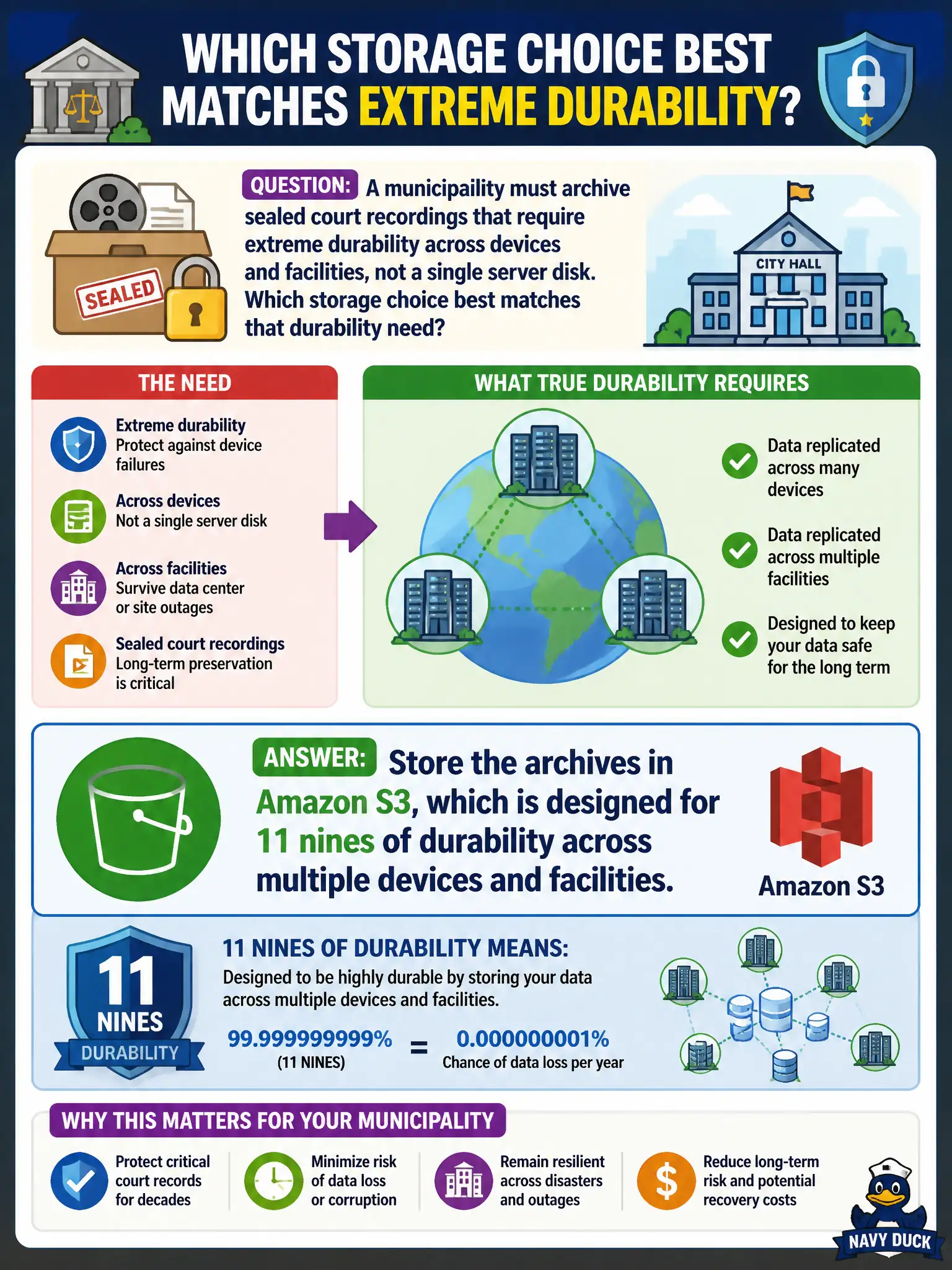
A municipality must archive sealed court recordings that require extreme durability across devices and facilities, not a single server disk. Which storage choice best matches that durability need?
Select an answer to reveal the explanation.
Short Explanation
Think of S3 as a vault that spreads copies across many buildings, while one EBS disk is still one building’s problem. Archives that must never vanish belong on object storage with that durability design. Instance store and container scratch space are the opposite idea.
Full Explanation
Sealed court recordings for a municipality demand extreme durability across devices and facilities, not survival of a single server disk. Amazon S3 is designed for eleven nines of durability by redundantly storing objects across multiple devices and facilities in a Region. That design matches archival civic evidence that must remain intact for legal retention even if individual disks, servers, or facilities fail. Object storage also separates durability from compute lifecycle so recordings are not lost when an EC2 instance is replaced.
Storing the archives only on a single EBS volume attached to one EC2 instance fails because an EBS volume, while replicated within an AZ for availability of that volume, is still not the multi-facility object durability model required for sealed long-term archives, and it remains coupled to one instance attachment path. Keeping copies only on the application server’s instance store fails because instance store is ephemeral relative to instance lifetime and is the opposite of durable archival storage. Writing archives exclusively to an ephemeral container filesystem and rebuilding from memory on restart fails outright: container filesystems are not a durable court-of-record store.
Exam caveat: S3 durability is not the same as cross-Region disaster recovery; if the requirement also includes Regional loss, add replication or backup to another Region. Operational check: enable versioning and appropriate Object Lock or retention controls for sealed recordings, verify bucket policies and encryption, and periodically restore a sample object to prove retrieval still meets legal access needs.