
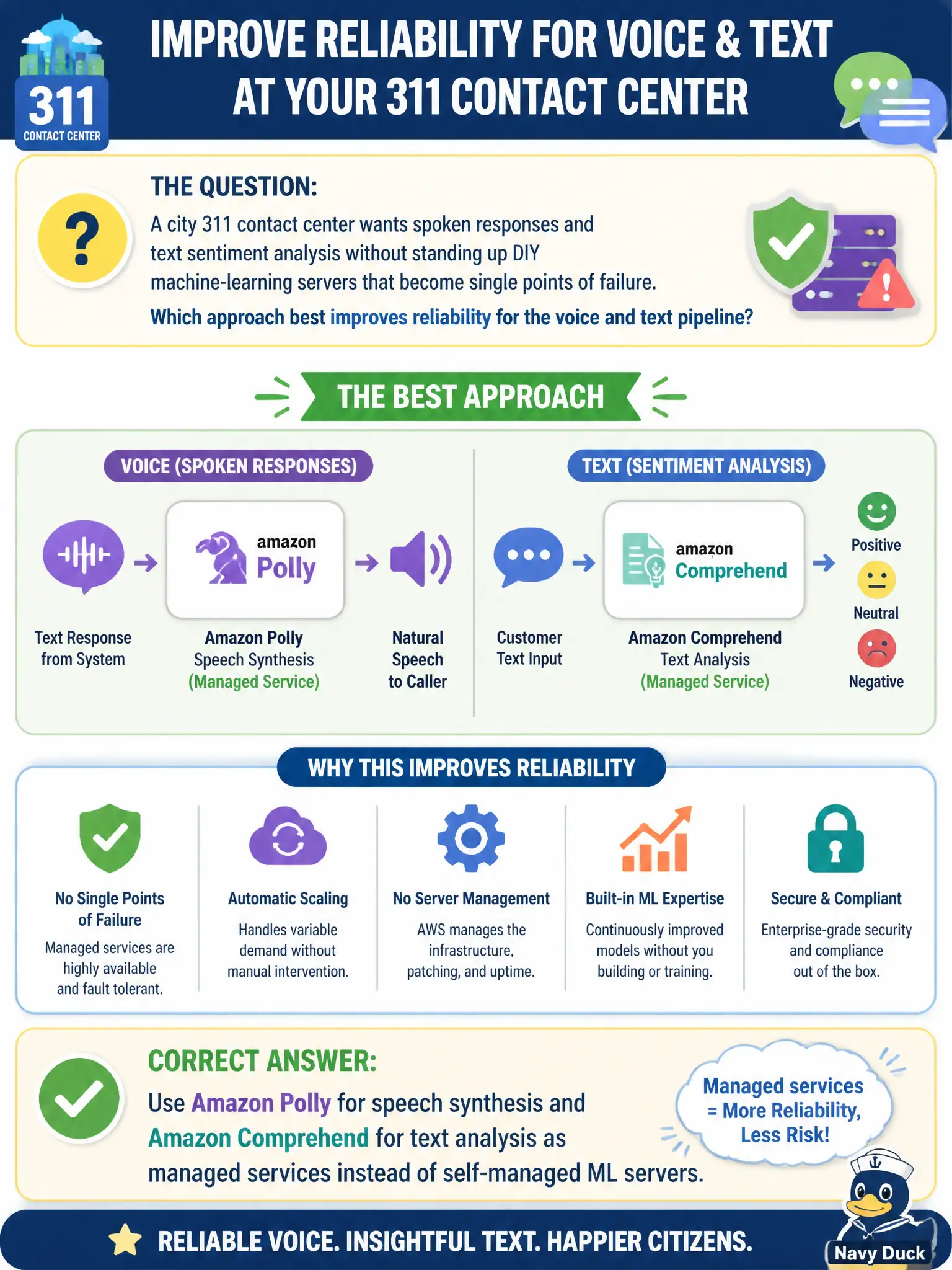
A city 311 contact center wants spoken responses and text sentiment analysis without standing up DIY machine-learning servers that become single points of failure. Which approach best improves reliability for the voice and text pipeline?
Select an answer to reveal the explanation.
Short Explanation
Managed AI services are like hiring a reliable contractor instead of babysitting your own fragile servers. Polly and Comprehend remove DIY ML boxes that go down with one AZ or one host. The city still owns the architecture—it just stops owning the SPOF.
Full Explanation
For a city 311 contact center that needs spoken responses and text sentiment analysis, Amazon Polly and Amazon Comprehend are purpose-built managed AI services. They deliver speech synthesis and natural-language understanding without municipal staff operating model hosts, GPU workstations, or single-task inference containers. That design improves reliability because AWS operates the capacity, patching, and multi-AZ service plane behind the API, so the voice-and-text pipeline no longer depends on one DIY machine-learning server as a single point of failure. The city still owns prompts, IAM, logging, and integration patterns—it simply stops owning fragile inference hardware.
Hosting open-source TTS and NLP models on a single large EC2 instance in one Availability Zone fails because that host and AZ remain concentrated failure domains; if the instance or zone fails, 311 voice and sentiment stop together. Training a custom model on a dedicated GPU workstation in the data center and exposing it through one NAT instance fails for the same SPOF reason plus on-premises operational burden and a single network path. Running inference containers on one always-on ECS task with local disk model files and no Multi-AZ placement fails because a lone task and local model files do not provide Availability Zone redundancy even though containers sound modern.
Exam caveat: managed AI services improve availability of the ML capability itself, but end-to-end 311 resilience still requires Multi-AZ application tiers, retries, and fallbacks when the API returns throttling or regional impairment. Operational check: invoke Polly and Comprehend from Multi-AZ callers with IAM least privilege, CloudWatch alarms on error and throttle rates, and a documented degraded mode (for example text-only) when speech synthesis is unavailable.